

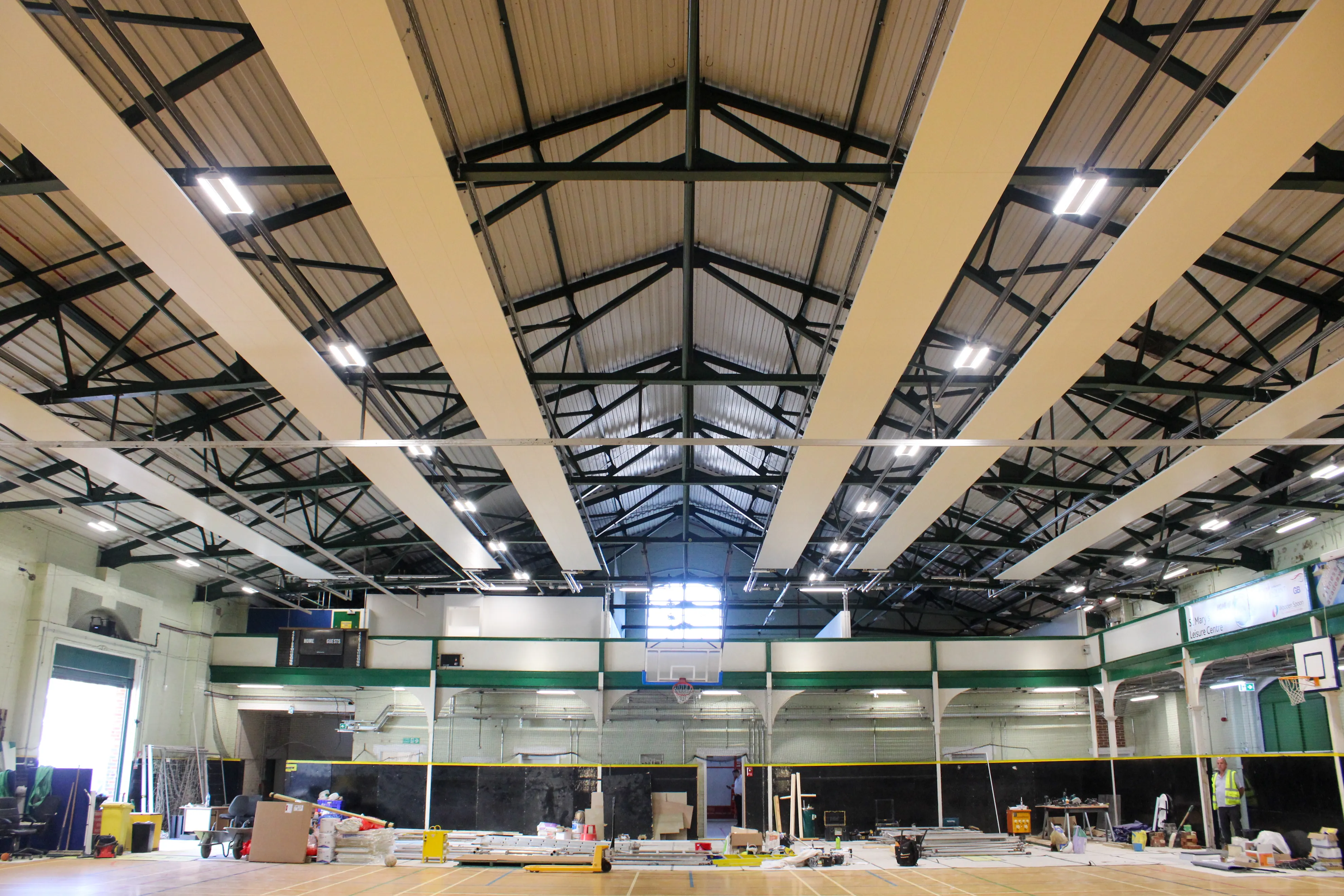
Introducing SPC's iTwelve Industrial Radiant Panel
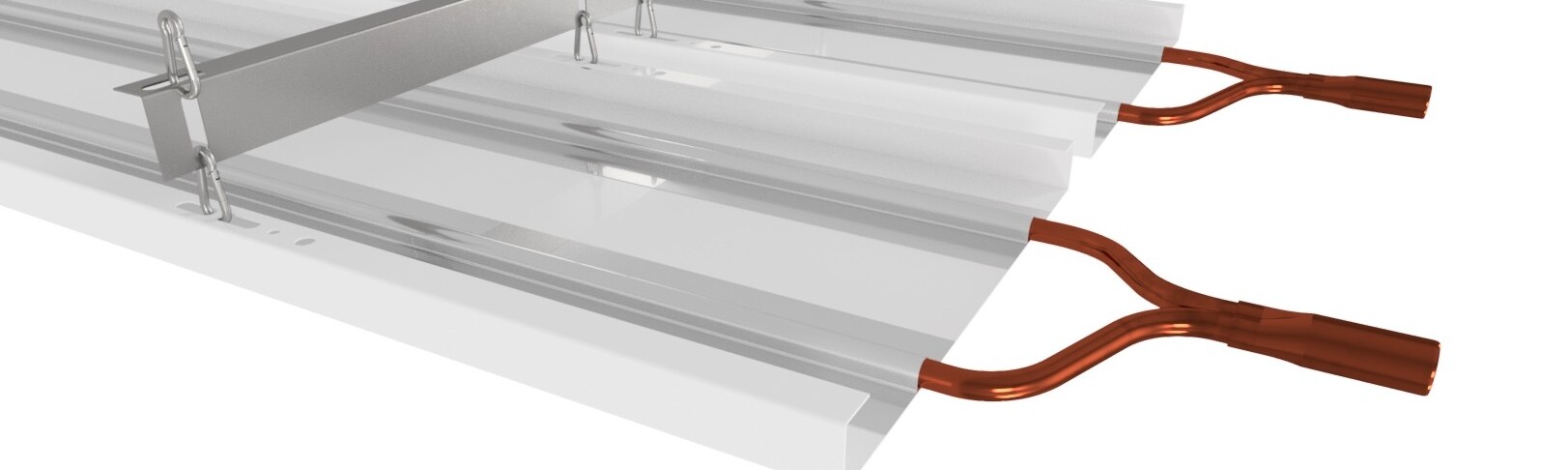
SPC has launched the iTwelve Industrial Radiant Panel, a low temperature hydronic radiant heating and cooling panel for industrial and large commercial spaces. Built from patented “D” shaped 12mm copper tubes bonded to a 1mm aluminium radiating panel, the iTwelve delivers higher heat output at lower weight than conventional steel tube industrial panels, and is engineered to operate efficiently with heat pumps.

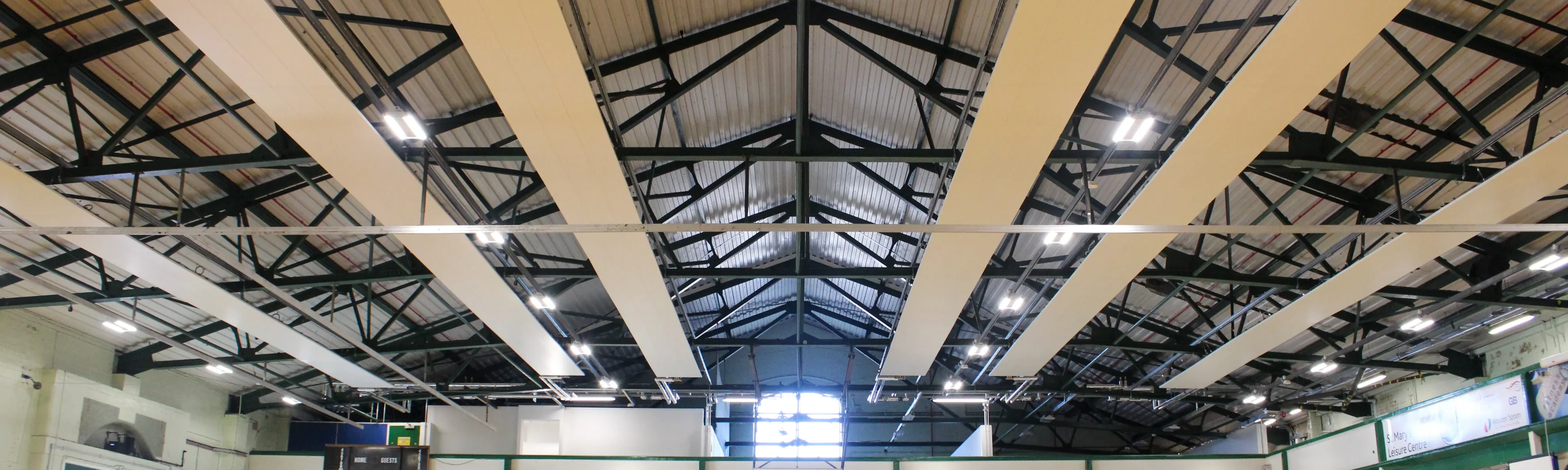
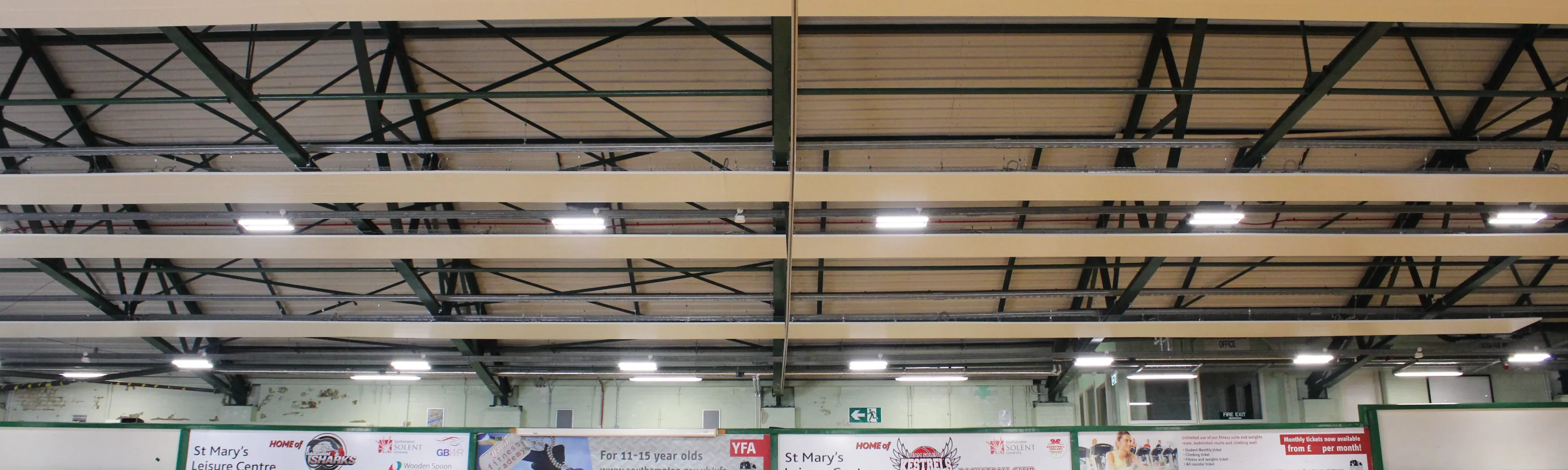
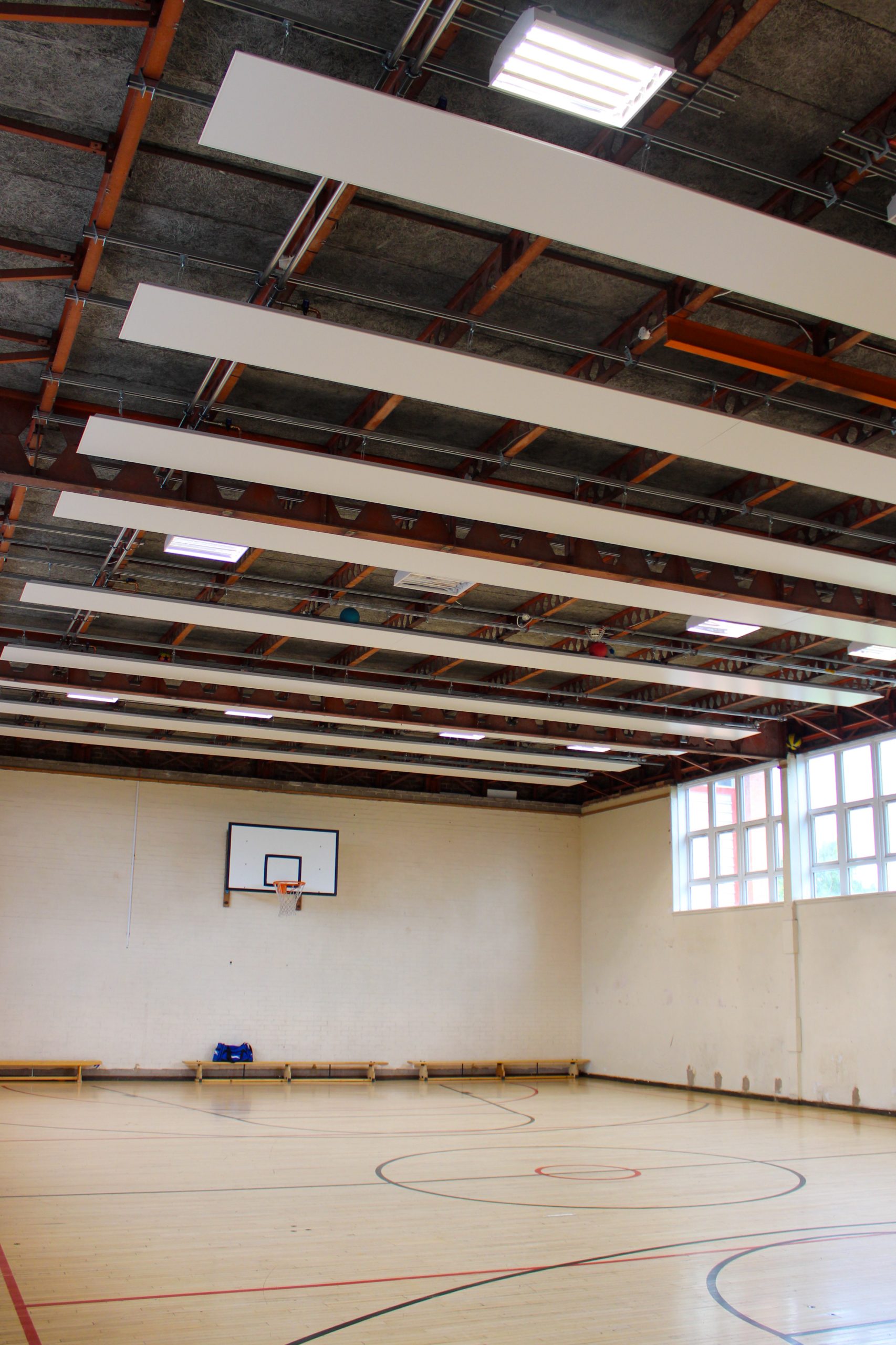
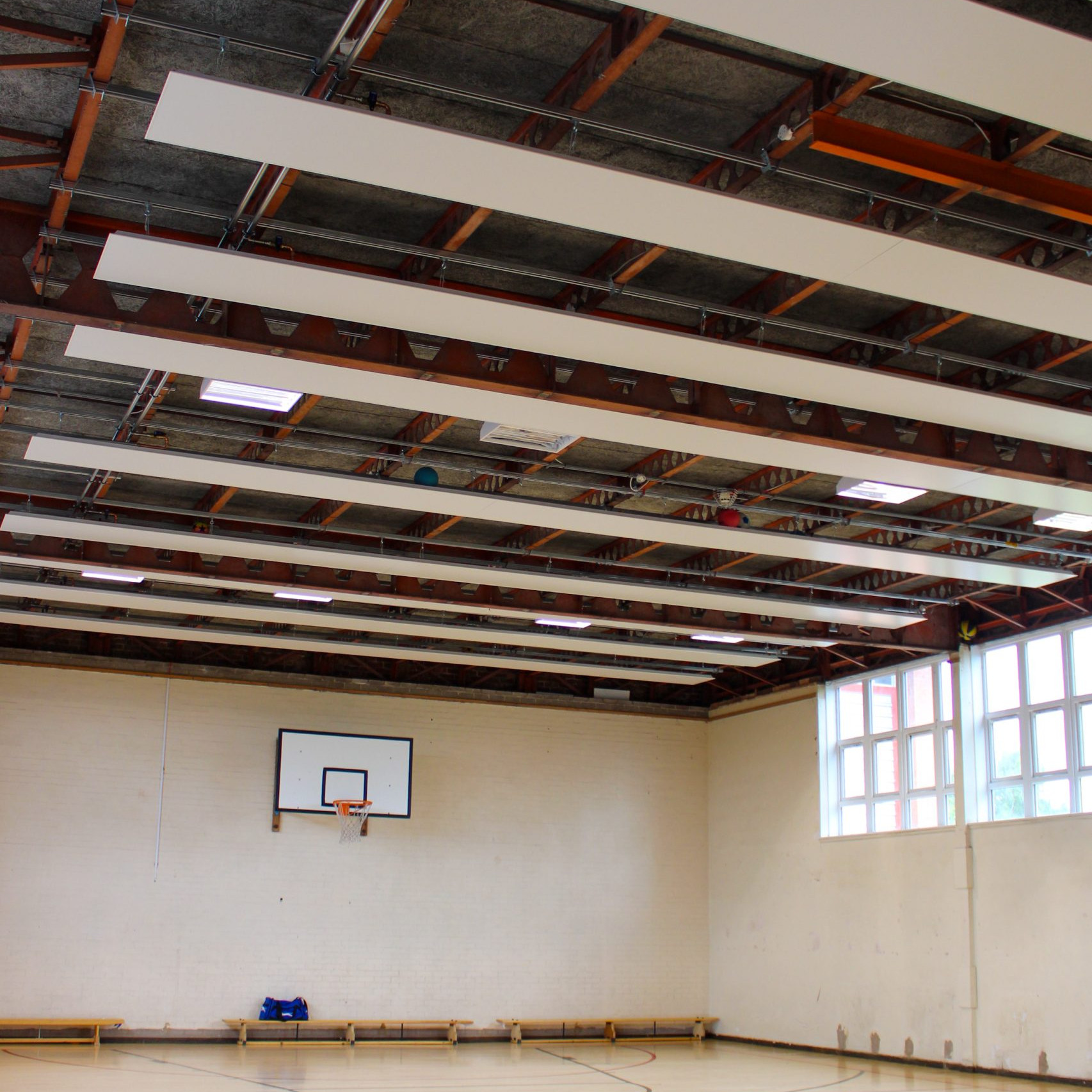
SPC iTwelve Industrial Radiant Panels installed at St Mary’s Community and Leisure Centre
How the iTwelve Radiant Panel Works
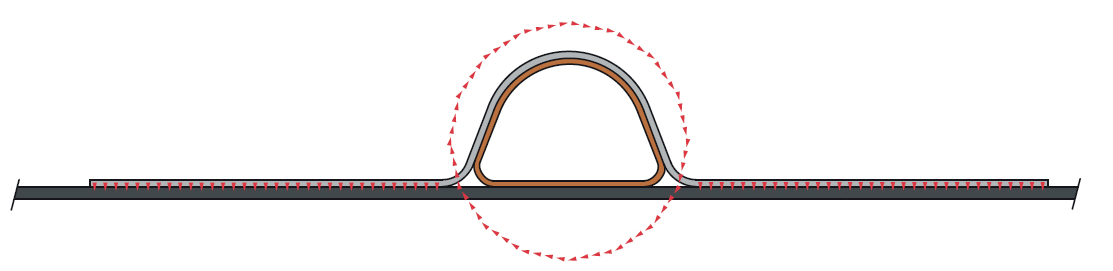
The 12mm copper primary tubes are flattened into a “D” shaped profile, wrapped in aluminium saddles, and adhered to a 1mm aluminium radiating panel. This gives approximately 360° contact between the copper tube and the panel surface, minimising heat transfer resistance and the temperature drop between the hot water and the radiating surface.
The downward-facing radiating surface is powder coated white to RAL 9016 to maximise radiant emissivity (0.95), while the upper surface carries an insulated blanket to reduce upward convective losses. Output is approximately 70 to 75% radiant and 25 to 30% convective, delivering heat directly to objects and occupants rather than warming the space air. This reduces stratification and allows space air temperature to be held several degrees lower than with a convective system while achieving the same resultant comfort.
The iTwelve can also be used for cooling when connected to a reversible heat pump, with chilled water temperature held above the dewpoint of the space air to prevent condensation on the panel surface.
Technical Specification
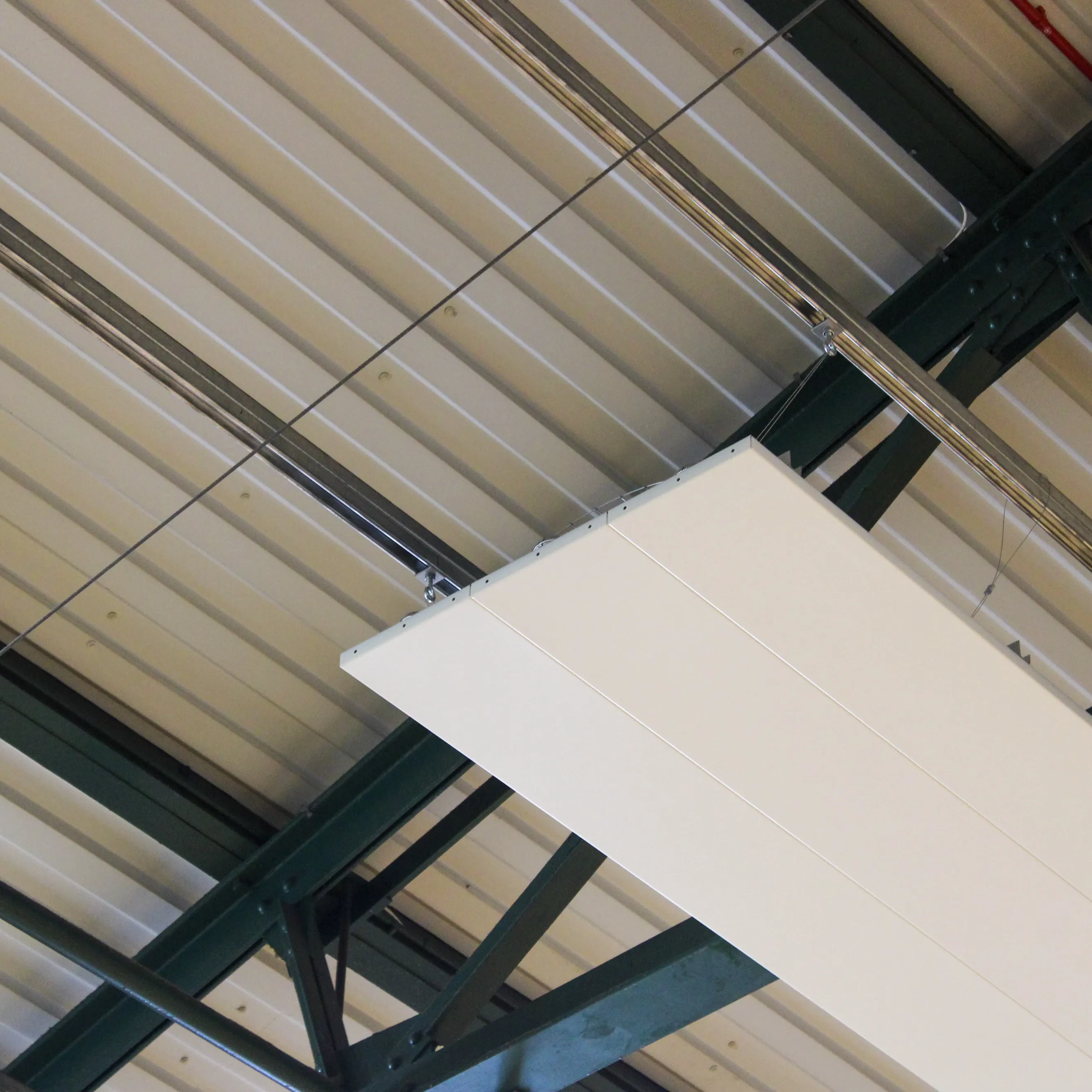
Panels are supplied in 300mm width modules, combined up to four wide for effective widths of 300 to 1200mm, in lengths up to 3m and joined end to end for longer runs. Connections are made via 22mm copper crimp connectors or push-fit flexible hoses, with no welding required on site. Full technical specifications, including pressure and temperature ratings, are available on the iTwelve product page.
Lightweight by Design
A 3m iTwelve module weighs approximately 5.5kg dry, compared to around 20kg for an equivalent conventional steel tube panel. This lighter build simplifies suspension and reduces the number of on-site joints needed, cutting installation time compared to conventional steel tube panels.
Heat Output
Output varies with excess temperature, the difference between mean hot water temperature and room air temperature. At 20°C excess, the iTwelve delivers around 216 W/m², rising to roughly 639 W/m² at 50°C excess. SPC calculates precise outputs and pressure drops at the design stage.
Where the iTwelve Is Used
The iTwelve suits large industrial and commercial spaces where ceiling-level radiant heating is the preferred solution, including sports halls and leisure centres (reinforced variant available), aircraft hangars, warehouses and distribution centres, manufacturing and assembly facilities, logistics and e-commerce fulfilment centres, workshops and service bays, and other large commercial buildings with high-bay areas.
Sports Hall Variant
A dedicated sports hall panel variant is available, built to comply with DIN 18032-3, including resistance to bombardment from sporting equipment. It features a fully folded construction with pipe connections hidden behind the panel, and optional domed mesh ball guards fitted after installation.
SPC Design Support
Every iTwelve project receives support from SPC’s sales and technical team from the earliest stages of design, including technical consultation and site visits, output calculations and pressure drop modelling, piping configuration assistance, and support with logistics, delivery, and installation.
Ongoing after-sales support is provided once the system is running. CIBSE-approved CPD sessions on the Decarbonisation of Industrial and Commercial Heating Systems are also available.
Frequently Asked Questions
It’s a low temperature hydronic radiant heating and cooling panel using 12mm copper “D” profile tubes bonded to a 1mm aluminium radiating panel, delivering high thermal output at lower weight than conventional steel tube panels.
Yes. It’s designed to operate at the low flow temperatures produced by heat pump generators, supporting industrial sites reducing or eliminating on-site fossil fuel combustion.
Yes. Connected to a reversible heat pump, the iTwelve can provide radiant cooling, with chilled water temperature kept above the dewpoint of the space air to prevent condensation.
Yes. A sports hall variant complies with DIN 18032-3, with a fully folded construction, hidden pipe connections, and optional domed mesh ball guards.
Specify the iTwelve on Your Next Project
To discuss the iTwelve for your next project, contact the SPC team:

A Great Night Out with the SDS Team in the South West
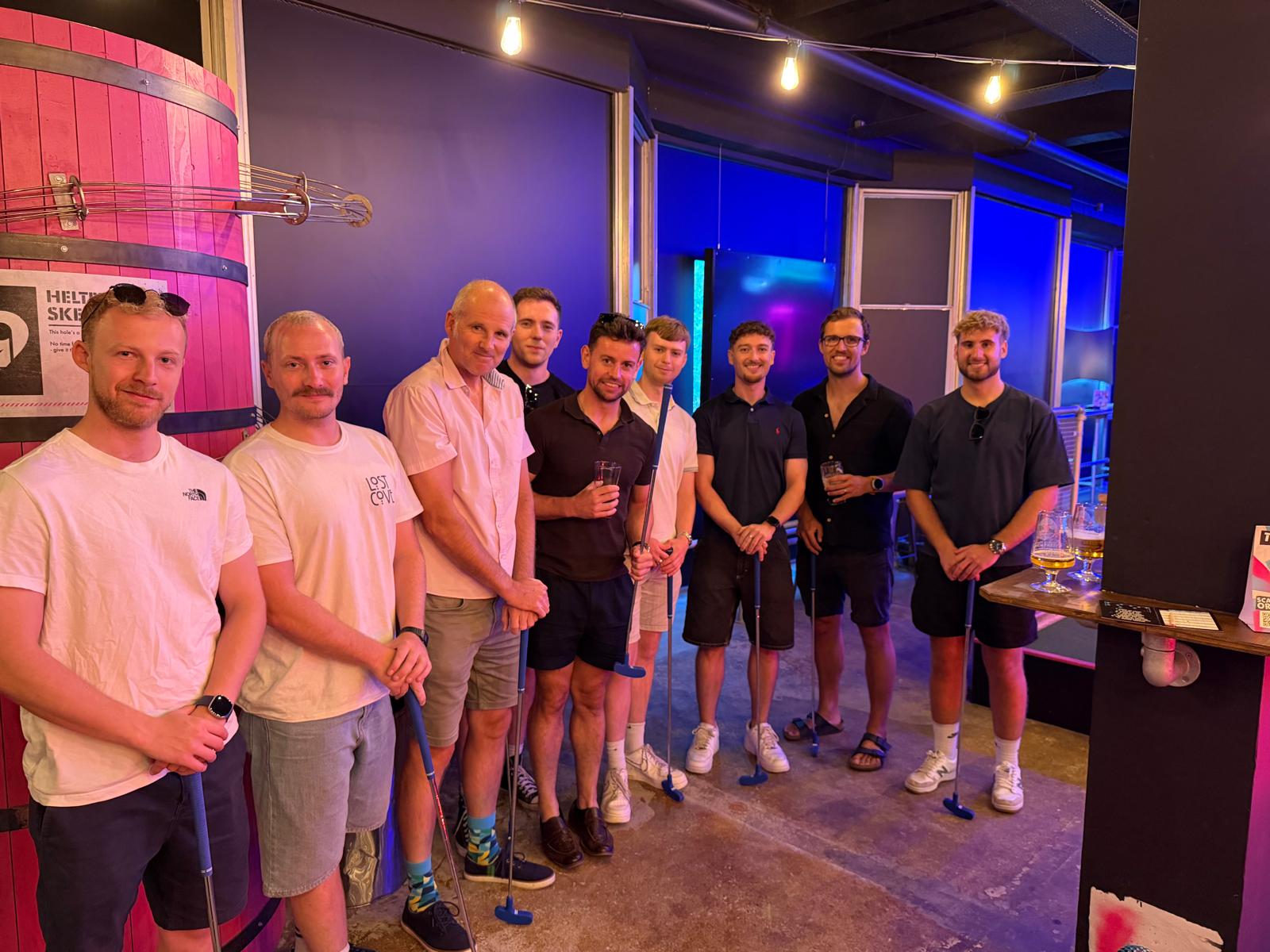
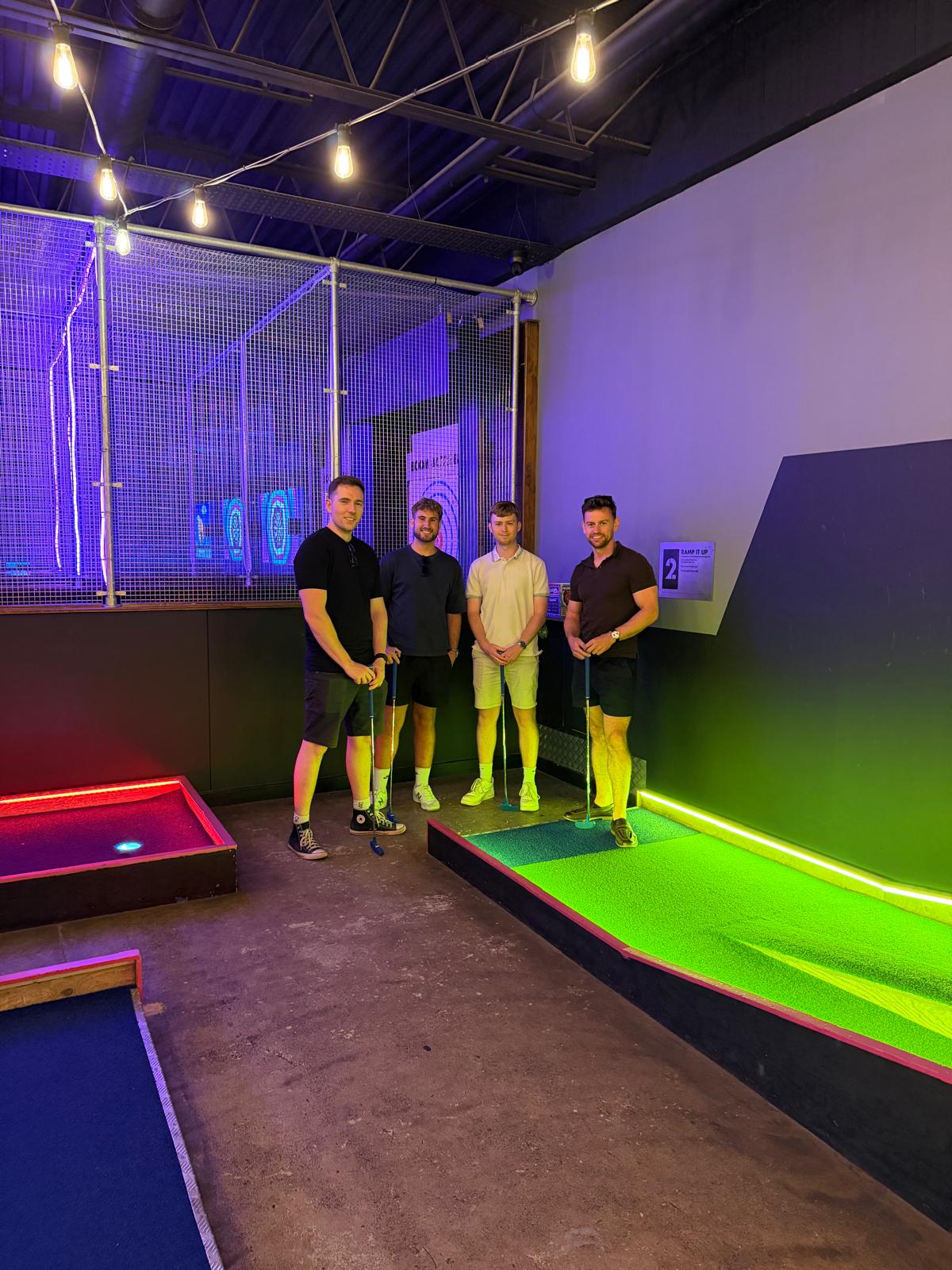
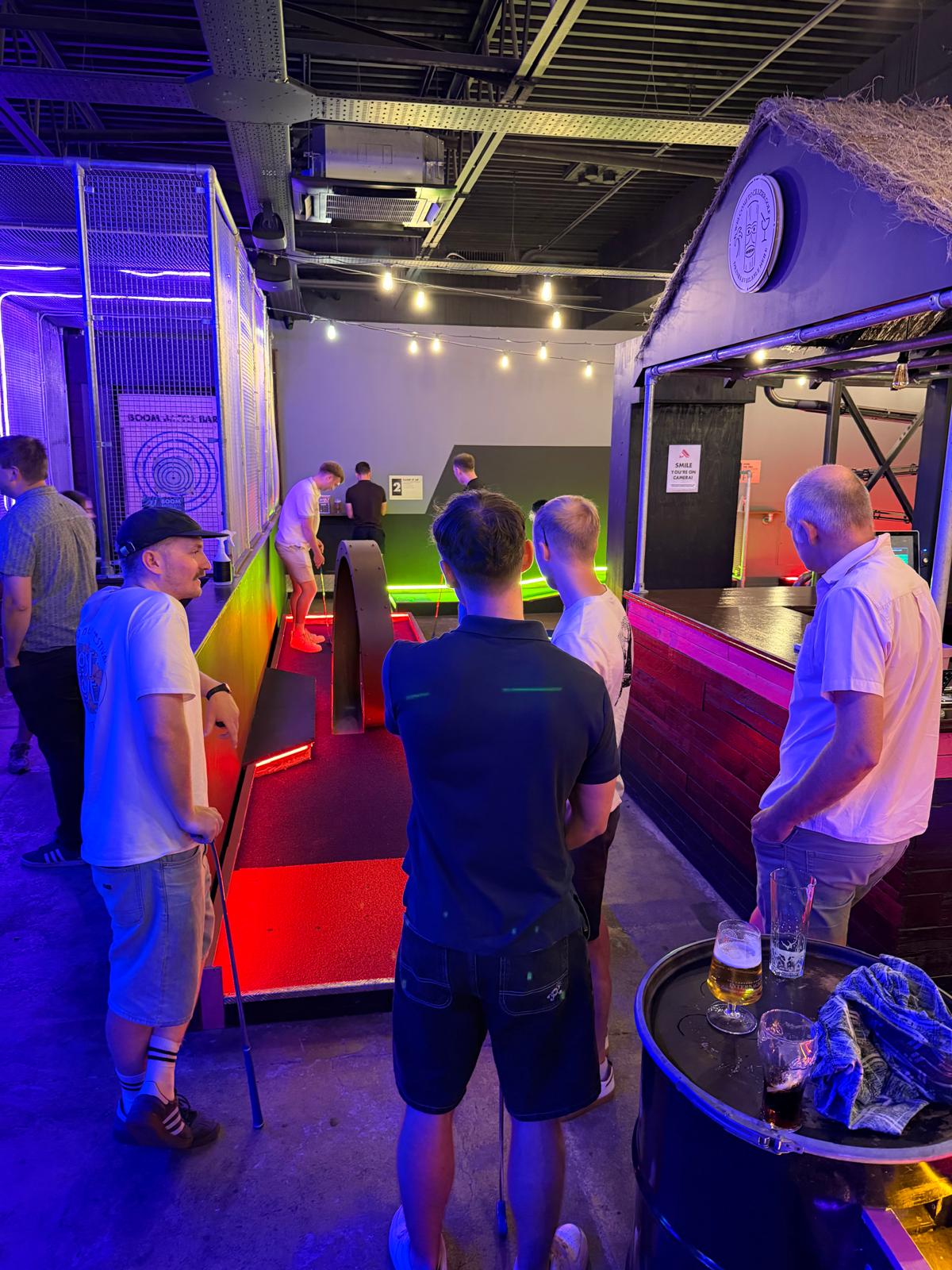
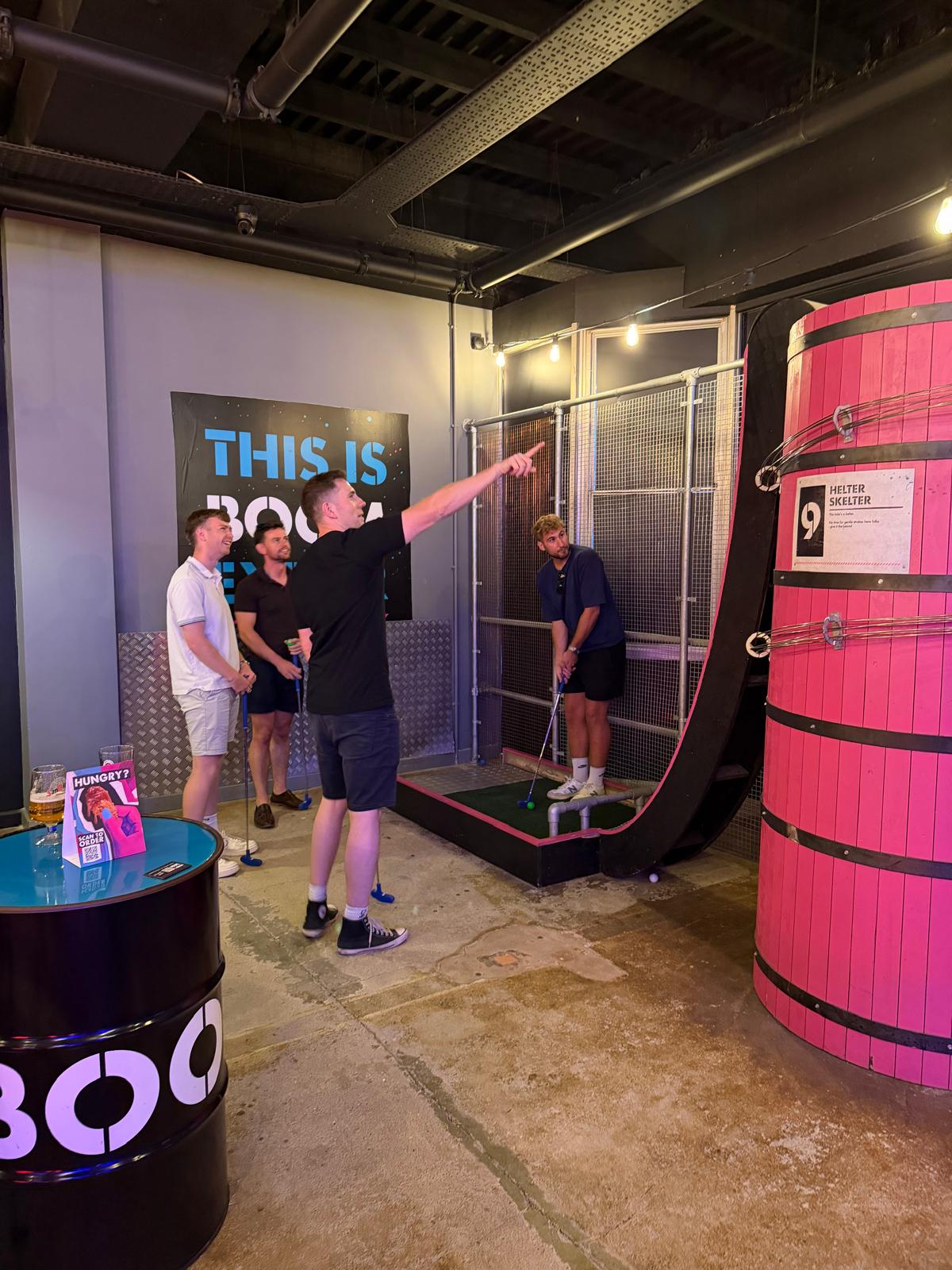
Earlier this month, SPC hosted a social evening for colleagues from the Services Design Solution (SDS) Exeter and Plymouth offices, organised by Area Sales Manager Chris Ward.
The evening was held at Boom Battle Bar in Exeter, with the group enjoying a round of crazy golf followed by food at Franco Manca.
Daniel Stevens from SDS shared his thoughts on the evening:
“A brilliant evening with colleagues from the Exeter and Plymouth offices. The mini golf at Boom Battle Bar was great fun, followed by some excellent pizza at Franco Manca. A big thank you to Chris and the team at SPC for organising and hosting us!”
Events like this are all part of building strong, lasting relationships with our partners across the South West, and we’re already looking forward to the next one.
Thank you to everyone from SDS Exeter and Plymouth who joined us.



Why Do Schools Use Fan Convectors and Radiant Panels Together in a Heating Upgrade?
A school heating upgrade rarely calls for a single heating type across the whole building. Classrooms, offices, and staff rooms need heat that responds quickly to changing occupancy, while sports halls and assembly spaces need consistent, draught-free warmth without air movement or ball impact risk. SPC supplies both Belgravia Fan Convectors and Thermatile radiant panels for exactly this reason: matching the right heating type to each space, rather than fitting one system throughout, is what makes a school heating upgrade genuinely work.
Why does a school heating upgrade need more than one type of heating?
Schools have varying spaces with very different heating demands. A classroom might be empty one period and full of thirty pupils the next, so it needs heat that responds fast. A sports hall, by contrast, is a large, high-ceilinged volume that’s occupied for longer stretches and needs heating that won’t interfere with ball games or dusty air quality. Treating every space the same way during a refurbishment usually means compromising somewhere, either overheating quiet rooms or leaving large halls cold and inconsistent.
Where do Fan Convectors fit into a school heating upgrade?
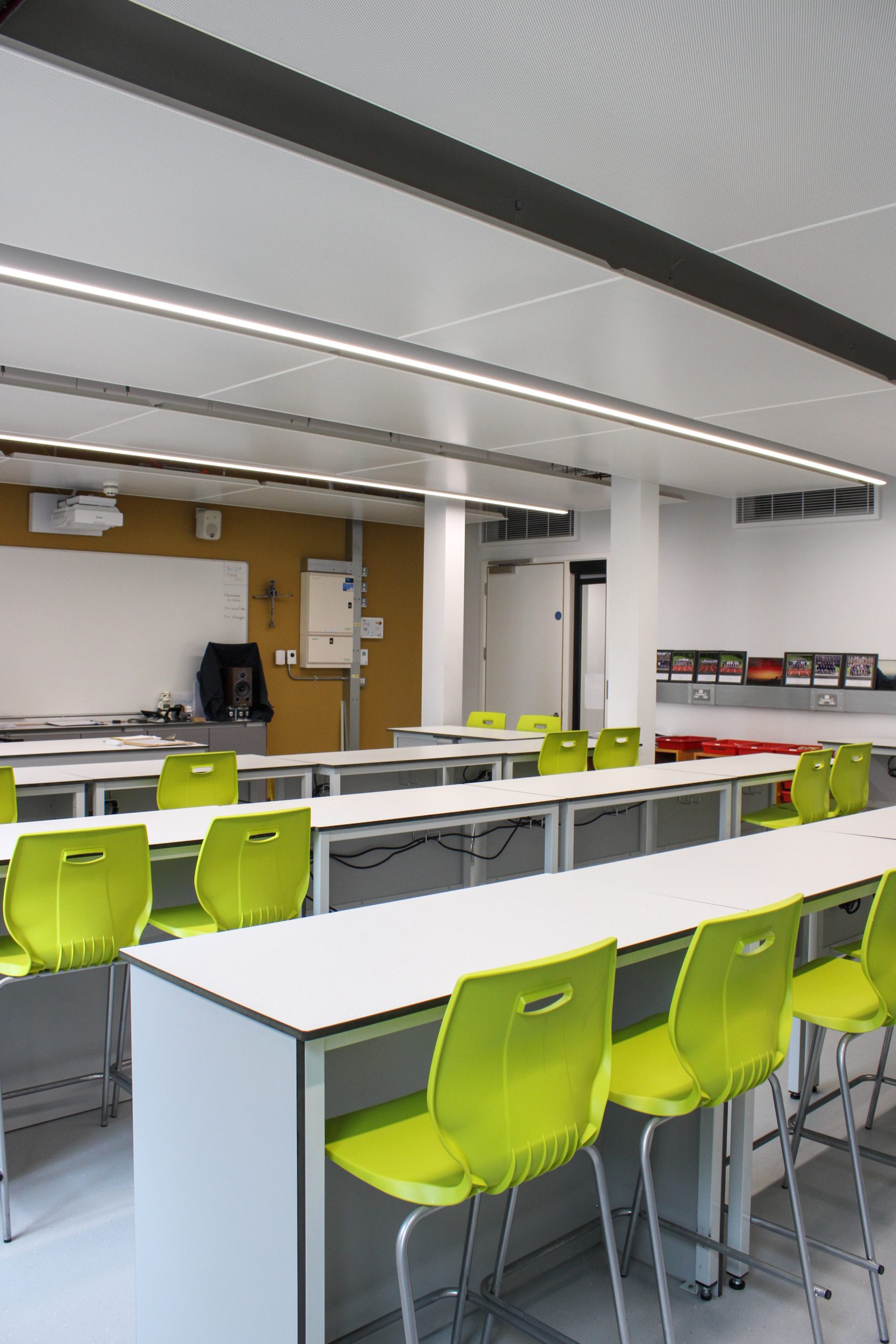
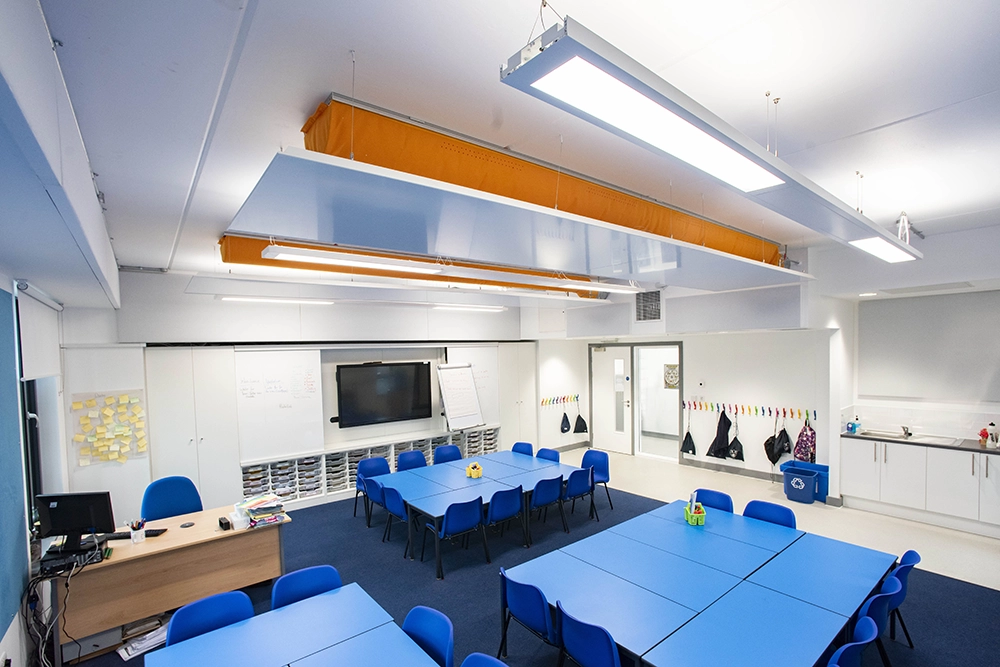
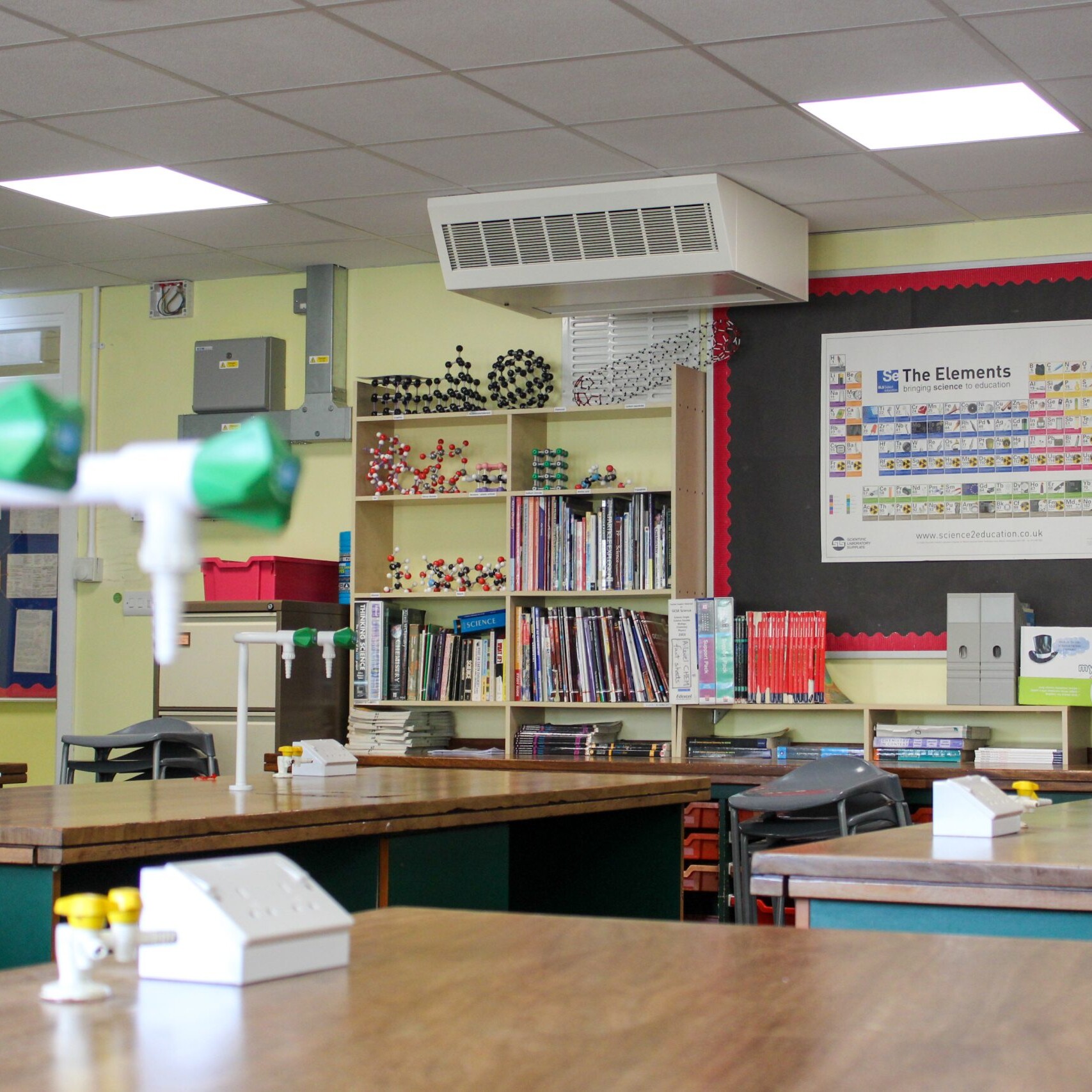
Belgravia Fan Convectors suit spaces with changing occupancy: classrooms, staff rooms, and offices. They warm up rapidly and distribute heat evenly through the room, which matters where lessons start and finish on a timetable rather than running continuously. Active LST (Low Surface Temperature) fan convector models keep casing temperatures below 43°C, meeting NHS safety guidance that many schools also apply, and the Belgravia Supreme’s rounded casing removes sharp corners in busy corridors and classrooms.
Where do Radiant Panels fit into a school heating upgrade?
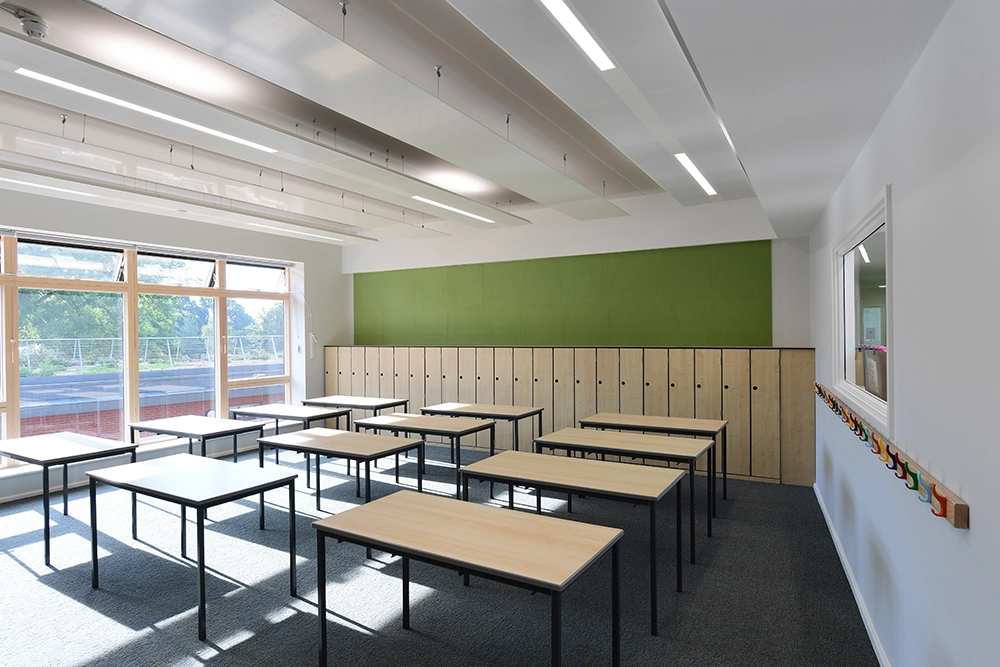
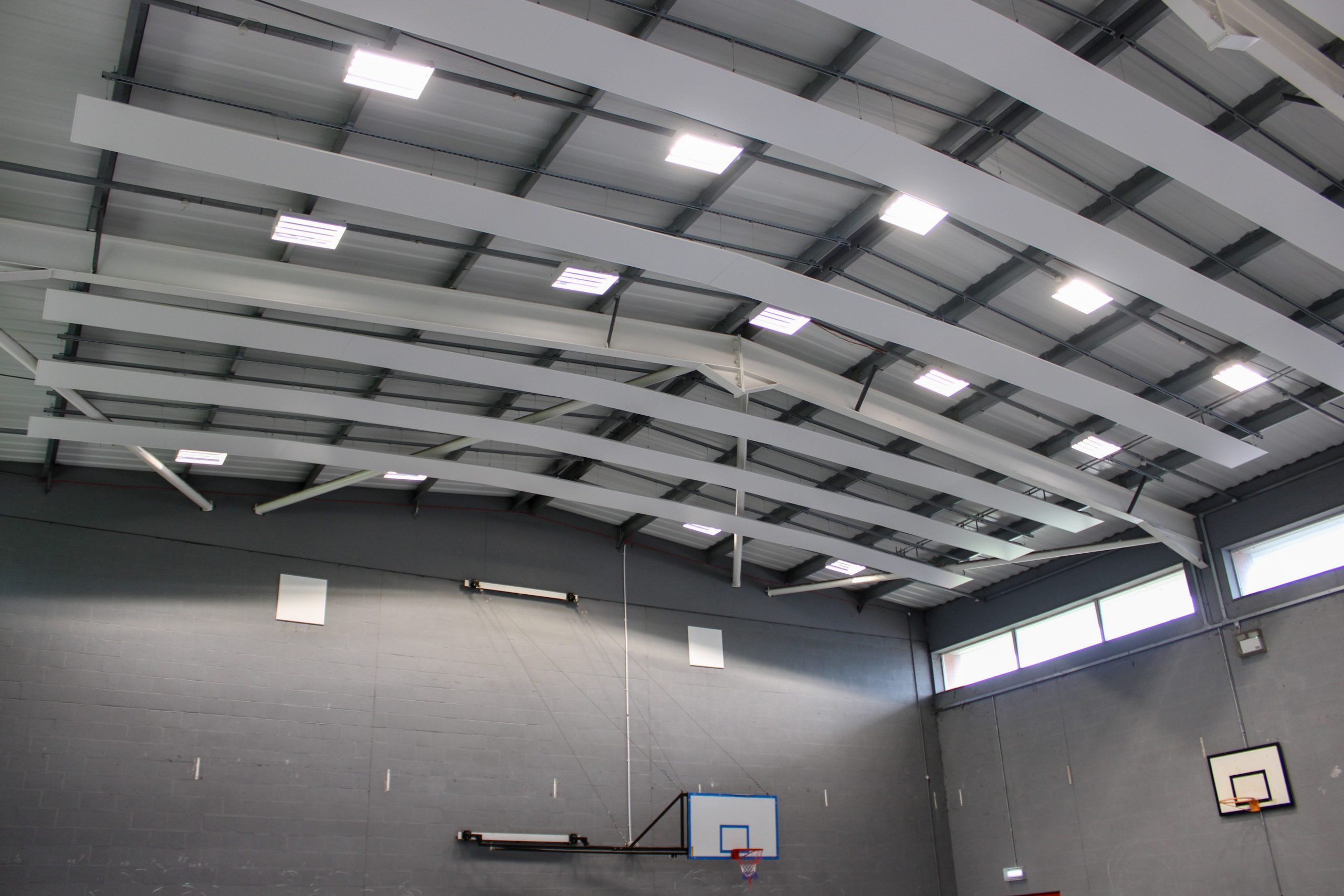
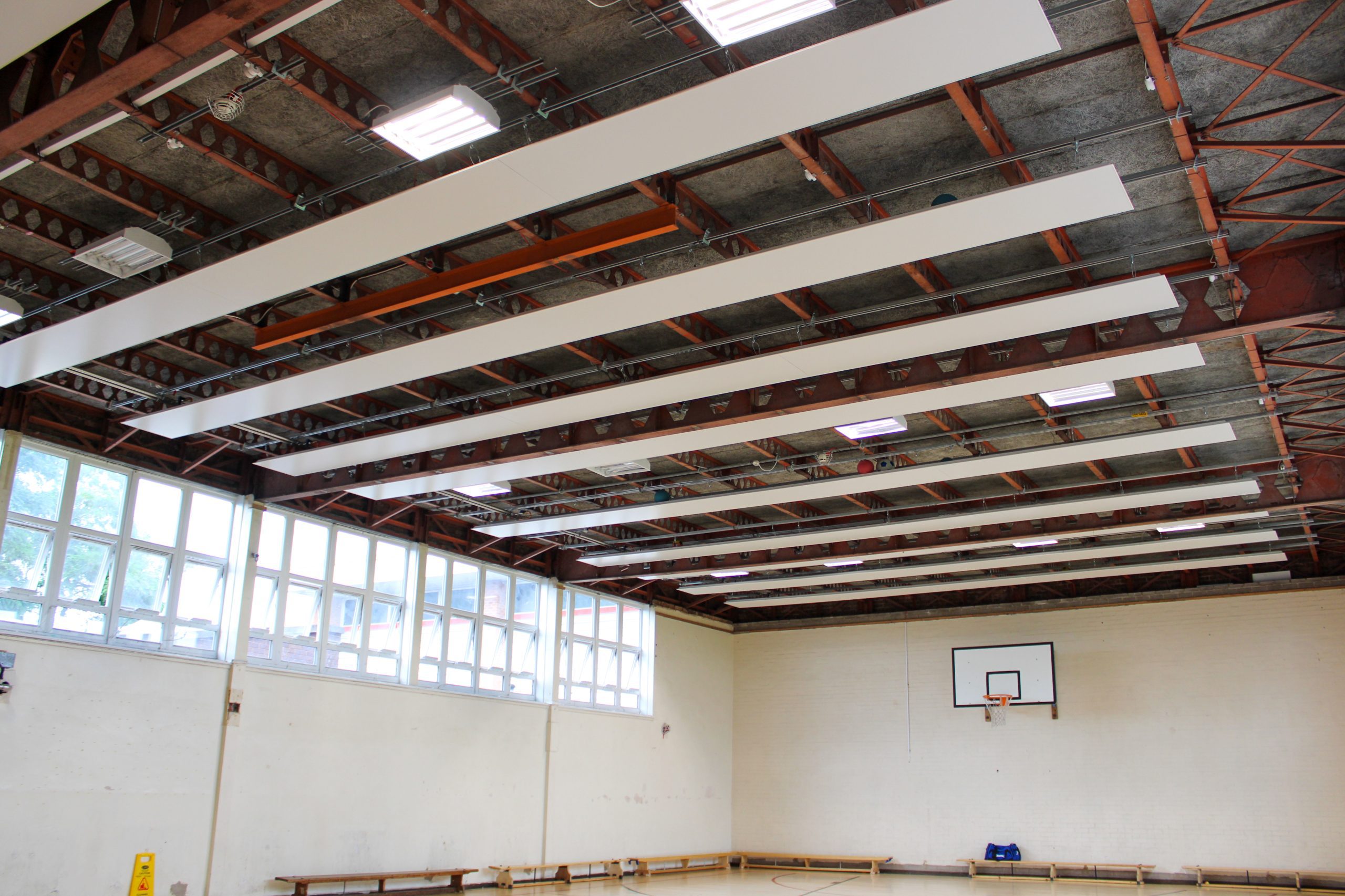
Thermatile radiant panels are often chosen for sports halls, assembly halls, and large open spaces because they transfer heat directly to people and surfaces rather than heating the air, there’s no fan noise and no air movement to circulate dust, a genuine consideration in shared teaching spaces. In sports halls specifically, SPC’s radiant panels are available with ball guard protection, tested to DIN 18032, so games can continue without risking damage to the panels or trapped equipment above them. Cannock Chase High School in Staffordshire specified this configuration for its sports hall as part of a wider heating upgrade.
Can Fan Convectors and Radiant Panels run from the same heating system?
Yes. Both ranges are designed to work with low-temperature hot water systems, including those fed by heat pumps, which matters where a school is upgrading its heat source as part of a wider decarbonisation project. Fan convectors specified with enhanced or low-flow heat exchangers, and Thermatile panels operating at 45 to 50°C flow temperature, can both be served from the same low-temperature circuit. This means a school doesn’t need to choose one product family over the other to hit its sustainability targets; the heat source and both heat emitter types can be specified together from the outset.
What does a combined installation look like in practice?
Barton Court Grammar School, Canterbury and Towers School & Sixth Form Centre, Dover are among some schools where SPC’s fan convectors have been specified for classroom and teaching spaces, while Cannock Chase High School shows the same approach applied to a sports hall using radiant panels. Specifying both product families under one project allows an estates team or M&E consultant to work with a single manufacturer across every room type, rather than sourcing classroom and hall heating separately.
Frequently Asked Questions
Yes. Both ranges support BMS integration, so a school can monitor and control classroom fan convectors and sports hall radiant panels from a single system rather than managing two separate control setups.
They can be installed in the same phase and, in many cases, by the same contractor. Both ranges are supplied by SPC from Leicester, so specification, lead times, and technical support run through a single point of contact rather than two separate supply chains.
Classrooms and offices are usually prioritised first, since fan convectors address the most frequently used teaching spaces. Sports halls and assembly spaces can be phased in later using radiant panels, provided the heat source is sized with future expansion in mind from the outset.
Fan convectors have accessible filters that need periodic checking, typically during holiday windows to avoid disrupting lessons. Thermatile radiant panels have no fans or filters, so routine maintenance needs are minimal once installed.
There’s no minimum. SPC’s radiant panels have been specified in classrooms at Marlborough College and St Luke’s Primary School, Brighton, as well as in smaller-scale spaces such as the Ashmolean Museum, Oxford and Liskeard Library, Cornwall. Larger, higher-ceilinged spaces such as sports halls are a strong fit because radiant heat avoids the temperature stratification that convection struggles with at height, though fan convectors are sometimes chosen for these spaces too when rapid warm-up from cold is the priority over radiant comfort.
Talk to SPC About Your School Heating Project
If you’re planning a school heating upgrade covering more than one building type, from classrooms to sports halls, our team can help you specify the right combination of fan convectors and radiant panels for each space.
CurveVector Cassette Heater: A New Circular-Grille Option for Ceiling-Mounted Heating
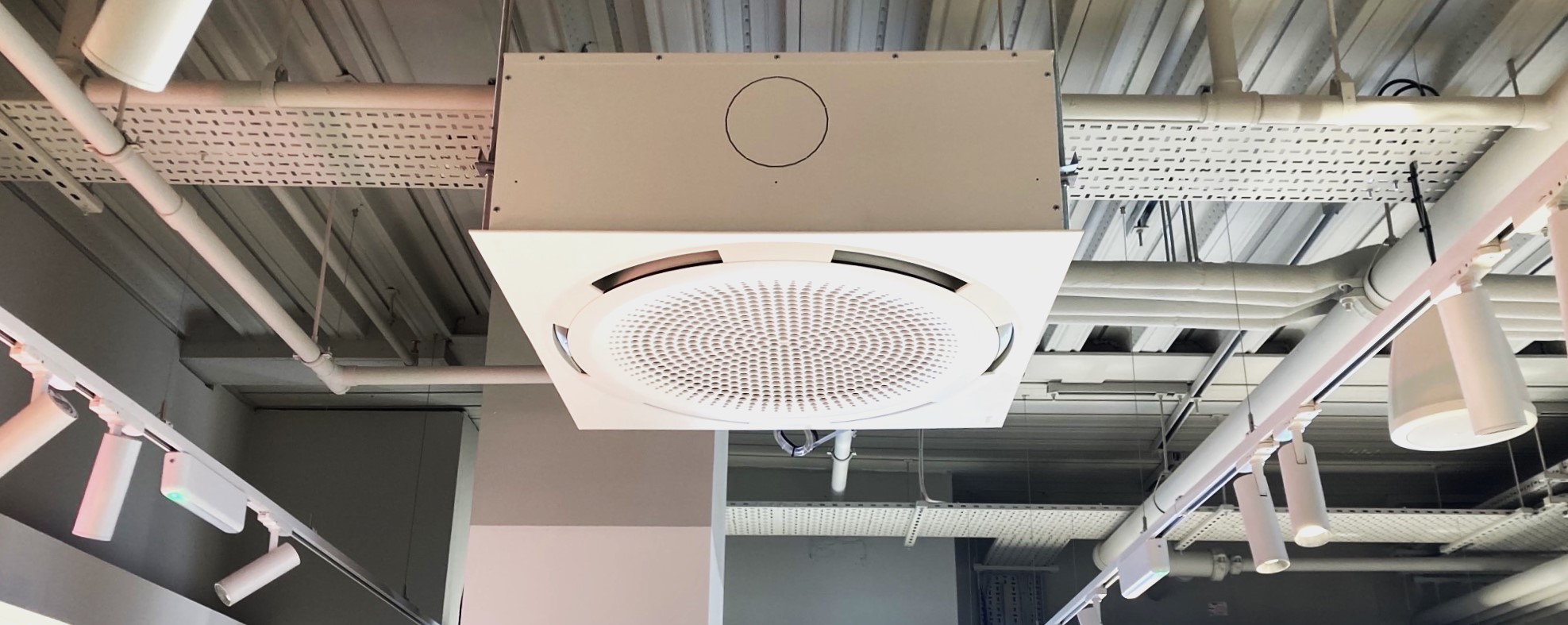
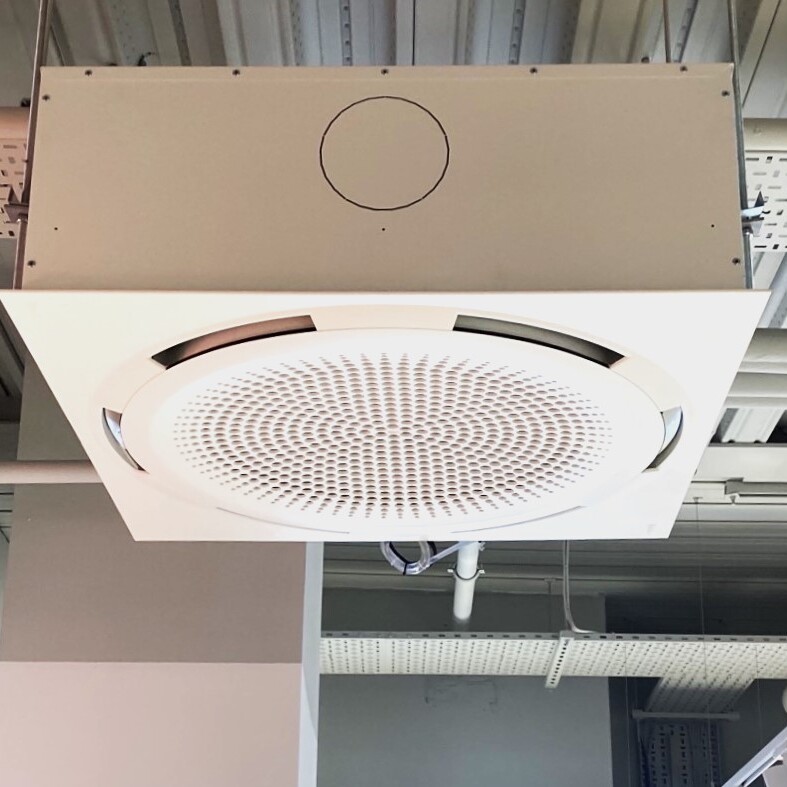
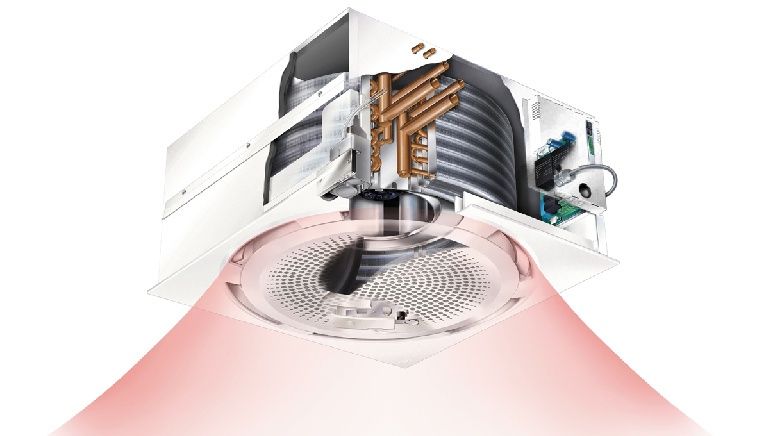
SPC has added the CurveVector cassette heater to its range of ceiling-mounted heating solutions. Recessed into a standard 600x600mm suspended ceiling grid, the CurveVector distributes warm air through a distinctive 360° circular discharge pattern via a circular grille, finished in RAL 9016 white as standard.
The CurveVector gives specifiers another option where floor and wall space is limited and a ceiling-integrated finish is required. Its circular grille and full 360° discharge offer a different aesthetic to SPC’s existing ceiling tile fan convectors, making it a useful addition for projects where the visual finish or air distribution pattern is a key part of the specification.
How the 360° Discharge System Works
Air is drawn in through the perforated central section of the grille, passed across the hot water coil, and discharged outward and downward at a fixed 45° angle through a continuous circular outlet running around the full perimeter of the unit. This means warm air reaches the occupied space evenly from a single point in the ceiling, without depending on the layout or orientation of the room below.
The unit is fitted with an EC fan motor as standard, supporting low-temperature operation and contributing to the overall energy performance of the installation. It is compatible with heat pumps, condensing boilers, and waste heat recovery systems, with output varying by coil option and system flow temperature.
Quiet Operation
The CurveVector operates from 29 NR at low fan speed, making it suitable for noise-sensitive environments, including classrooms, offices, healthcare waiting areas, libraries, and meeting rooms where acoustic comfort is part of the specification brief.
Installation
Supplied with adjustable mounting brackets as standard, the unit can be positioned before or after the ceiling grid is installed and repositioned in any direction for accurate alignment. The grille is adjustable on site, and water connections are made via copper side connections, keeping the installation straightforward in standard 600x600mm suspended ceiling grids.
Controls
A range of control options are avaliable to suit different building types, including on/off, multi-speed, and proportional thermostats, along with rocker switch options. Contact SPC for futher control options.
Where the CurveVector Fits
The CurveVector is suited to commercial, education, retail, healthcare, and public sector projects, including classrooms, offices, reception areas, waiting rooms, and other spaces where a discreet, ceiling-integrated finish is preferred over a wall or floor-mounted unit.
Where a more traditional tile-format finish is preferred, SPC’s Tilevector range remains available with an egg-crate grille, offering an alternative aesthetic within the same ceiling-mounted family.



Frequently Asked Questions
The CurveVector is designed for standard 600x600mm suspended ceiling grids, sitting flush with the surrounding tiles for a clean, integrated finish.
Yes. The CurveVector operates effectively across a range of flow temperatures, including those typical of heat pump systems, making it suitable for both new-build and retrofit low-temperature heating circuits.
The CurveVector is supplied with a circular discharge grille as standard. Where a more traditional egg-crate finish is preferred, SPC’s Tilevector range offers this alternative within the same ceiling-mounted family.
Specify the CurveVector on Your Next Project
If you are looking to specify the CurveVector for a project, need product data sheets, or want to discuss heat pump compatibility with a member of our team, contact us directly:
SPC Celebrates 250 Years of the Carver Group
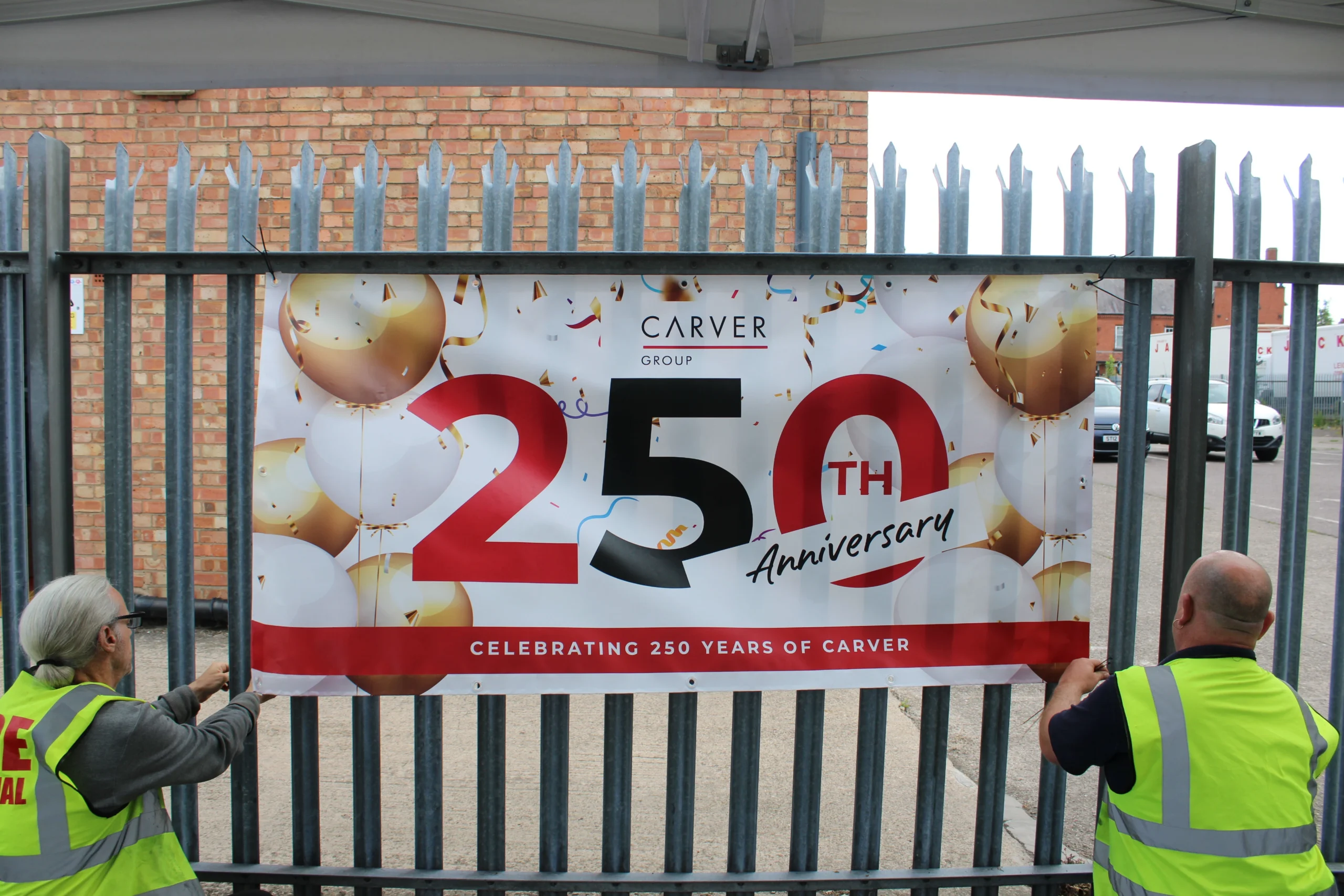
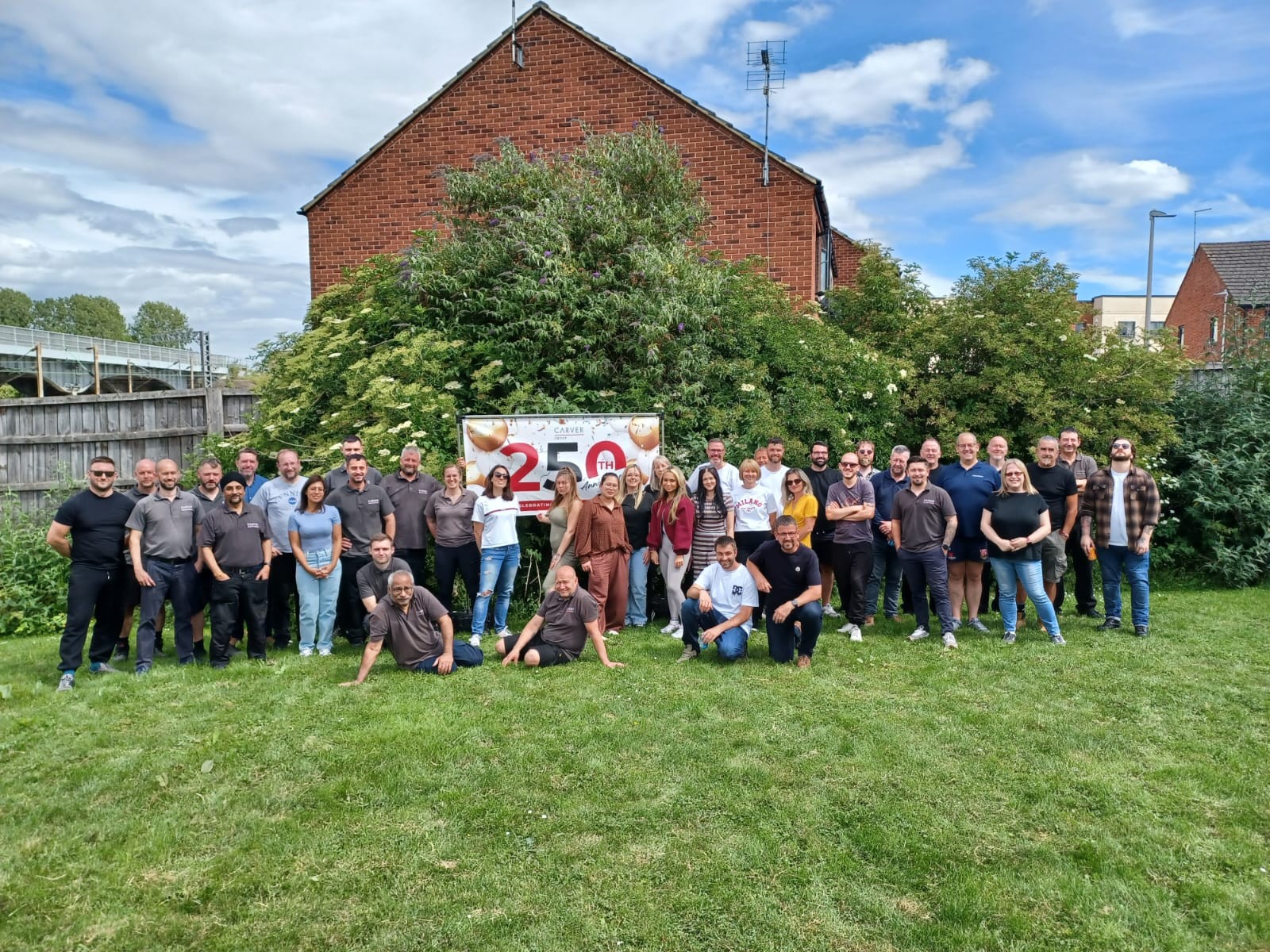
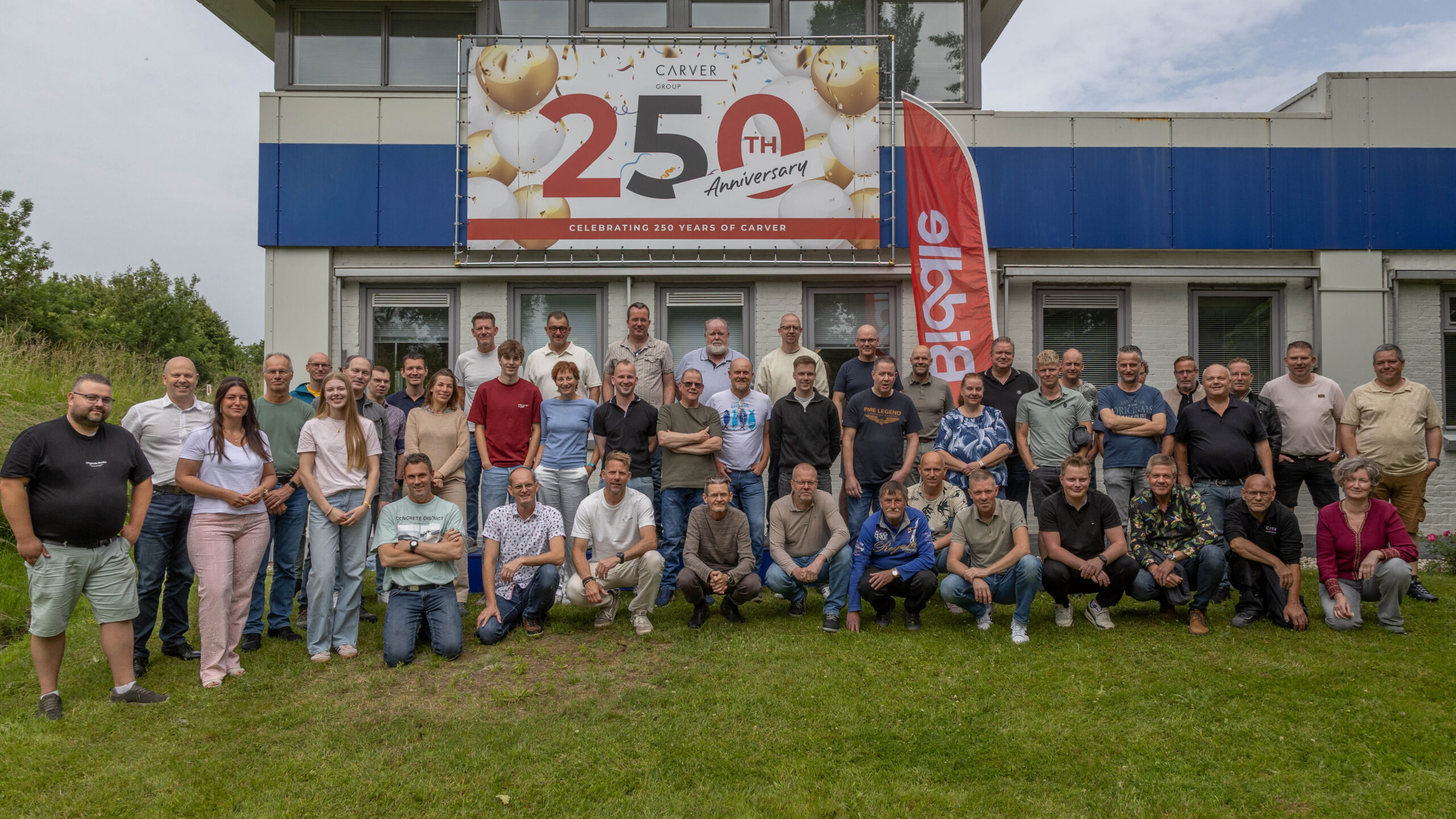
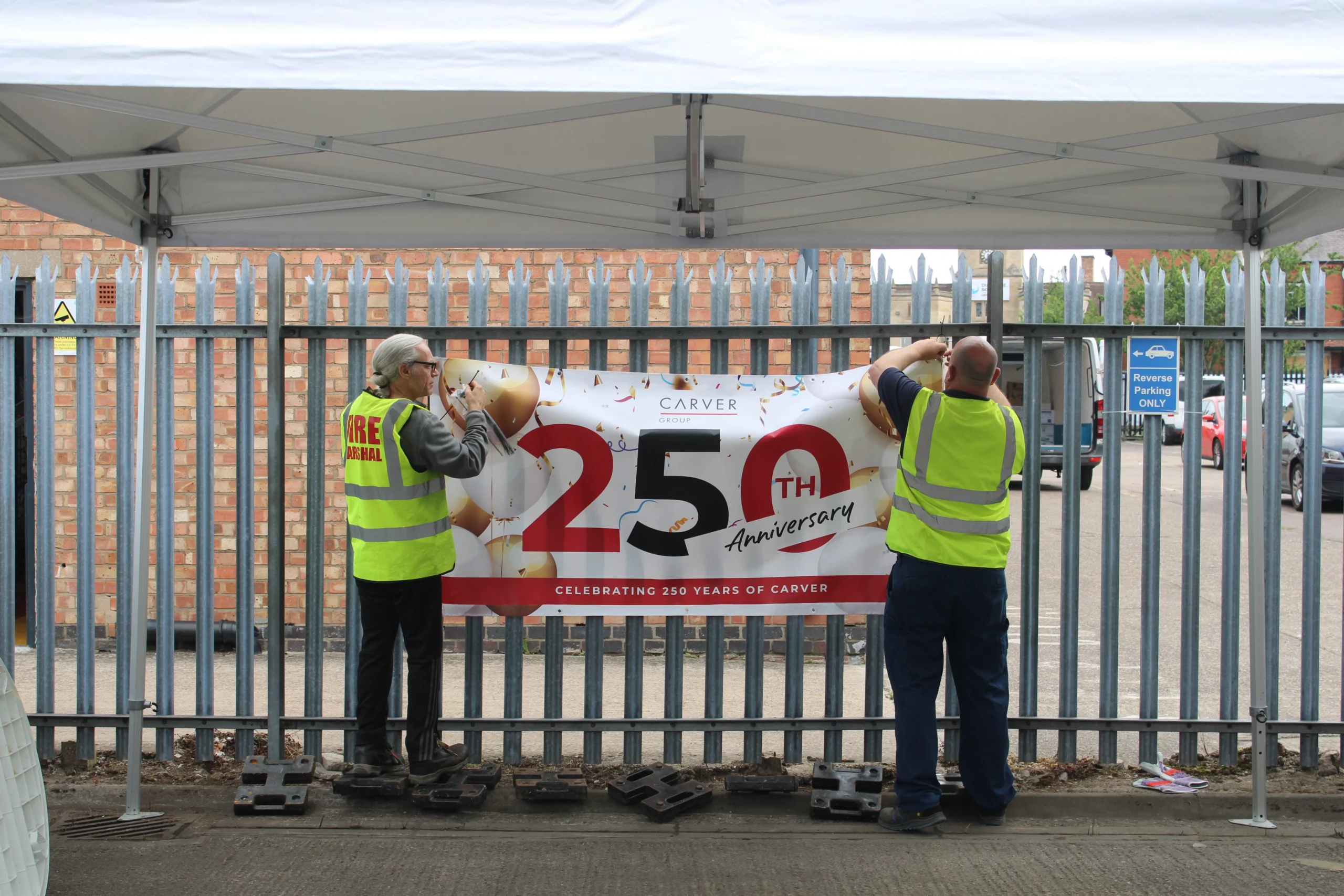
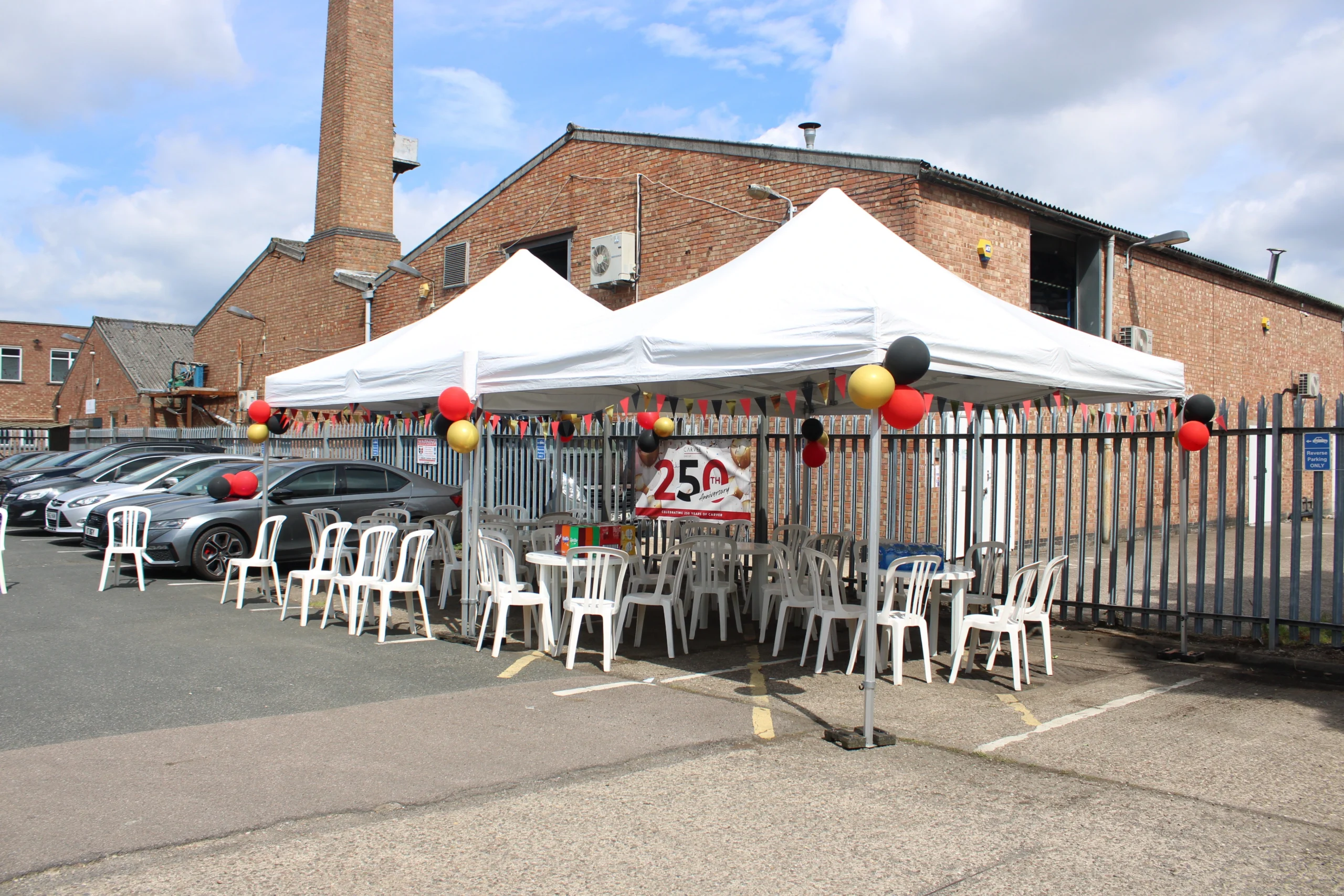
Last week, the team at S & P Coil Products Limited in Leicester took a moment to mark a genuinely remarkable milestone: the 250th anniversary of the Carver Group. Founded in 1776 as a family business, the Carver Group has grown over eight generations into one of Europe’s leading HVAC manufacturing groups. On 16th June 2026, every company across the portfolio paused to celebrate together.

A Lunchtime Celebration at SPC
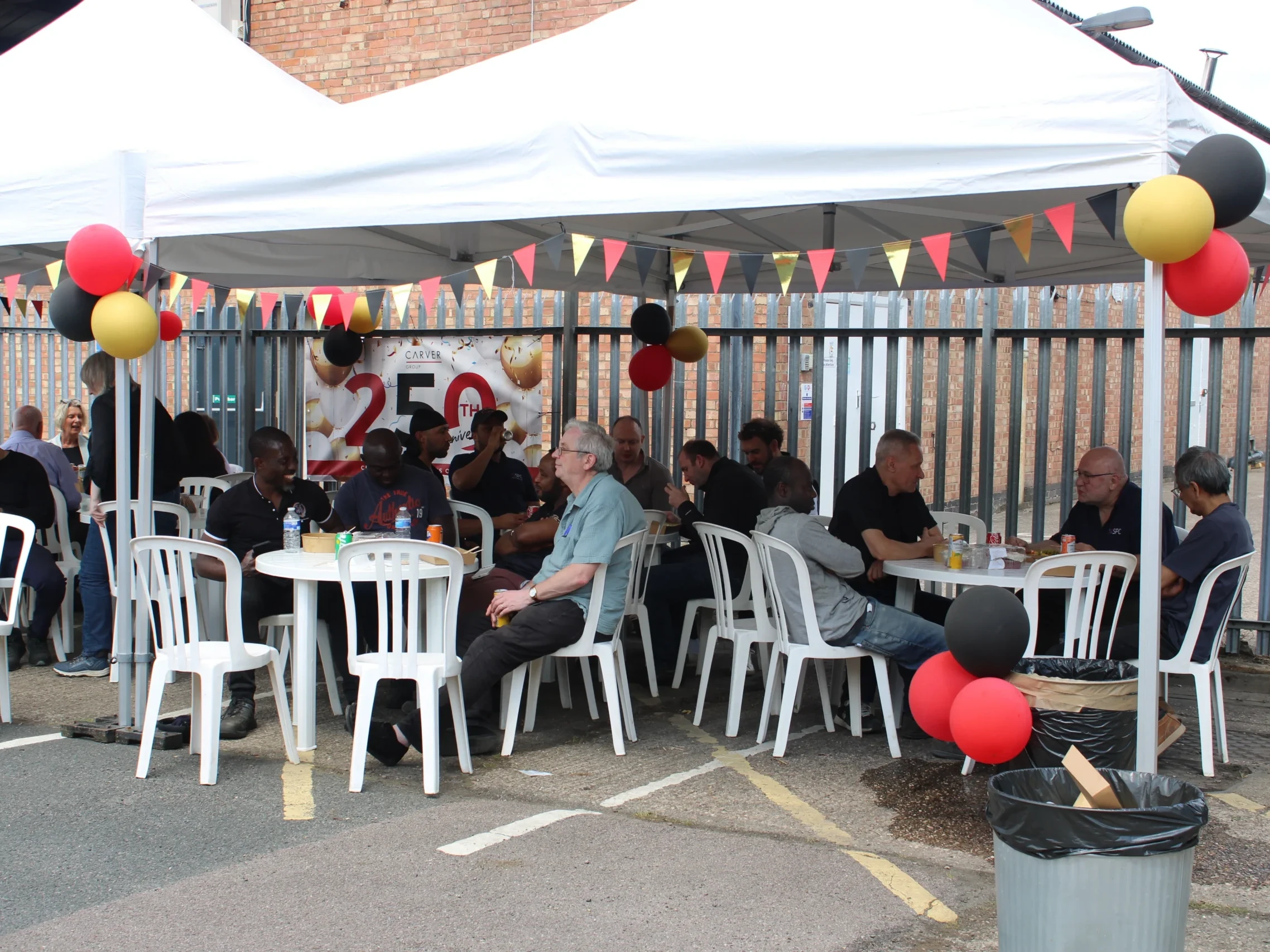
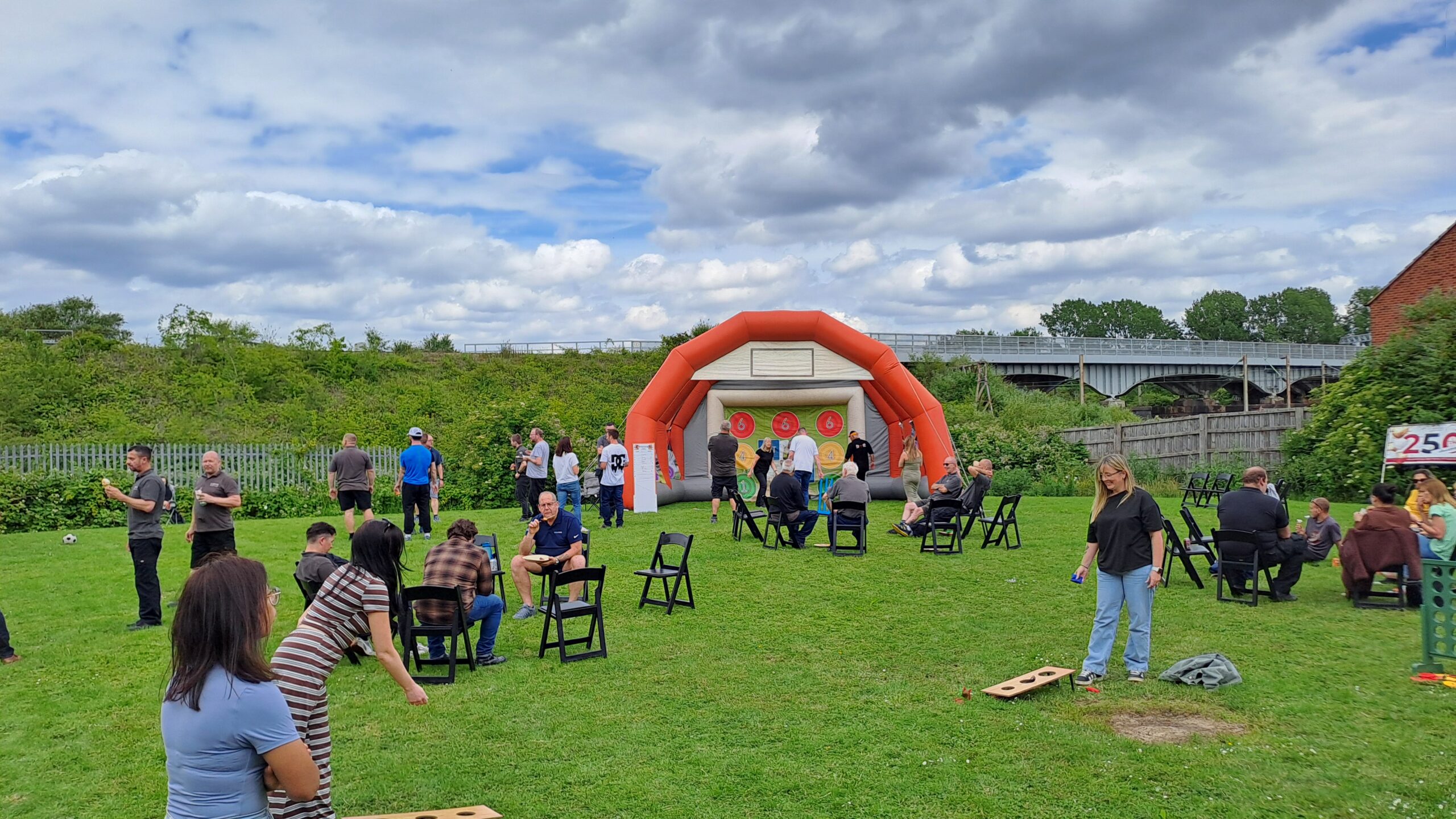
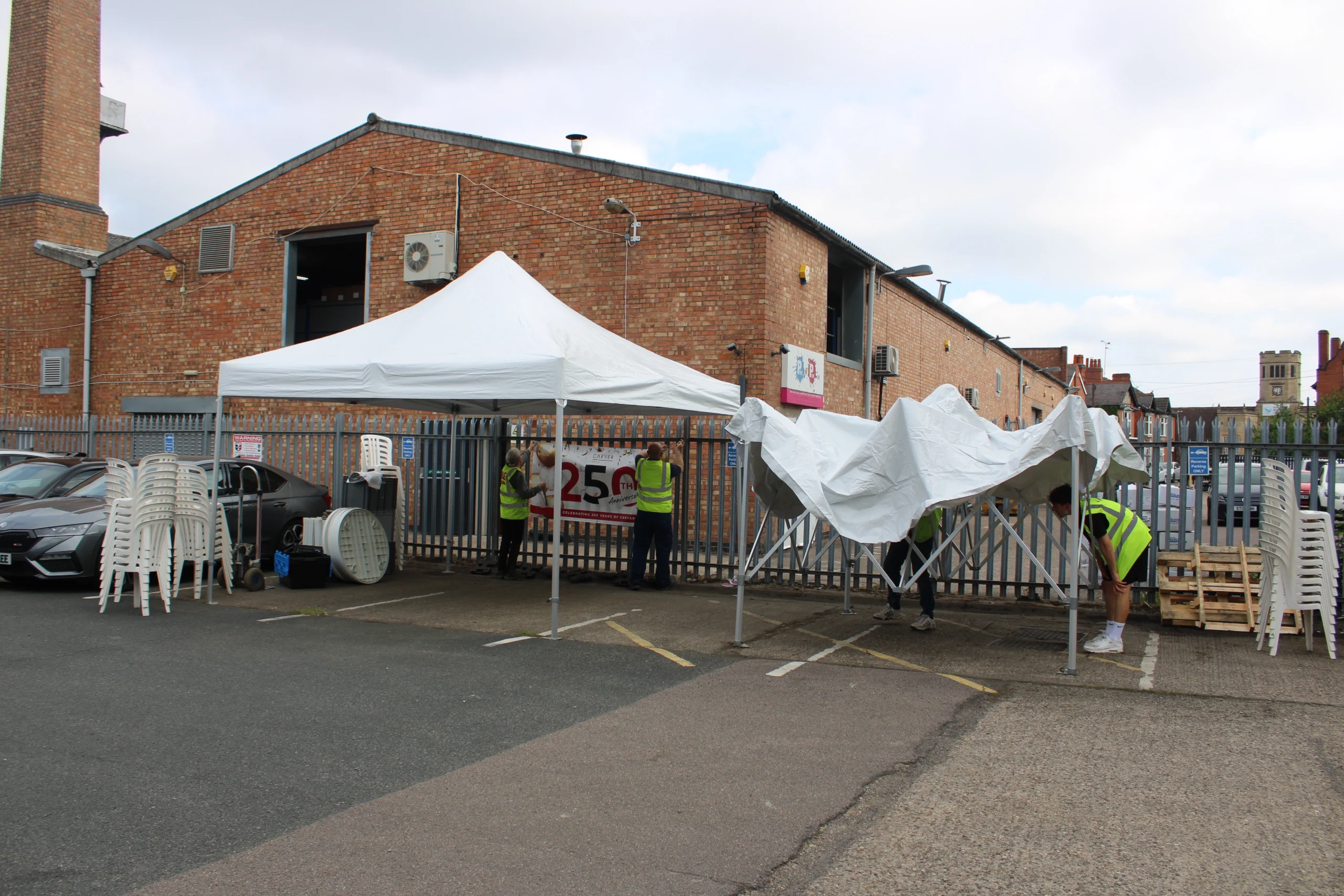
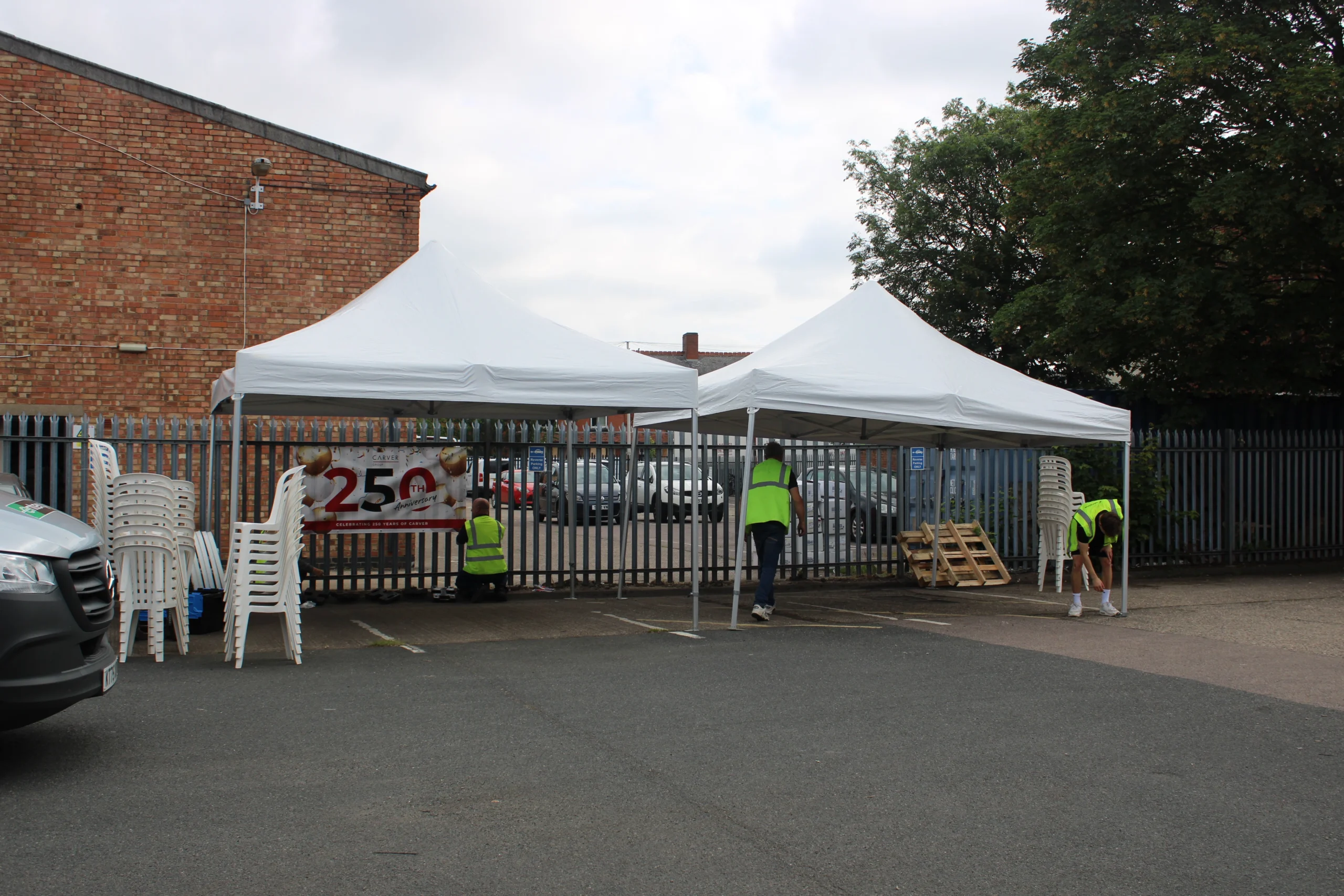
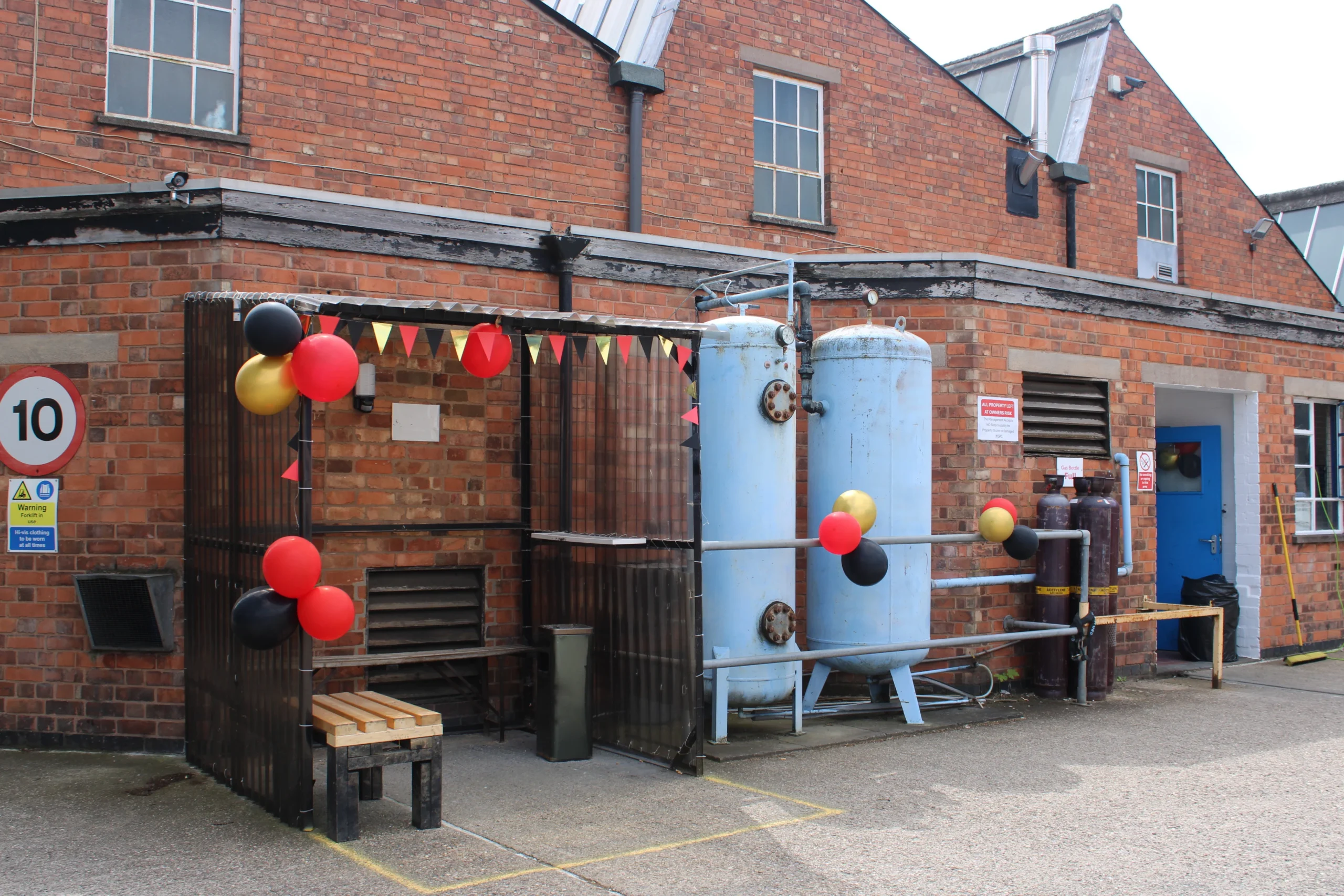
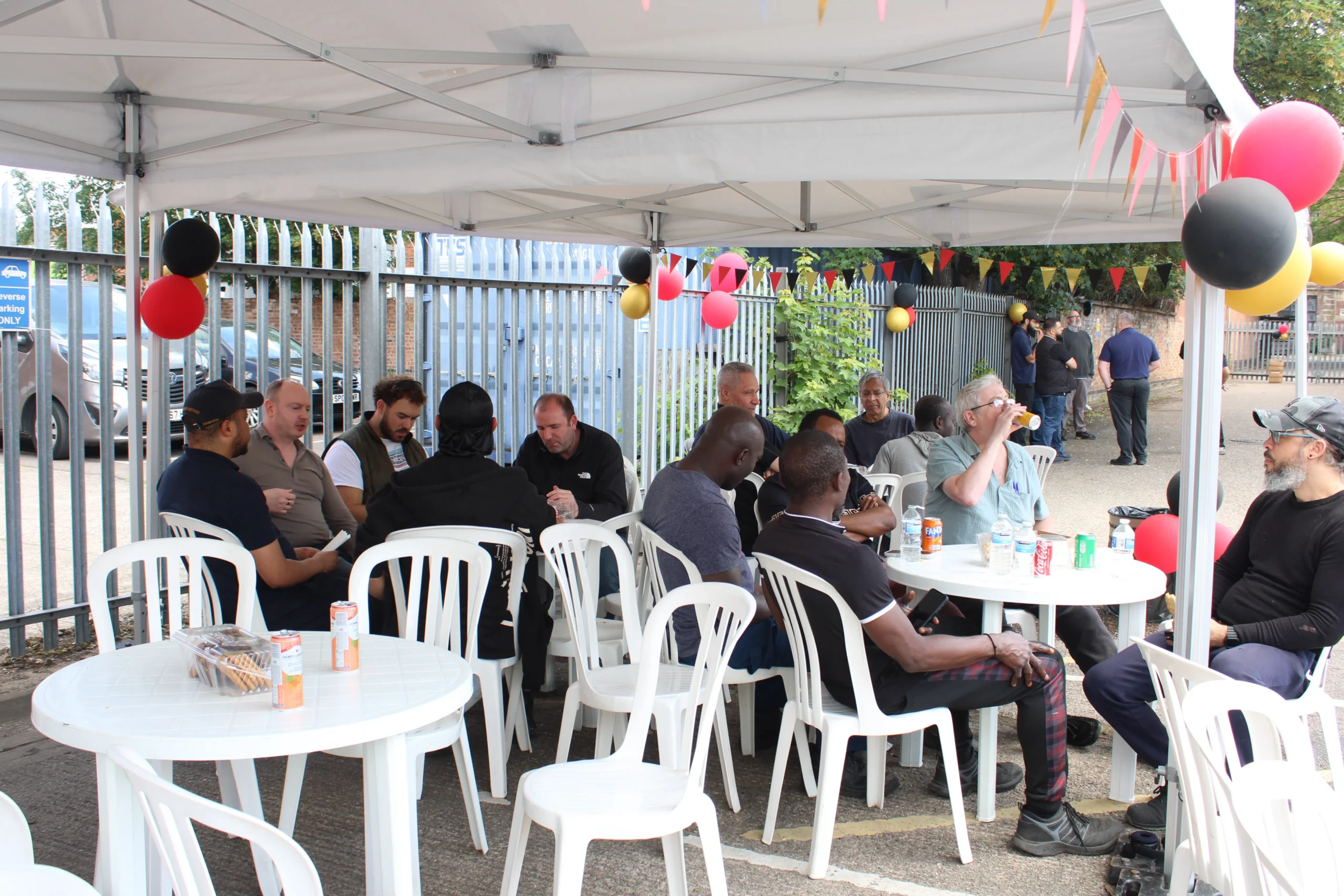
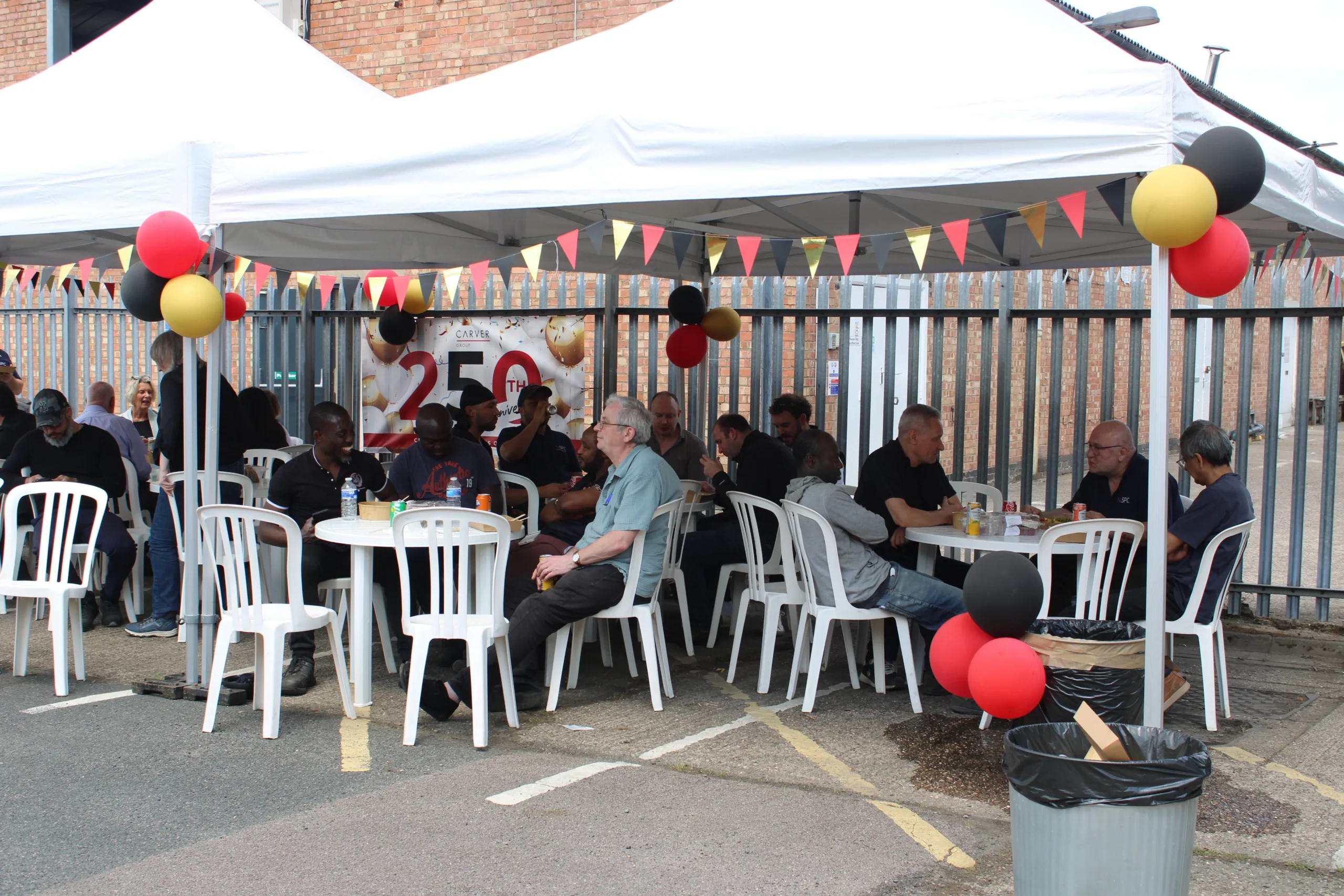
To mark the occasion, SPC invited all staff to step away from their desks and the factory floor for a celebration in the rear car park. The afternoon brought the whole team together for food, music, and a chance to relax and socialise.
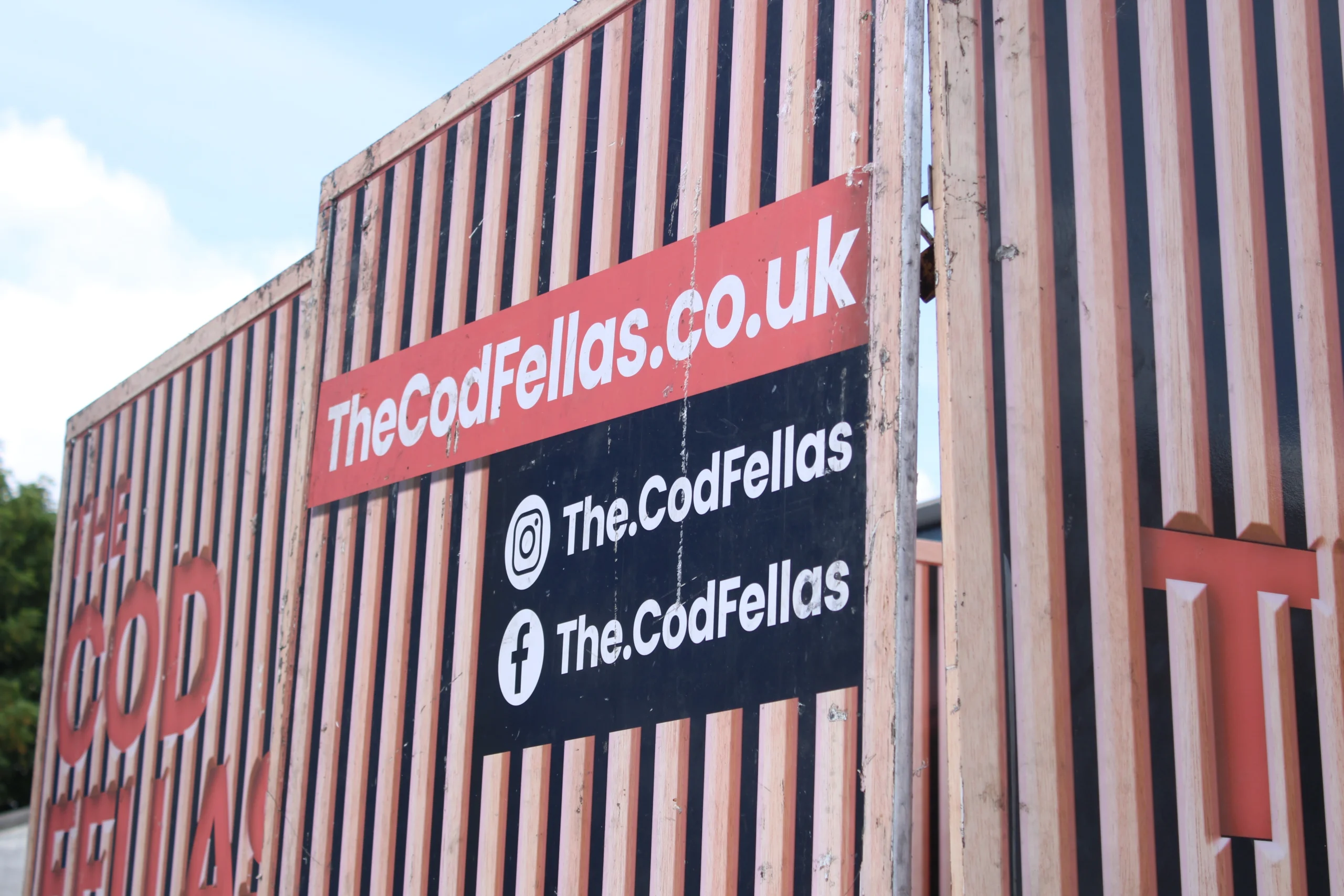
The CodFellas, a popular mobile fish and chip van, provided the catering, with a menu that went down well on a warm summer afternoon.
One Group, Many Celebrations
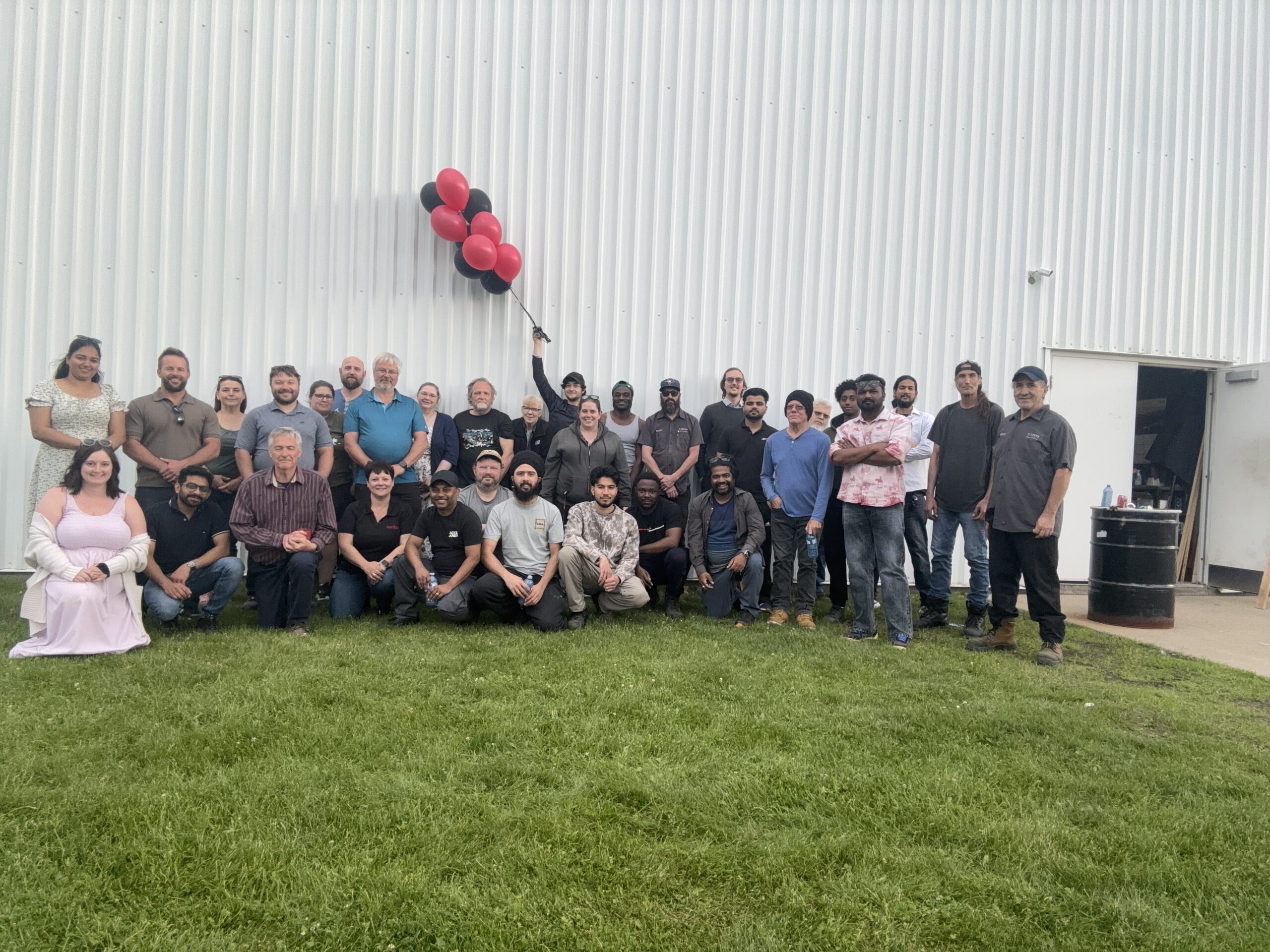
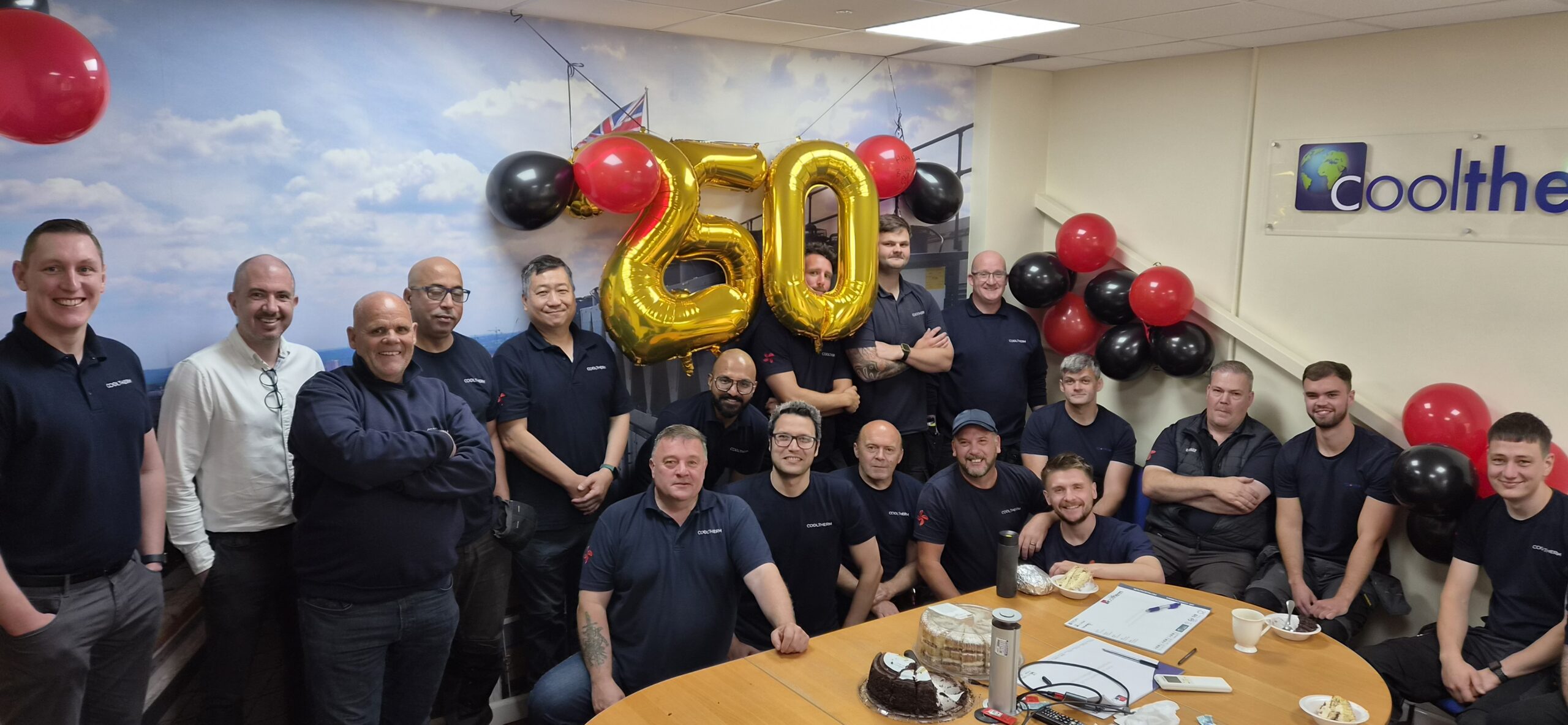
SPC was not alone in marking the anniversary. Across the Carver Group’s portfolio of businesses, each company held its own celebration at their respective sites. The full group includes Applied Comfort, Biddle, Carver Clamps, Cooltherm, Powrmatic, Thermoscreens, and Widney Leisure, a collection of specialist HVAC manufacturers spanning the UK, Europe, and North America.
Rather than a single centralised event, each business was encouraged to celebrate in a way that suited their team and culture. The result was a series of local celebrations united by a shared sense of pride in the group’s history.

250 Years of Family Ownership
The Carver Group was founded in 1776 by Joseph Carver in Walsall, originally producing goods for the carriage industry. Over the following two-and-a-half centuries, the business evolved through engineering and manufacturing before moving into the HVAC sector it operates in today. It is now an eighth-generation family business with operations across the UK, Germany, France, Ireland, the Netherlands, and Canada, serving customers in more than 50 countries worldwide.
SPC joined the Carver Group in 2024, bringing over 50 years of heating and cooling manufacturing expertise to the portfolio. Based in Leicester, SPC continues to design and manufacture a full range of HVAC products including fan convectors, trench heating, coils, radiant panels, and air curtains, for commercial and industrial applications across the UK.
A Milestone Worth Marking
250 years of continuous family ownership, through the industrial revolution, two world wars, and the shift to net zero, speaks to a consistency of values that is genuinely unusual in modern manufacturing. As the Carver Group enters its third century of trading, its focus remains on sustainable growth, innovation, and delivering long-term value for customers and communities. For SPC, being part of that story is something the whole team is proud of.
To find out more about SPC and the products we manufacture, conatct us or call 0116 249 0044.



Frequently Asked Questions
The Carver Group is a family-owned HVAC manufacturing group founded in 1776 and now in its eighth generation of family ownership. The Group manages a portfolio of specialist manufacturing businesses, including Applied Comfort, Biddle, Carver Clamps, Cooltherm, Powrmatic, SPC, Thermoscreens, and Widney Leisure, with representation in over 50 countries.
S & P Coil Products Limited joined the Carver Group in 2024. Based in Leicester, SPC has been manufacturing heating and cooling solutions for over 50 years and operates as part of the Group’s UK HVAC portfolio.
S & P Coil Products Limited joined the Carver Group in 2024. Based in Leicester, SPC has been manufacturing heating and cooling solutions for over 50 years and operates as part of the Group’s UK HVAC portfolio.
How Does HVAC Coil Replacement Work in Commercial Buildings?
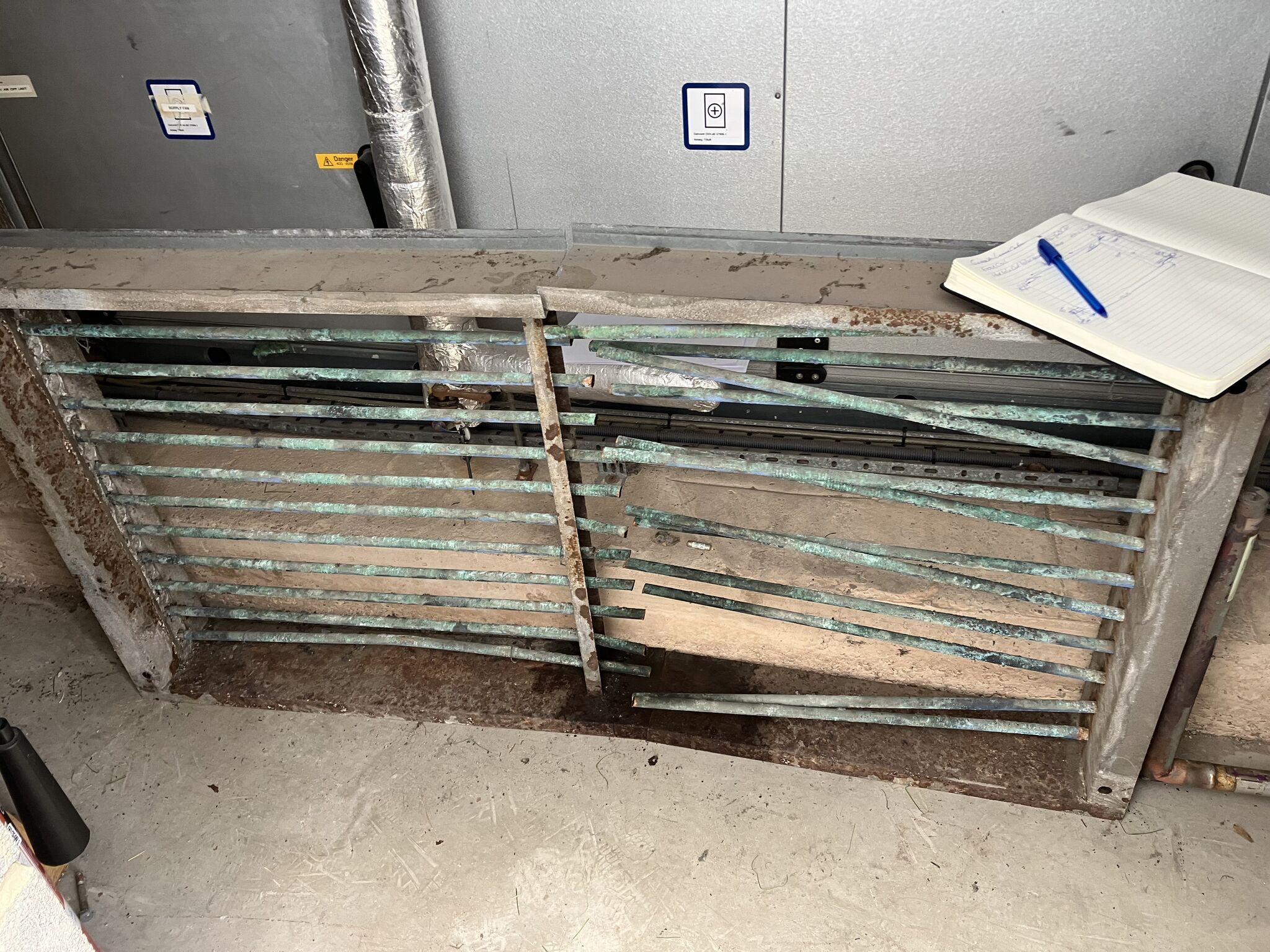
When an HVAC coil begins to leak or fails outright, replacement is usually the only practical solution. HVAC coil replacement in a commercial building involves a site survey to assess the failed unit, bespoke manufacture of a new coil matched to the existing air handling unit (AHU), and careful installation to restore system performance with minimum disruption.
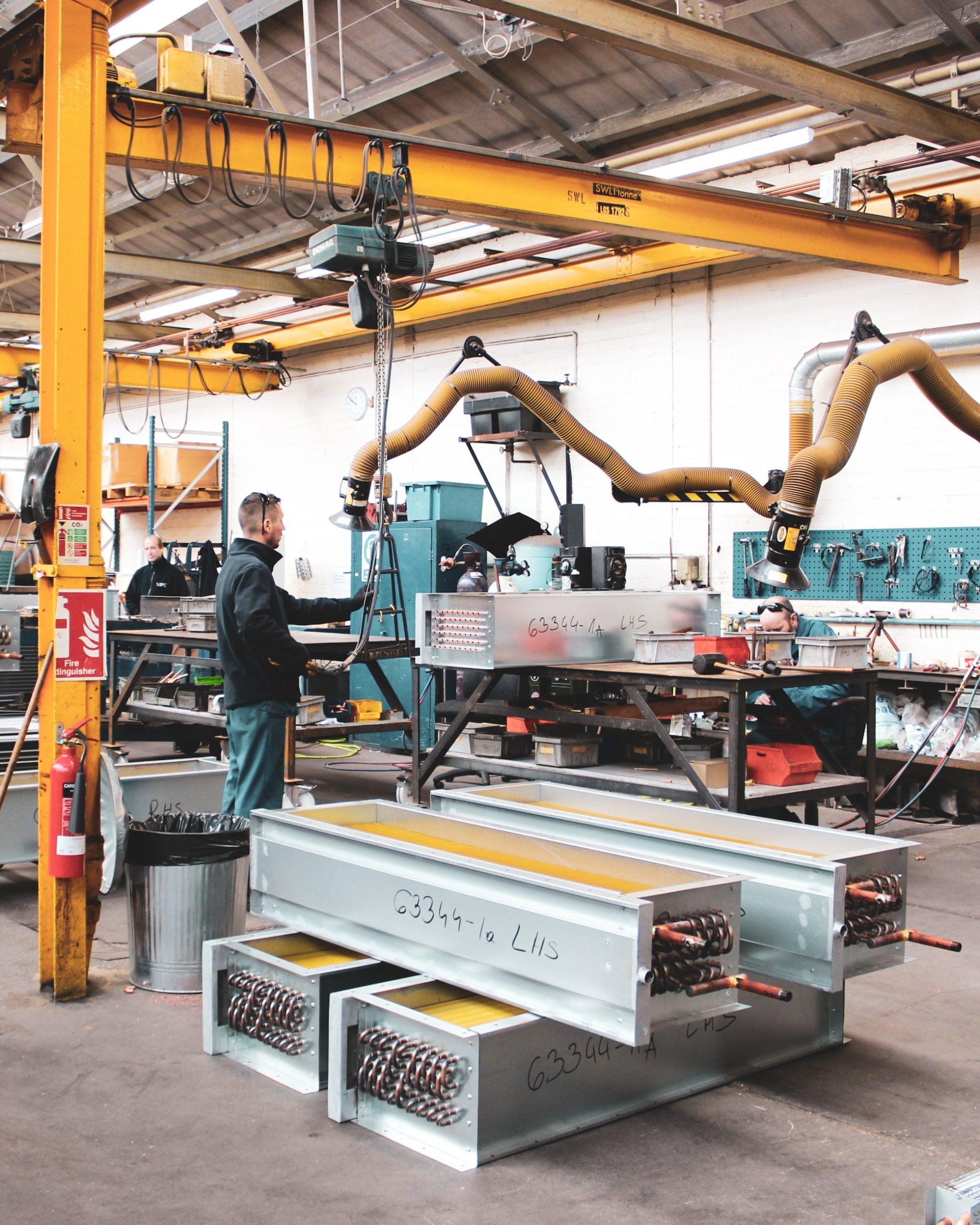
SPC has been manufacturing and supplying replacement coils from Leicester for over 50 years, supporting building owners, facilities managers, and mechanical contractors through the process from first inspection to delivery.
Why Do HVAC Coils Fail?
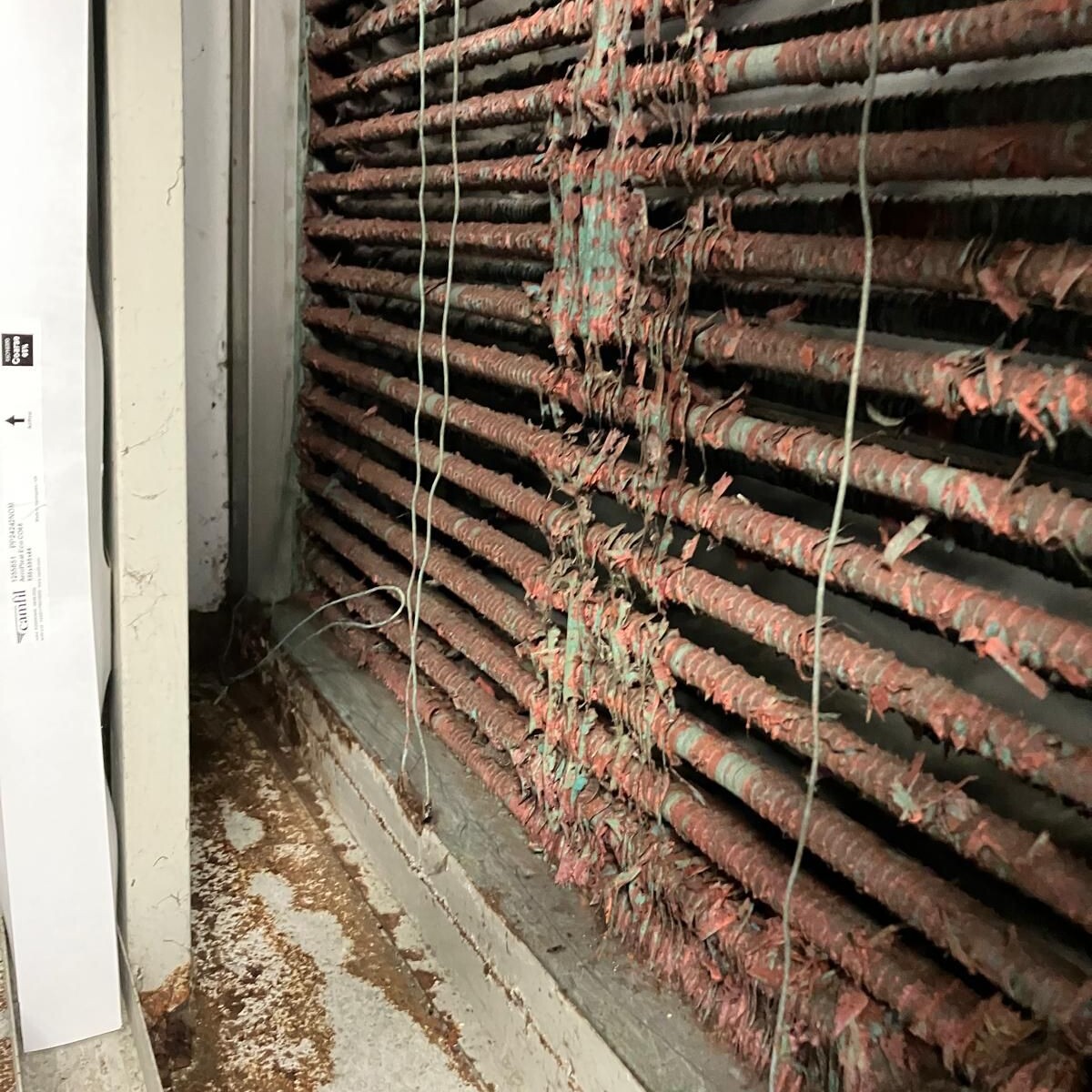
Freeze damage is one cause of coil failure, but it is far from the only one. In commercial buildings, coils fail for a range of reasons, and understanding the cause matters — both for specifying the right replacement and for avoiding a repeat failure.
Common causes include:
- Corrosion over time, particularly in coastal or industrial environments where airborne contaminants attack copper tubes and aluminium fins
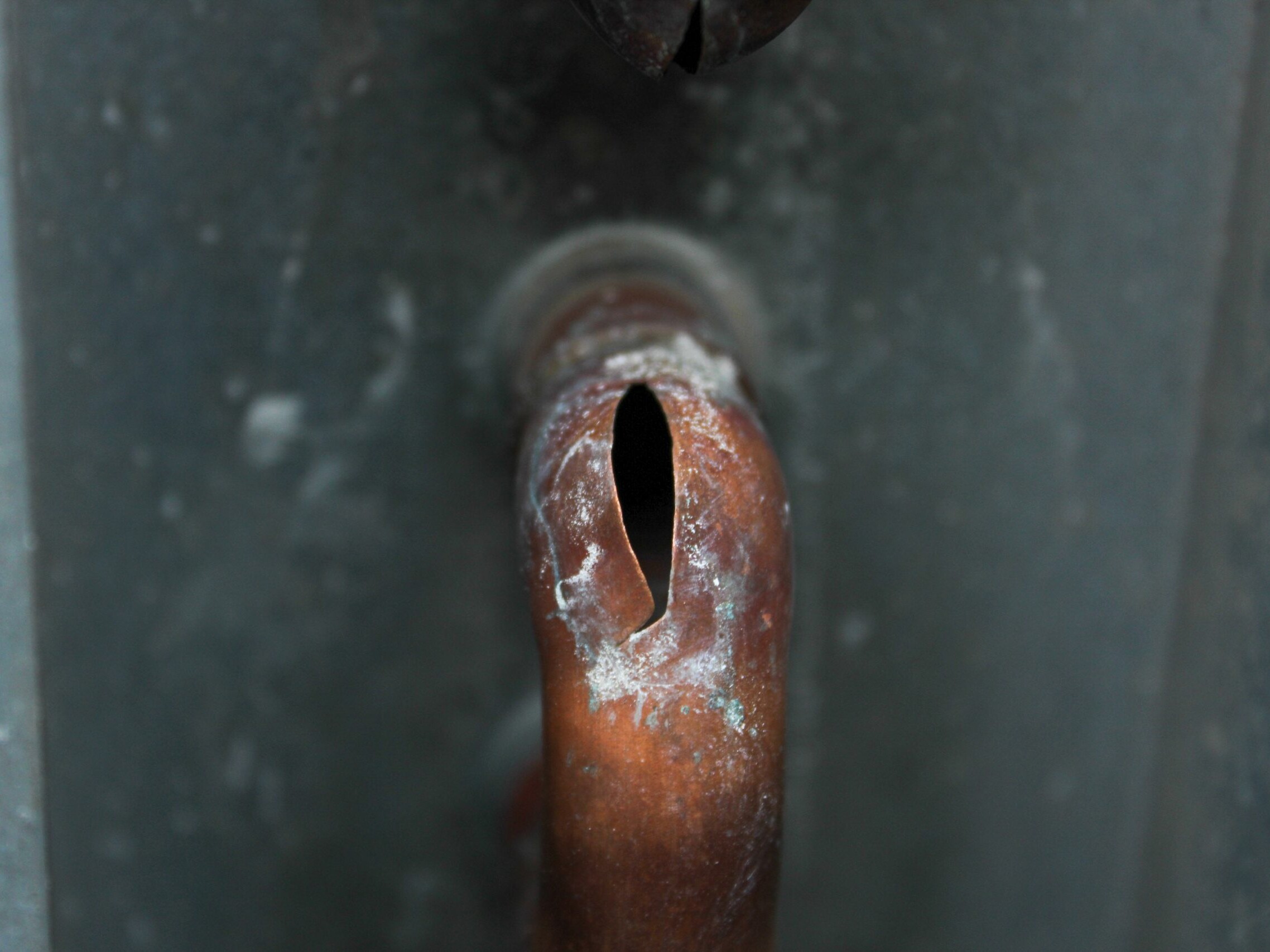
- Mechanical wear at joints and connections, which leads to gradual leaks that worsen under system pressure
- Age and material fatigue — coils have a finite service life, and units installed 15 or more years ago can simply reach the end of theirs
- Poor water quality, where untreated or poorly balanced system water accelerates internal corrosion
- Physical damage during maintenance or from debris in the airstream
A leaking coil will reduce heat transfer efficiency, risk water damage to surrounding plant and structure, and ultimately cause system downtime. The earlier a failing coil is identified and assessed, the simpler and less disruptive the replacement process tends to be.
What Does HVAC Coil Replacement Involve?
Replacing a coil in an active commercial building is not a straightforward swap from a catalogue. AHU casings vary significantly by manufacturer, age, and specification, which means a replacement coil must be engineered to fit the existing housing precisely. Getting this wrong creates air bypass around the coil, reduces efficiency, and can impose additional strain on pipework.
The replacement process typically follows four stages.
Site survey. An area sales manager or the technical team visits to inspect the failed coil, assess the condition of the surrounding system, identify any contributing factors to the failure, and take the precise measurements needed for manufacture. This is particularly important when the coil cannot be removed easily, or when the original manufacturer’s records are no longer available.
Specification and design. Using the survey data, a replacement coil is designed to match the original dimensions, row configuration, fin pitch, and pipework connections. Material selection is confirmed at this stage, including whether standard copper-and-aluminium construction is appropriate or whether enhanced corrosion protection is needed for the application.
Manufacture. The replacement coil is built to order. SPC manufactures coils at its Leicester facility, and each unit is pressure tested to 22 bar before despatch, in line with ISO 9001:2015 quality procedures.
Installation. Because the replacement coil has been manufactured to match the existing AHU housing precisely, on-site modifications are minimised, reducing installation time and disruption to the building.
Why Bespoke Manufacture Matters
An HVAC coil that fits incorrectly will never perform correctly. Even small dimensional variations can create air bypass channels that reduce effective heat transfer, meaning the new coil underperforms from day one. A bespoke approach eliminates this risk.
SPC manufactures replacement coils for AHUs from any manufacturer, not only those originally supplied by SPC. All that is required are the survey measurements and the application data, water temperatures, airflow rates, and required thermal output, to produce a coil that integrates correctly with the existing plant and meets the system’s performance requirements.
SPC's Replacement Coil Service
SPC’s Area Sales Managers carry out site surveys across the UK, working alongside facilities teams and mechanical contractors to scope replacement coil projects. Recent surveys have included commercial retail environments, where failed coils have affected heating and cooling across large public-facing buildings.
The full range of coil types SPC manufactures for replacement projects includes water coils (heating and cooling), steam coils, DX refrigerant coils, runaround coils, and electric heater batteries.
For building services professionals seeking to understand coil selection and heat transfer principles in more depth, SPC offers a CIBSE-approved CPD session, An Introduction to Coil Heat Exchangers, available free of charge to architects, mechanical consultants, and contractors.
For guidance on planned preventive maintenance schedules for air handling units and associated heat exchangers, CIBSE Guide B provides a recognised industry reference for building services engineers.
Frequently Asked Questions
Service life depends on the application, water quality, and maintenance regime, but many coils in commercial AHUs last between 15 and 25 years. Coils in coastal, industrial, or high-humidity environments may degrade faster due to increased corrosion exposure.
Yes. SPC manufactures replacement coils for AHUs from any manufacturer. The site survey process captures all the information needed to produce a correctly specified replacement, regardless of who made the original.
For most commercial replacements, a site survey is strongly recommended. It ensures the replacement coil is manufactured to the correct dimensions and specification, reducing the risk of installation problems and the cost of re-work.
Lead times depend on the coil type and complexity. Where a failure has caused urgent downtime, SPC’s team can advise on the fastest available route. Contact the team to discuss your timeline.
Contact SPC for Coil Replacement Support
If an HVAC coil is leaking or has failed, SPC’s team can help with a site survey and bespoke replacement.
What Type of Heating Is Best for an Industrial Warehouse or Facility?
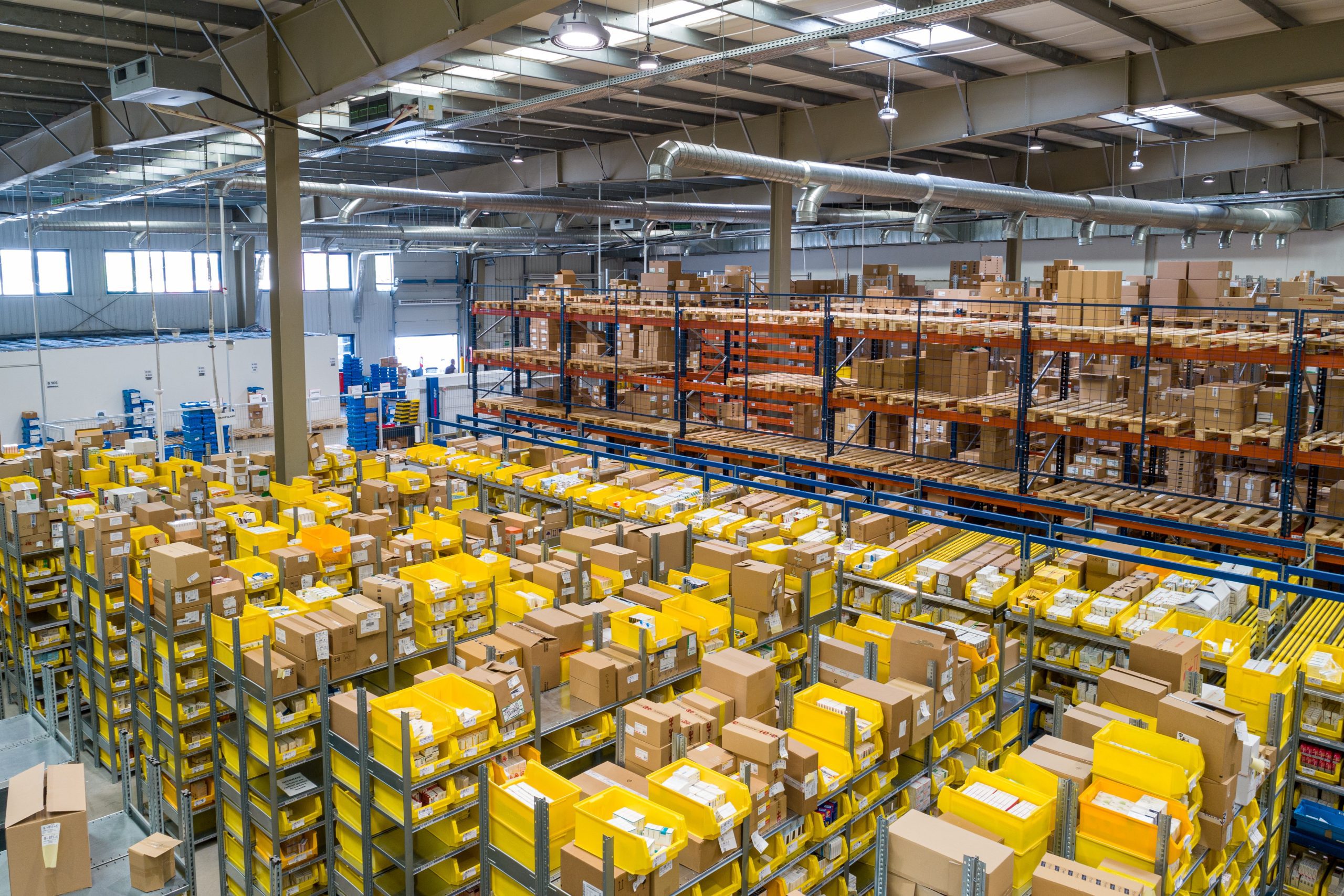
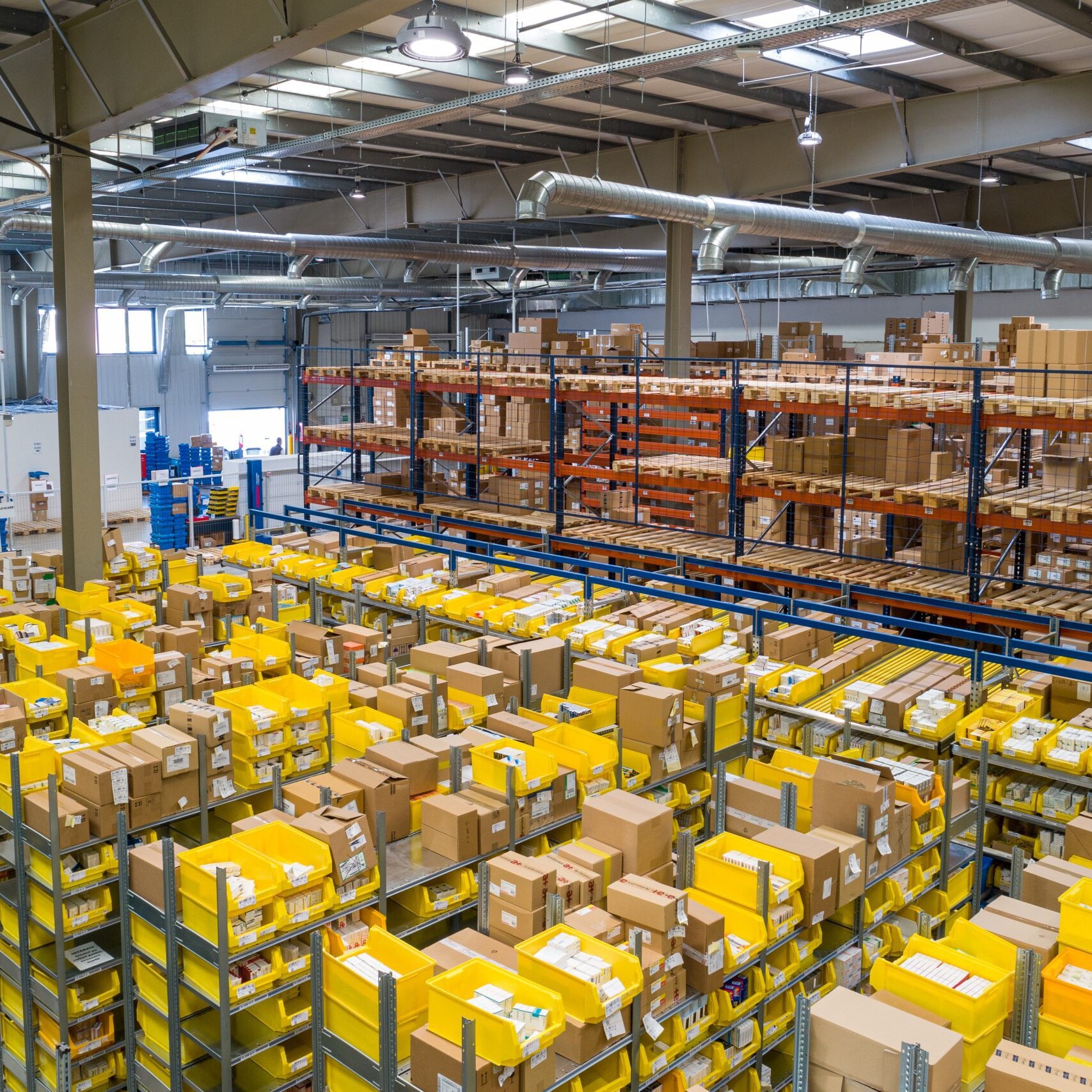
Choosing the right industrial warehouse heating system depends on ceiling height, occupancy pattern, energy source, and whether the building needs to meet future low-carbon targets. The most commonly specified solutions for UK industrial buildings are unit heaters and radiant panels, and understanding the difference between them is the most important decision a specifier or facilities manager will make at the design stage.
SPC (S & P Coil Products Limited), a Leicester-based manufacturer with over 50 years of experience and ISO 9001:2015 certification, produces both product types and supports specifiers across the full design and specification process.
What Are the Main Options for Industrial Warehouse Heating?
Two product types dominate industrial heating specifications in the UK.
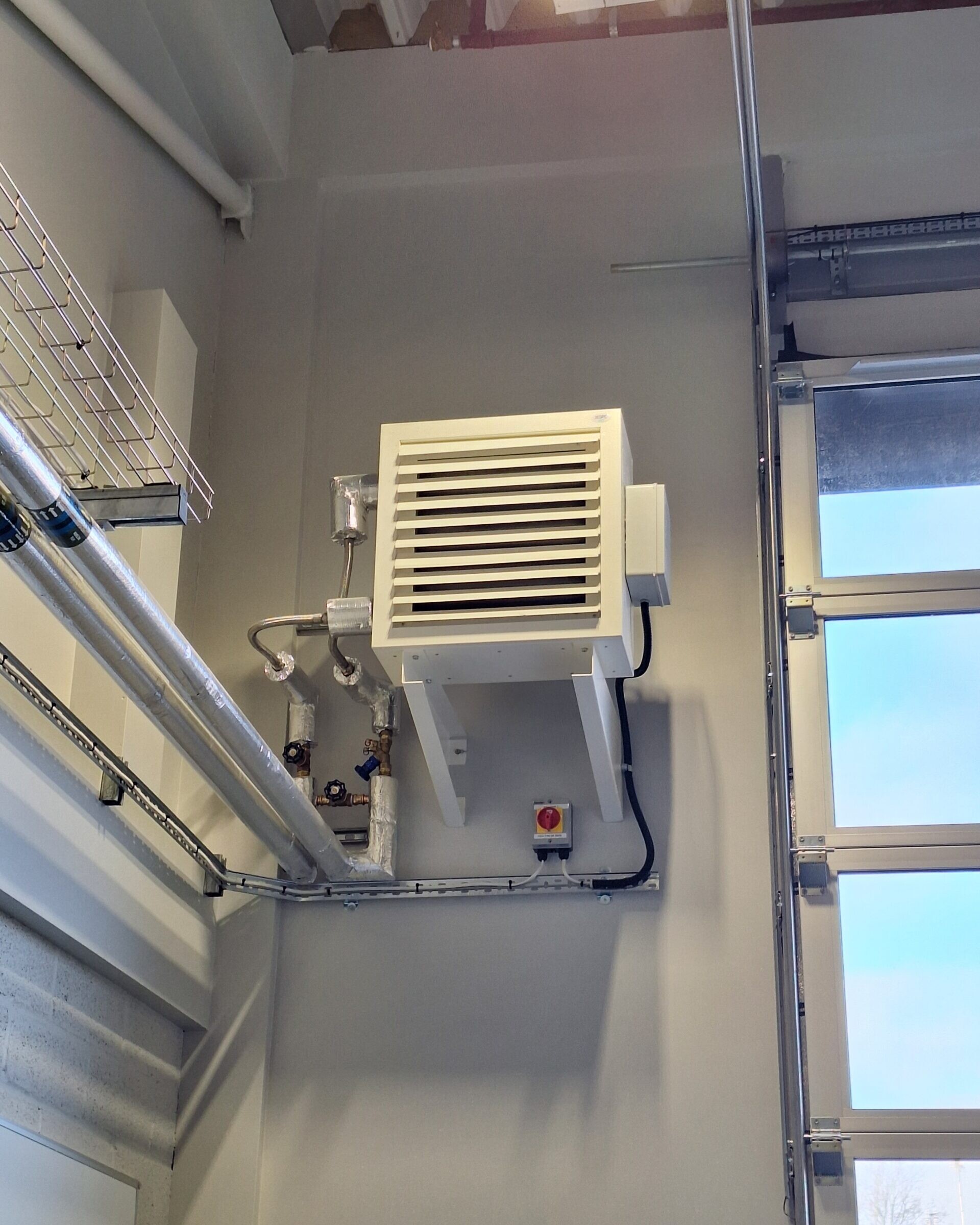
Unit heaters use an axial fan to distribute warm air across a large area from a wall or ceiling-mounted position. Unit heaters respond quickly, cover large floor areas from a single unit, and are straightforward to commission and control. SPC’s CiRRUS Unit Heaters are a widely specified example, with outputs up to 50.9kW and throw distances up to 27 metres.
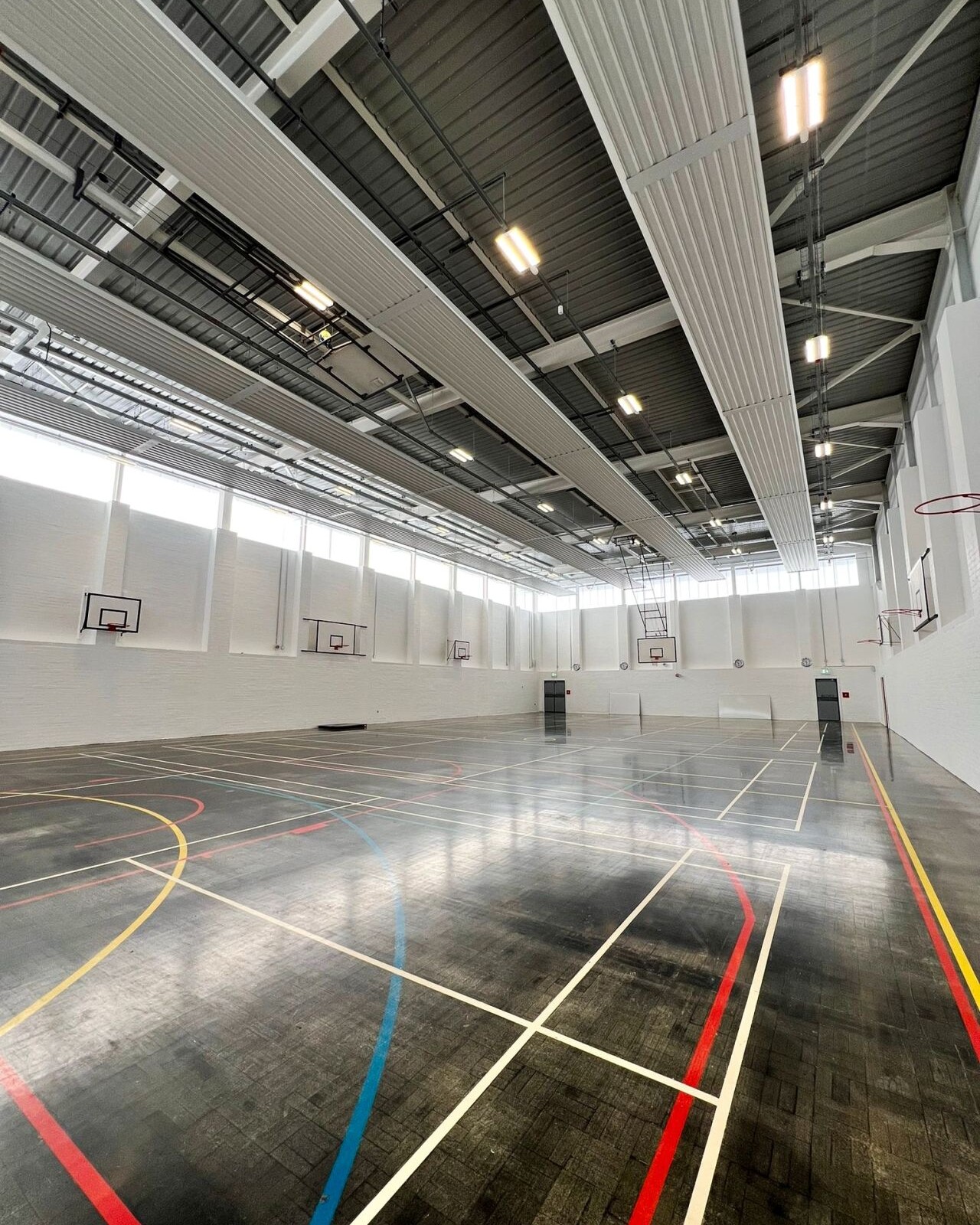
Radiant panels heat occupants and surfaces directly through infrared radiation rather than heating the air. Radiant panels operate silently, with no fan or air movement, and are particularly effective in large, draughty spaces where heated air would be lost rapidly. SPC manufactures a range of industrial radiant panels designed for high-bay and varying ceiling height applications.
Both product types are available in LPHW (low pressure hot water) versions compatible with heat pump systems.

When Should You Specify Unit Heaters for an Industrial Building?
Unit heaters are typically the right choice when:
- The space needs to reach temperature quickly at the start of the working day
- Heating is intermittent rather than continuous
- Budget or installation constraints favour a simpler system with fewer distribution points
- The building has variable occupancy or zoned heating requirements
CiRRUS Unit Heaters are wall or ceiling mounted, require no floor space, and can be commissioned with BMS control via 0-10V or BACnet. For workshops, service bays, and distribution centres with high traffic through loading bay areas, they are a practical, high-output solution.
When Should You Specify Radiant Panels for an Industrial Warehouse?
Industrial radiant panels are typically the better choice when:
- The building is frequently ventilated or has large openings, where heat loss through air movement is a factor
- Continuous background heating is more efficient than intermittent operation
- Silent operation is a requirement
- The building is targeting net zero and a heat pump is part of the energy strategy
- Occupant comfort at low ambient temperatures is a priority
SPC’s industrial radiant panels are practical for large floor areas without excessive pipework. The range covers high-bay and mid-height applications, with appropriate panel configurations available depending on ceiling height and building type.
Are Industrial Radiant Panels Compatible with Heat Pumps?
Yes, where the system is designed with the right flow temperatures. Radiant panels are among the most heat-pump-compatible emitter types available for industrial applications. Because they rely on surface radiation rather than convective air heating, they can deliver effective comfort at lower water temperatures, which is precisely the condition under which heat pumps operate most efficiently.
Unit heaters can also be used with heat pumps, but their performance is more sensitive to water temperature reduction. At low-temperature outputs, a unit heater’s thermal output drops more significantly than a radiant panel’s, which is worth accounting for at the design stage.
What Is the Best Industrial Warehouse Heating System for Net Zero Compliance?
For warehouses and industrial facilities with decarbonisation targets, the typical specification direction is a heat pump as the energy source with radiant panels as the emitter. This combination works because radiant panels deliver meaningful comfort at flow temperatures that a heat pump can sustain efficiently. SPC’s industrial radiant panel range covers high-bay and mid-height industrial buildings, and the right configuration for a given project can be confirmed with the SPC technical team.
SPC also offers the Decarbonisation of Industrial and Commercial Heating Systems CPD, a CIBSE-approved session covering heat pump integration, low-temperature emitter design, and embodied carbon assessment aligned with the CIBSE TM65 methodology. The CPD is available to architects, mechanical consultants, and contractors. Book your CPD session today!
Frequently Asked Questions
SPC’s CiRRUS Unit Heaters deliver outputs up to 50.9kW (Ci8, 3-row coil, 82/71°C). They are available in four sizes (Ci5 to Ci8) and can cover floor areas up to 25 x 25 metres per unit at high fan speed.
Yes. This is actually one of the strongest arguments for radiant heating in industrial environments. Because radiant panels heat occupants and surfaces directly rather than heating the air, the comfort effect is less disrupted by air movement or infiltration through open doors. A unit heater in the same scenario would lose its heated air rapidly.
SPC’s industrial radiant panel range covers both high-bay and mid-height applications. The appropriate panel configuration depends on ceiling height, building type, and heating load. The SPC technical team can advise on the right specification for a given project — contact 0116 249 0044 or spc@spc-hvac.co.uk.
CiRRUS Unit Heaters support BMS integration via 0-10V signal or BACnet, allowing full remote control of fan speed and waterside modulating valves. Manual rocker switches and local thermostatic control are also available.
Yes, and for some industrial buildings this is the optimal approach — for example, radiant panels for the main floor area with unit heaters in loading bay or reception areas where rapid response is needed. SPC can support specification across both product ranges.
Talk to SPC About Your Warehouse Heating Project
Contact SPC to discuss the right industrial warehouse heating solution for your project.
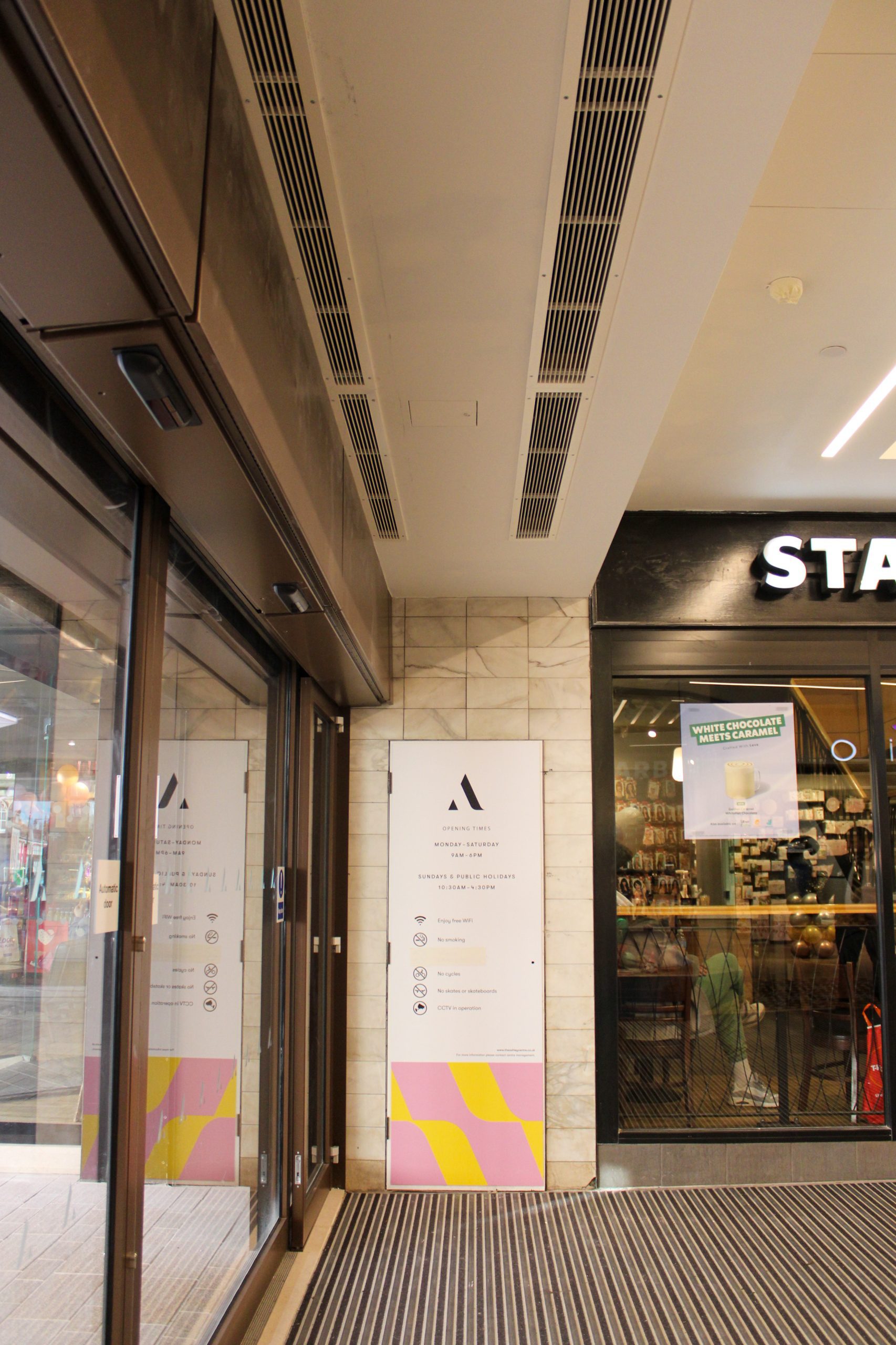
How Air Curtains Improve Comfort and Reduce Energy Loss in Commercial Spaces
Air curtains improve comfort and reduce energy loss at commercial entrances by projecting a controlled stream of high-velocity air across the full width of a doorway, creating an invisible barrier between inside and outside. For building services engineers and facilities managers specifying commercial entrances in schools, healthcare facilities, retail centres, and visitor attractions, an air curtain is often the most practical solution for maintaining internal conditions without restricting access or requiring a physical lobby.
This article explains how air curtains achieve this, what the comfort and energy benefits are in practice, and how the AIRDOR Forcefield range has been specified on commercial and public sector projects across the UK.
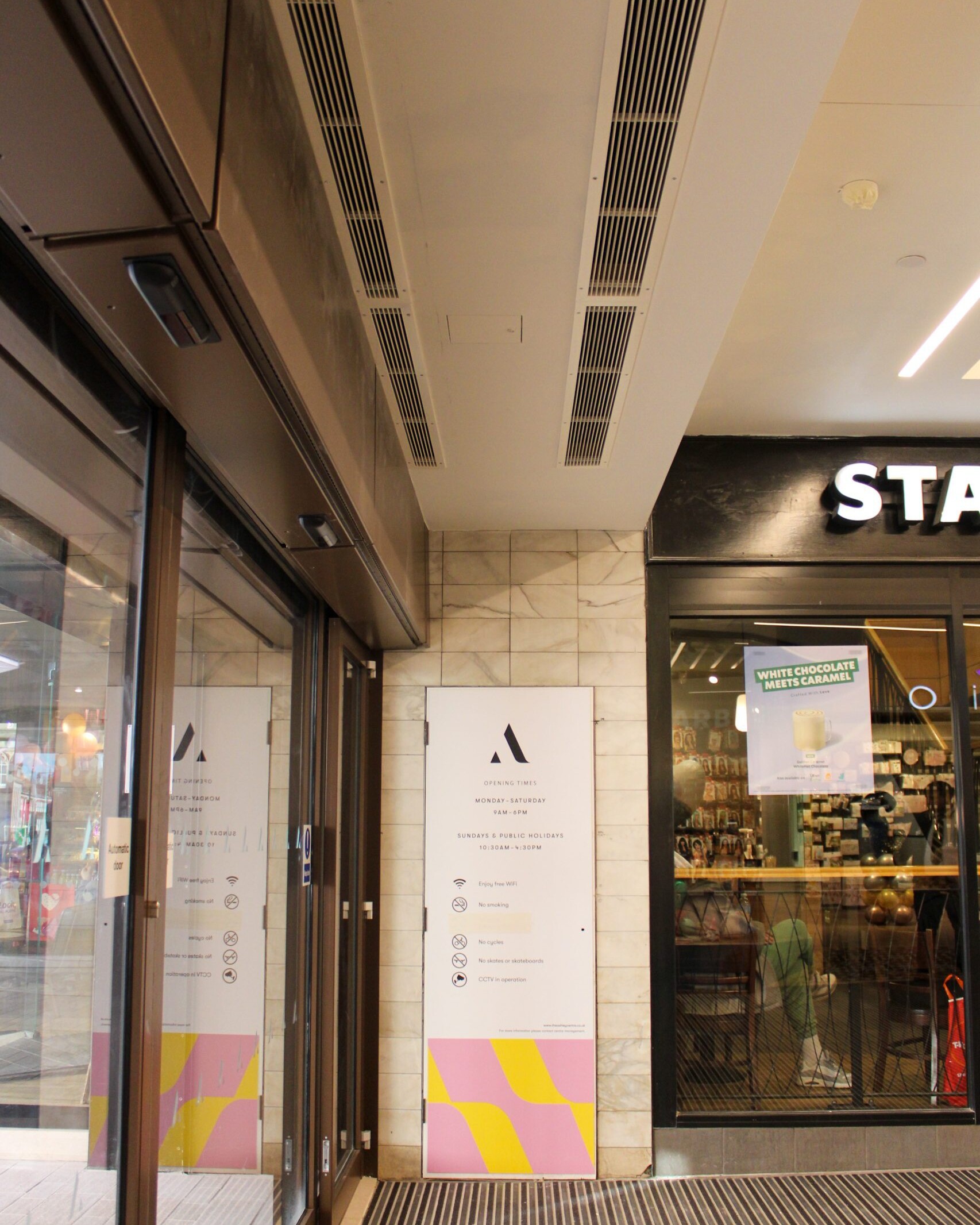
Why Commercial Entrances Lose So Much Energy
Commercial buildings with high-footfall entrances face a consistent problem: every time a door opens, a volume of conditioned air escapes and external air enters. In buildings with automatic sliding or swing doors (shopping centres, hospital receptions, school main entrances, visitor attractions), the door may be open for a significant proportion of the working day. This continuous exchange of air places a direct load on the heating or cooling system, increases energy consumption, and creates uncomfortable draughts in the entrance zone that affect staff and visitors near the door.
Draught lobbies and vestibules solve this architecturally, but they are not always possible in refurbishment projects, heritage buildings, or spaces where the footprint cannot accommodate a secondary entrance structure. Air curtains solve the problem without structural modification.
How Air Curtains Create An Effective Barrier
An air curtain works by directing a high-velocity jet of air downward across the full width of the opening, from the unit mounted above the doorway to floor level. This air jet disrupts the natural exchange of air that would otherwise occur when the door is open, significantly reducing the volume of conditioned air that escapes and the volume of external air that enters.
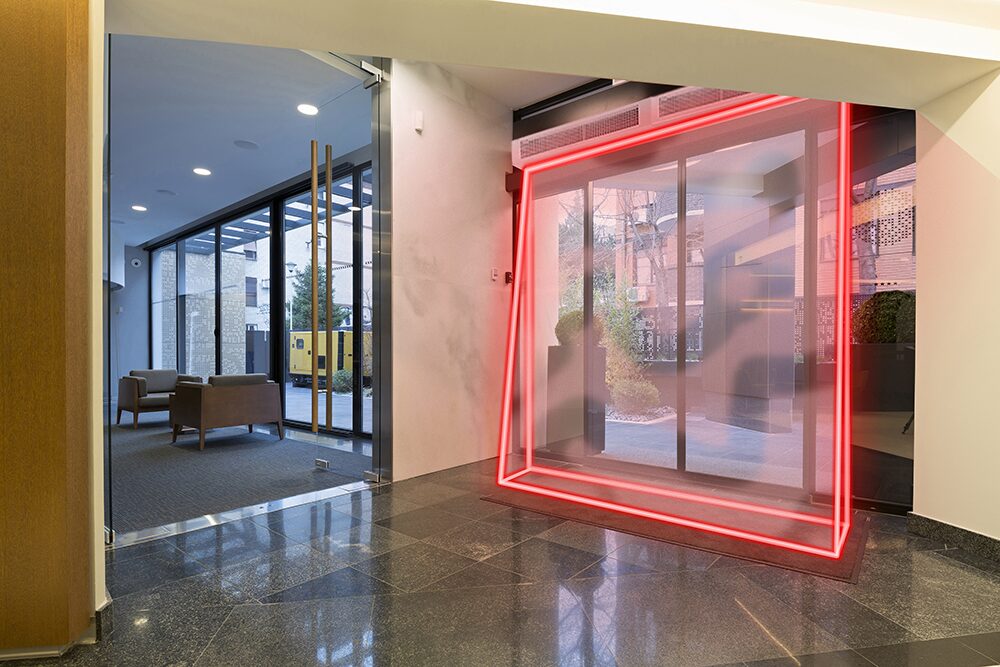
The AIRDOR Forcefield range uses EC (electronically commutated) motors as standard across all units. EC motors offer continuous, variable-speed controllability via a 0-10V DC signal, and run at significantly lower wattage than equivalent AC motors at the same airflow. Units can be connected to door contactors with delay relays so the air curtain operates only when the doorway is open, avoiding unnecessary energy use during closed periods.
For spaces where the internal heating system operates at low flow temperatures, including buildings served by heat pumps or condensing boilers, LPHW Forcefield units are available with enhanced heat exchangers that maintain effective thermal performance at low water temperatures. This makes Forcefield a practical specification for heat pump-compatible building services designs.
Comfort Benefits Beyond Thermal Management
In addition to reducing heat loss, air curtains improve occupant comfort in several ways that are particularly relevant in commercial and public sector buildings.
The air barrier prevents cold draughts from reaching staff and visitors in the entrance zone. In retail environments, this affects the experience of shoppers immediately inside the entrance. In schools and healthcare facilities, it protects occupants near reception areas who might otherwise be exposed to repeated blasts of cold external air during busy periods.
Air curtains also prevent the ingress of insects, airborne dust, and odours through open doors. This is a specification consideration in food service environments, healthcare buildings where infection control is a priority, and visitor attractions where maintaining air quality affects both comfort and the preservation of exhibits or collections.
Projects Where Forcefield Has Been Specified
The AIRDOR Forcefield has been used across a range of commercial, education, heritage, and healthcare applications.
The Ashley Centre, Epsom
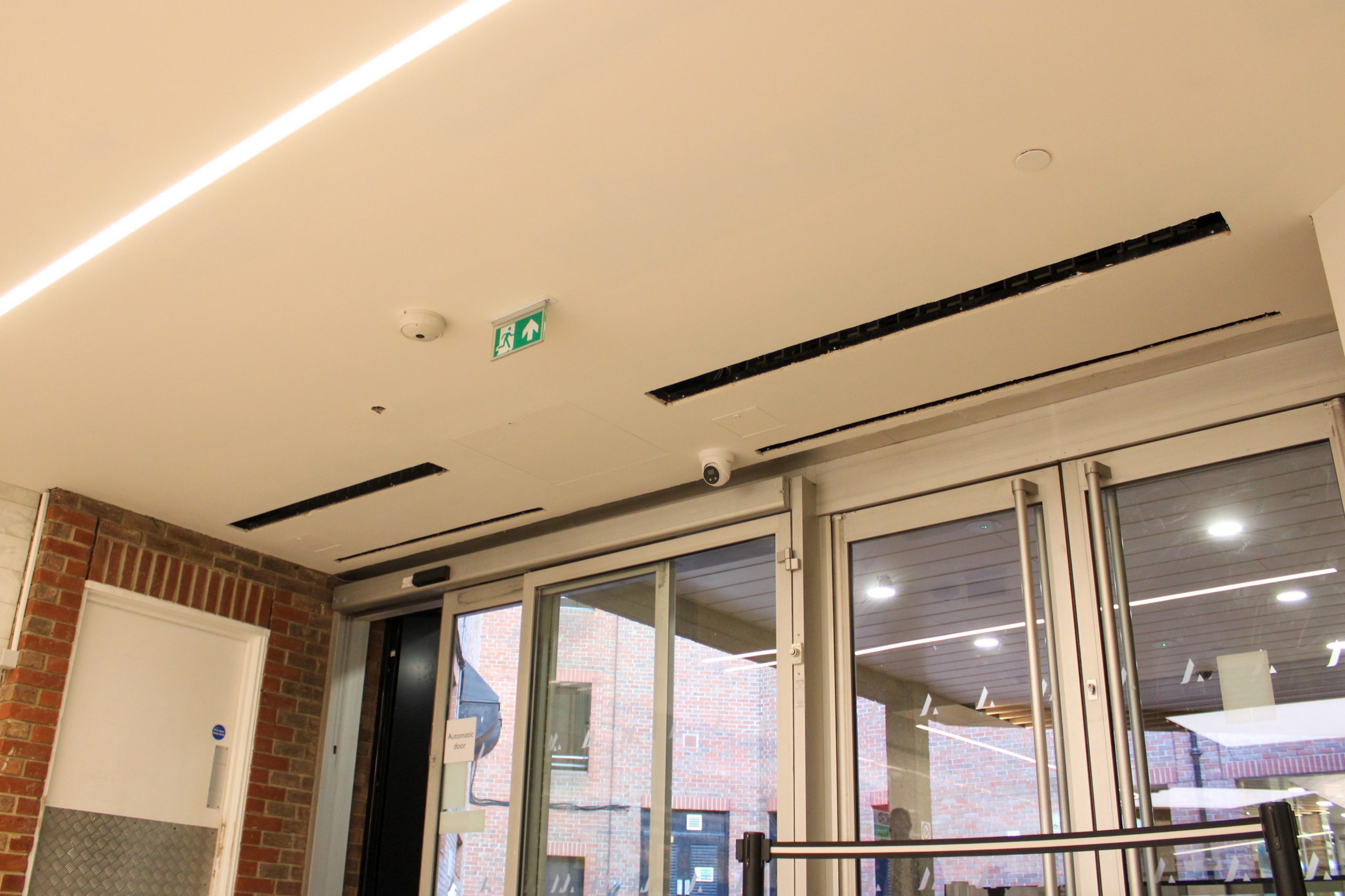
At the Ashley Centre in Epsom, concealed Forcefield electric units with plasterboard room inlets were installed across multiple entrance points at the shopping centre. The mix of 1m, 1.5m, and 2m units was selected to match each entrance width, with the concealed installation ensuring the units integrated cleanly with the centre’s interior.
Claverham Community College, Battle
At Claverham Community College in Battle, East Sussex, four 2m LPHW Forcefield units were installed at the college’s main entrances. The units were specified with air on 15°C and water at 80/60°C, a standard selection basis for an educational building with a conventional hot water system. Installation was carried out by Derry Building Services, with Bowmer + Kirkland as main contractor.
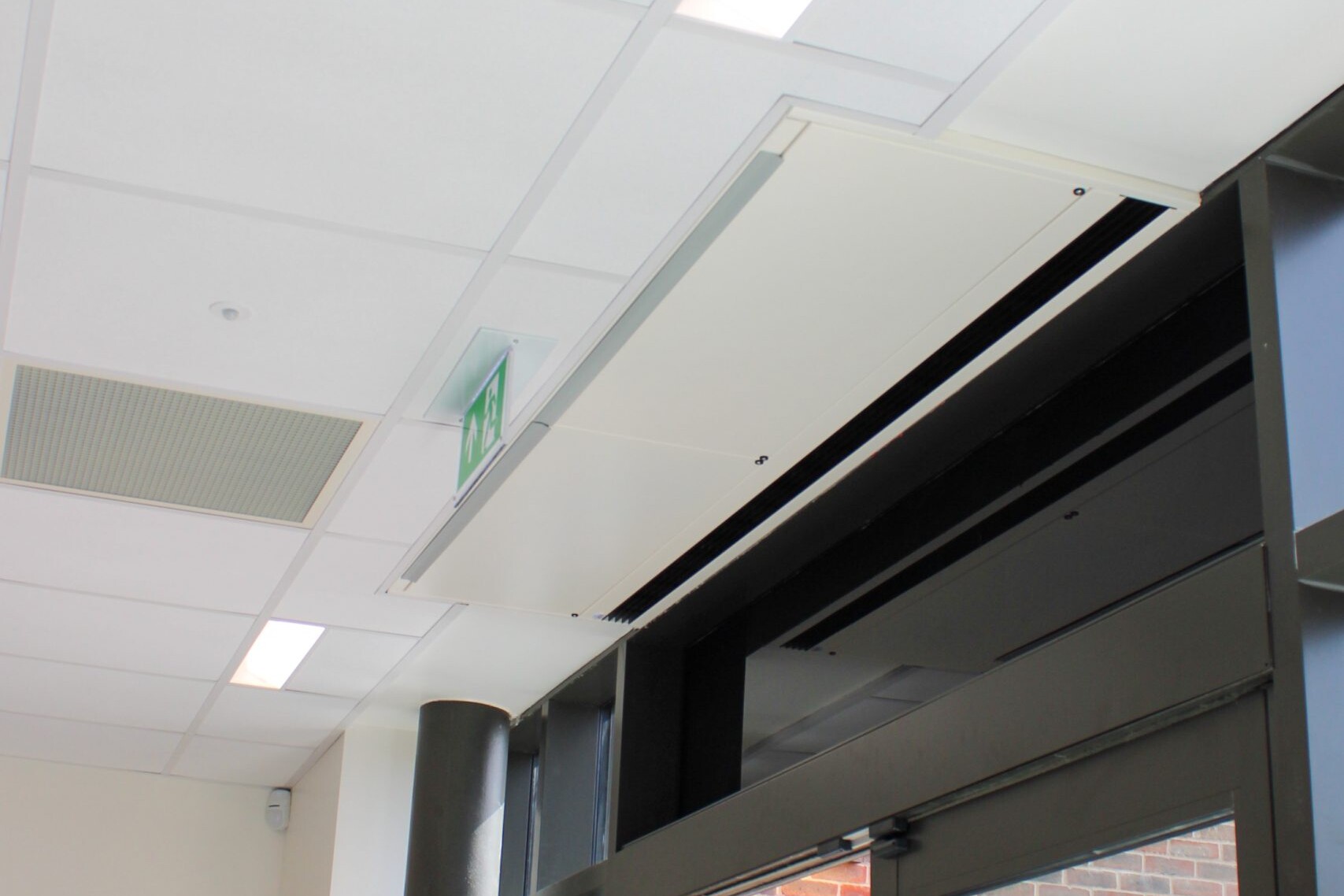
Greater Manchester Fire Station Museum, Manchester
At the Greater Manchester Fire Station Museum (Fireground) in Manchester, three ceiling-mounted Forcefield units were supplied across the primary museum entrance, secondary museum entrance, and café entrance. The project used a mix of electric and LPHW models to suit the available heat source at each location, with BMS integration and EC motor control across all three units.
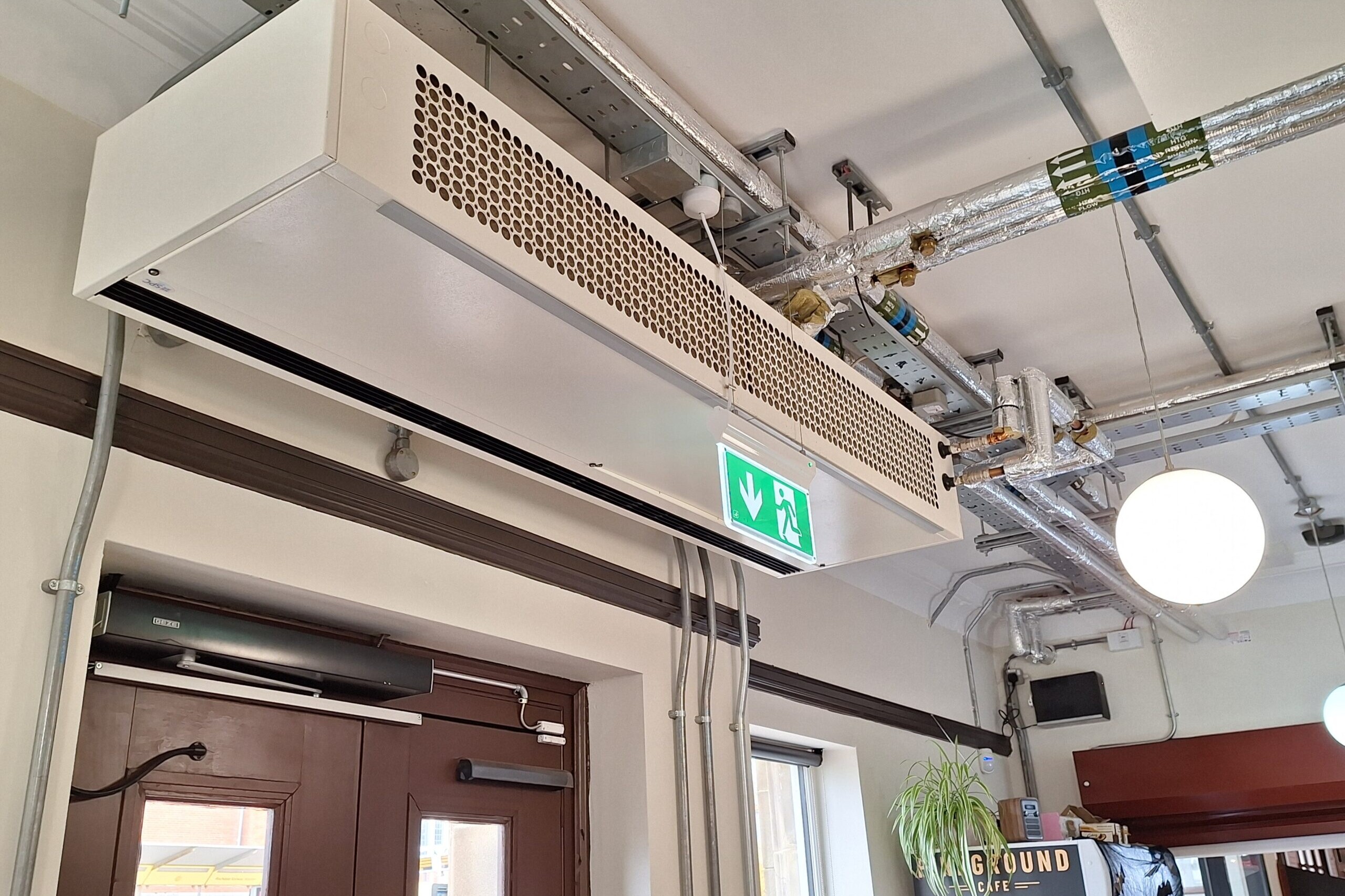
St Anne's Hospice, North West
At St Anne’s Hospice in the North West, a recessed T-bar ambient Forcefield unit was installed to improve thermal separation at the entrance without requiring a heated unit. The ECM motor and clean RAL 9010 finish were specified to match the clinical aesthetic of the healthcare environment.
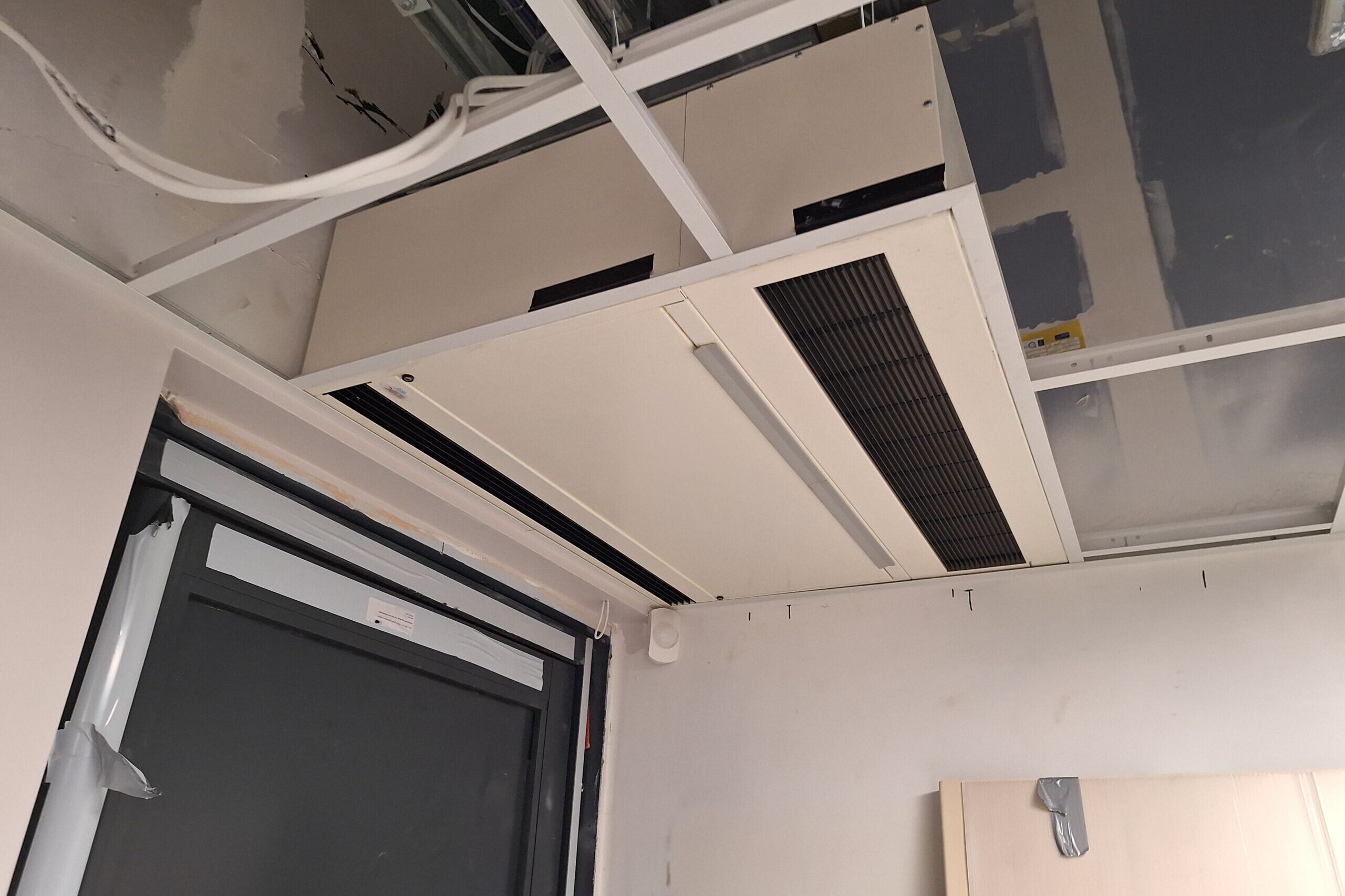
When To Specify The iForce For Larger Openings
The AIRDOR Forcefield is designed for commercial building entrances up to 3.5 metres high. For industrial and large commercial openings up to 6 metres, the iForce Industrial Air Curtain provides the same thermal separation at a larger scale, with LPHW outputs up to 69.6kW on the 2.5m unit and electric options available where hot water is not accessible. The iForce is used in warehouses, distribution centres, food processing facilities, and large public buildings where the door height exceeds the Forcefield’s range.
For more information on choosing between horizontal and vertical mounting configurations for your project, see our guide to vertical vs horizontal air curtains.

Frequently Asked Questions
Yes. AIRDOR Forcefield units can be connected to door contactors with delay relays, so the unit activates when the door opens and continues running briefly after the door closes. This ensures the air curtain is only operating when the opening is active, avoiding unnecessary energy use during closed periods. The delay relay prevents rapid cycling on busy entrances where the door opens and closes frequently.
The unit length should match the width of the door opening as closely as possible, undersizing leaves part of the opening unprotected. The Forcefield range is available in lengths from 600mm to 2,000mm; for wider openings, multiple units can be placed side by side. The selection also depends on mounting height (the Forcefield covers 1.8m to 3.5m) and whether a heated or ambient unit is required. SPC’s technical team can provide selection support based on your door dimensions, mounting height, and heat source.
Yes. LPHW Forcefield units are available with enhanced heat exchangers suited to low flow temperature operation, including systems served by heat pumps or condensing boilers. For standard LPHW selection, the Forcefield is typically sized at 80/60°C or 80/70°C water temperatures. For heat pump systems operating at lower flow temperatures, contact SPC’s technical team for selection advice to ensure the unit achieves the required thermal output.
Yes. Concealed and recessed Forcefield configurations allow units to be installed with minimal visual impact, flush with a plasterboard ceiling or integrated into a T-bar grid. At the Greater Manchester Fire Station Museum, three ceiling-mounted units were installed across the public entrance points of a 1933 listed building without structural modification. Custom RAL finishes are also available where a specific colour match is required.
An ambient air curtain has no heat exchanger; it projects room-temperature air across the opening. It provides an effective barrier against draughts, insects, and external air infiltration, but adds no heat to the airstream. A heated air curtain (electric or LPHW) warms the air before it is discharged, which offsets heat loss at the door and maintains comfort in the entrance zone during cold weather. The ambient version is suitable for year-round use in conditioned buildings where entrance temperatures are already maintained by the building’s primary heating system. Where the entrance zone is subject to significant cold weather exposure, a heated unit is generally the better specification.
Specifying the AIRDOR Forcefield Air Curtain
The Forcefield range is available in ambient (no heat), electric, and LPHW variants, in lengths from 600mm to 2,000mm. Mounting height range is 1.8m to 3.5m. All units use EC motors with 0-10V DC control and are available in textured RAL 9010 white as standard, with custom finishes available to order.
Standard accessories include washable air filters, low-temperature cut-out thermostats, BMS interface modules, remote switches, and connection boxes. Enhanced heat exchangers for low-flow and heat pump systems are available on LPHW units.
View the full AIRDOR Forcefield range
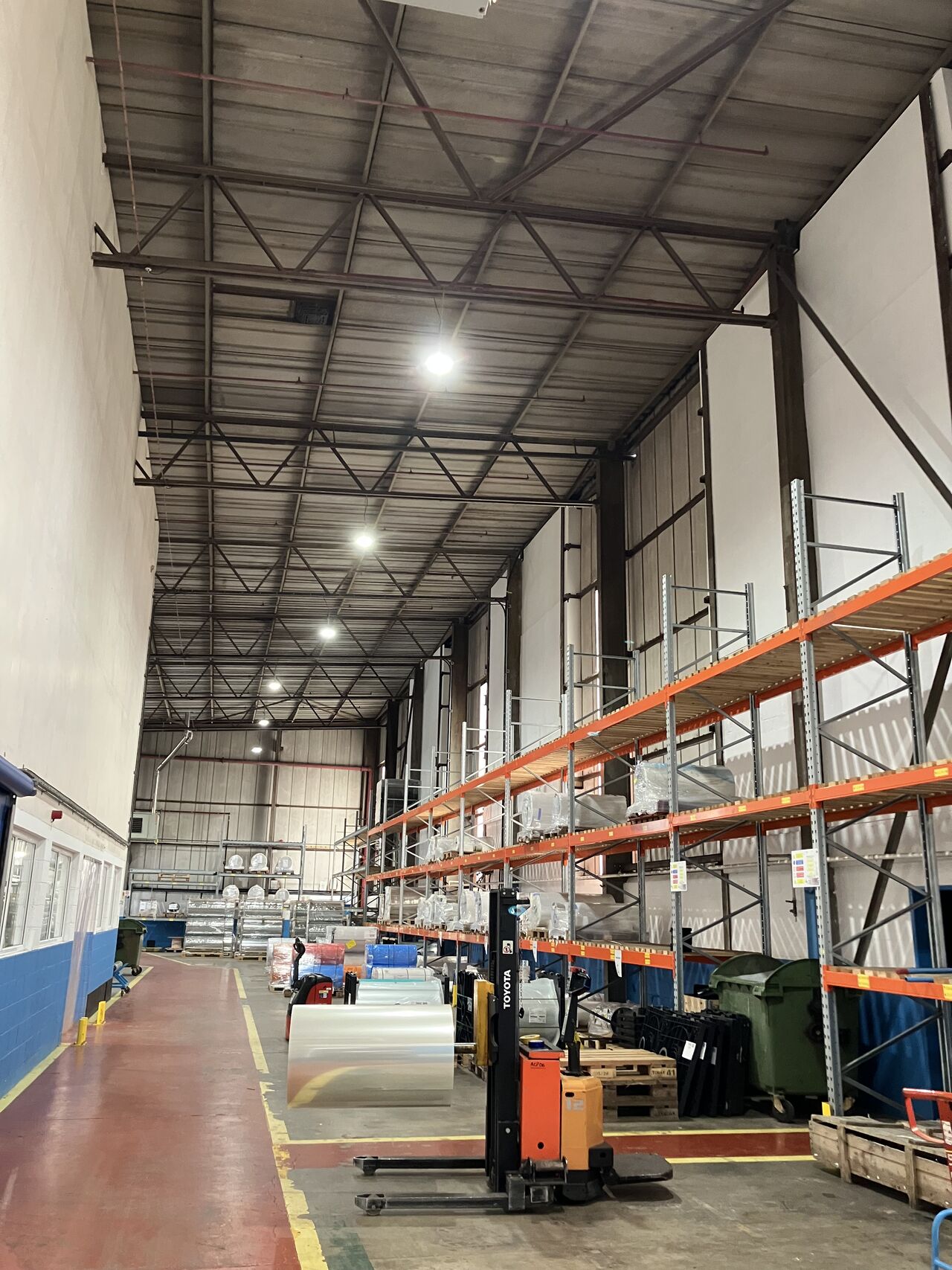
Why Are Radiant Panels Increasingly Specified for Industrial Heating?
Industrial radiant heating panels are increasingly the preferred choice for warehouses, factories, and large commercial spaces, particularly where buildings are targeting low-carbon heating systems or working towards net zero. Unlike unit heaters, radiant panels heat occupants and surfaces directly through infrared radiation rather than warming the air, making them well-suited to draughty, high-bay environments where heated air would otherwise be quickly lost to ventilation or door openings.
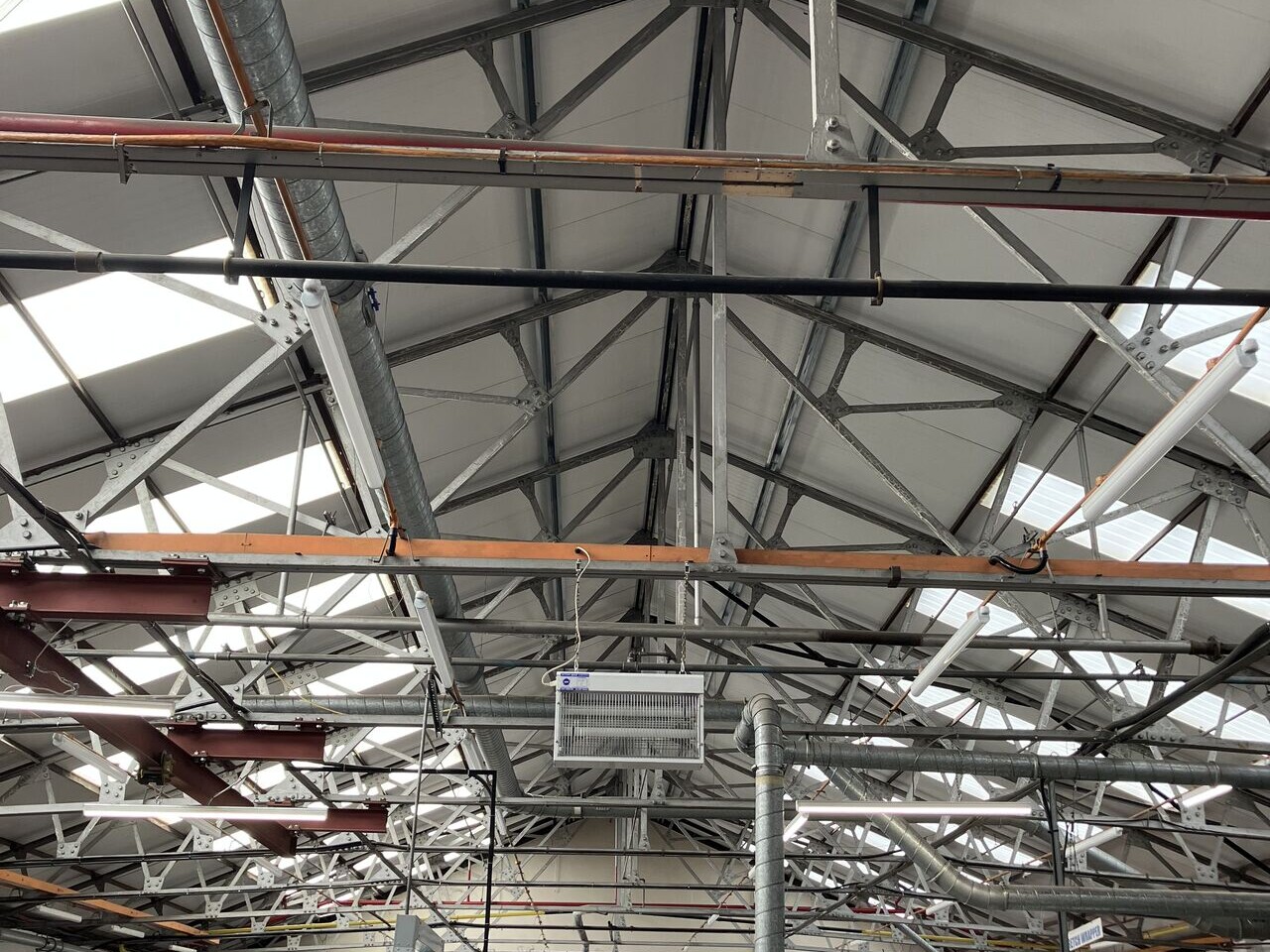
How Do Industrial Radiant Panels Work?
Radiant panels transfer heat through infrared radiation from the panel surface to occupants, floors, machinery, and other surfaces within range. No fan is required, and no air is moved. The heat is felt directly, in the same way that sunlight warms you on a cold day even when the air temperature is low.
This mechanism has practical advantages in industrial buildings:
- Heat is not lost through air movement, ventilation, or frequent door openings
- Comfort is maintained even in large, open spaces with high ceilings
- Silent operation — no fan noise in working environments
- No circulation of dust or airborne particles
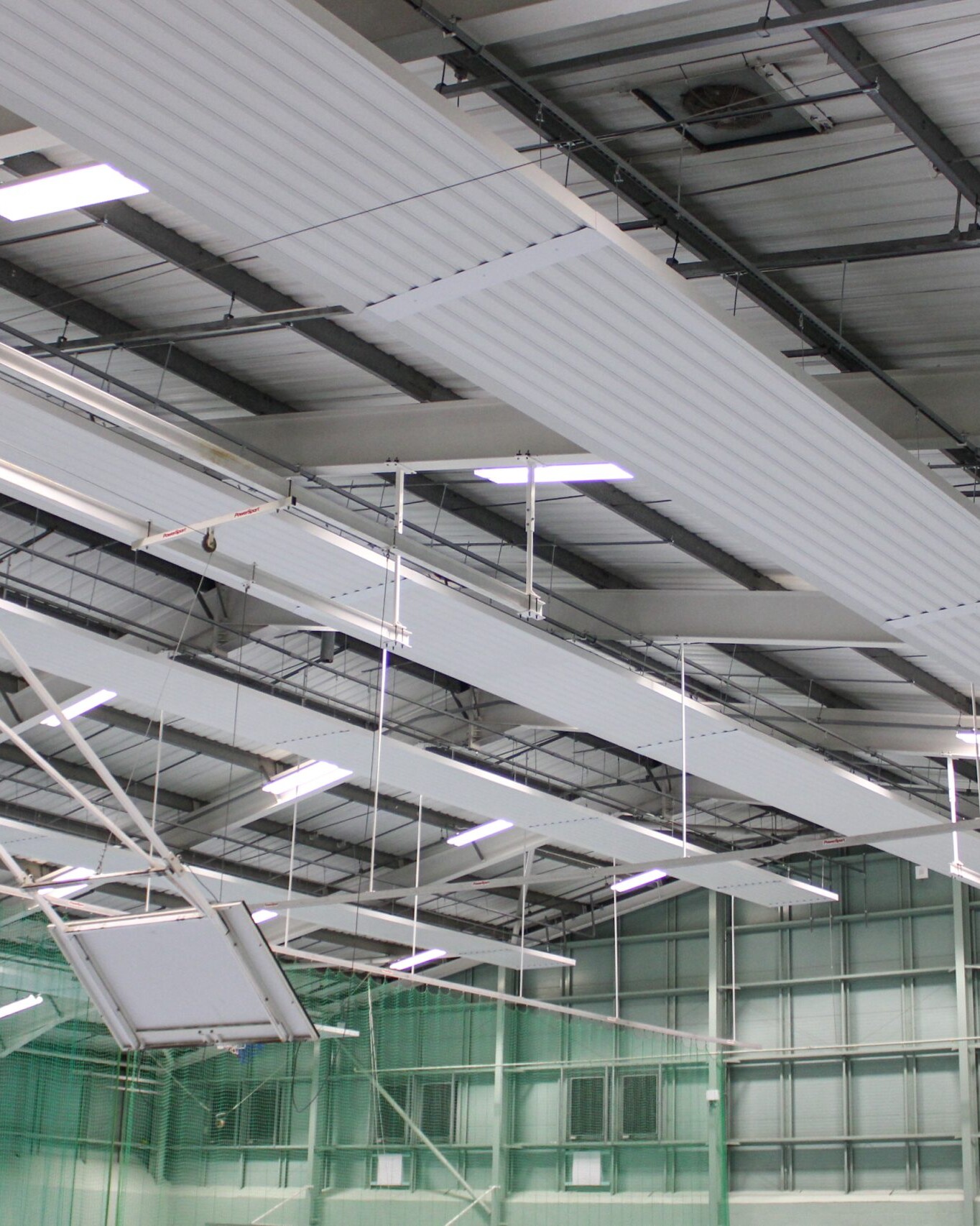
What Makes Radiant Panels Well-Suited to Large Industrial Spaces?
In a conventionally air-heated industrial building, warm air rises. In a warehouse with an 8 or 10-metre ceiling, a significant proportion of the energy input ends up at roof level rather than in the occupied zone. Radiant panels address this directly: because the heat transfer is radiative rather than convective, it reaches the space and occupants below rather than accumulating at roof level.
For large-footprint buildings, SPC’s industrial radiant panel range supports pipe runs of up to 70 metres from a single connection point, reducing the number of distribution circuits required and simplifying the overall system design.
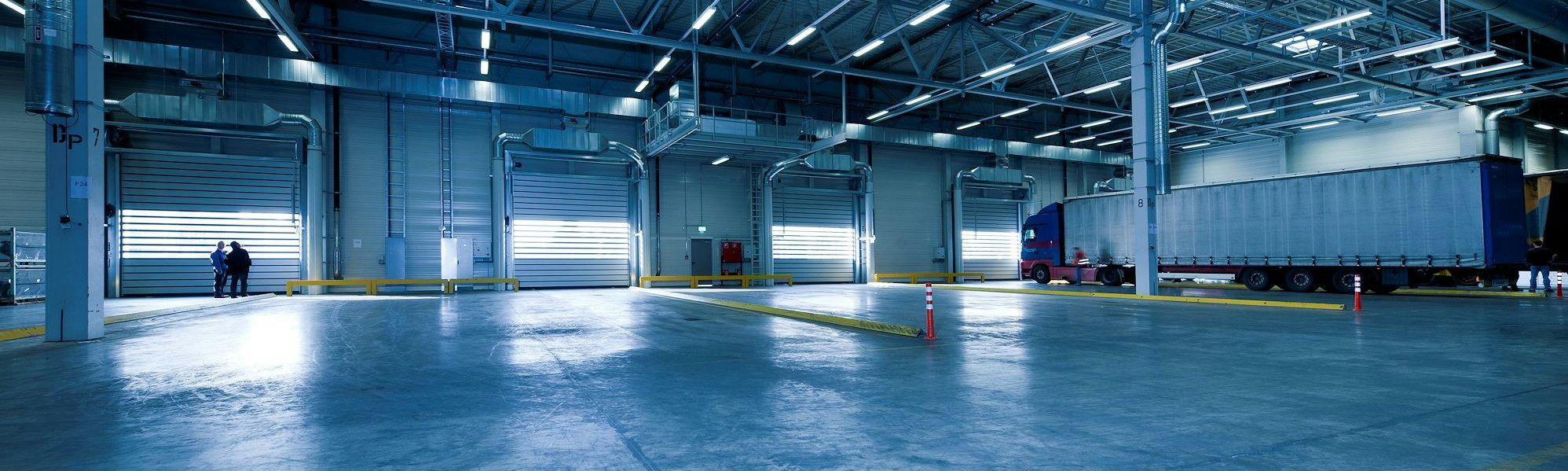
Are Industrial Radiant Panels Compatible with Heat Pumps?
This is one of the most important specification questions for industrial buildings with decarbonisation targets, and the answer is yes, with the right design approach.
Heat pumps operate most efficiently at lower flow temperatures, typically in the range of 45 to 60°C. Radiant panels are among the best-suited emitter types for heat pump systems because they rely on surface radiation rather than convective air heating. A radiant panel delivering heat at 50°C flow temperature can still provide meaningful occupant comfort; a unit heater at the same flow temperature will deliver a reduced output compared to its rated performance at 82°C, which is why emitter selection matters when specifying a heat pump system.
For industrial buildings planning a transition to heat pumps, whether now or in the next five to ten years, specifying radiant panels as the primary emitter is the most future-proof approach.
How Do Radiant Panels and Unit Heaters Work Together in Industrial Buildings?
Rather than treating radiant panels and unit heaters as competing options, many well-designed industrial heating systems use both, each in the zone where it performs best.
Radiant panels are typically the right choice for the main floor area, as they provide consistent background warmth, operate silently, perform well in areas with large openings where air temperature fluctuates, and are highly compatible with heat pump systems at low flow temperatures. SPC’s CiRRUS unit heaters, by contrast, excel in zones that require rapid heat-up from cold, such as loading bays, entrance areas, or intermittently used spaces, where their high-output axial fan delivers warmth quickly and with good throw and coverage.
The combination approach is increasingly common in buildings working towards net zero targets: radiant panels covering the main occupied area, supported by CiRRUS unit heaters in specific zones where fast response or localised heating is the priority.
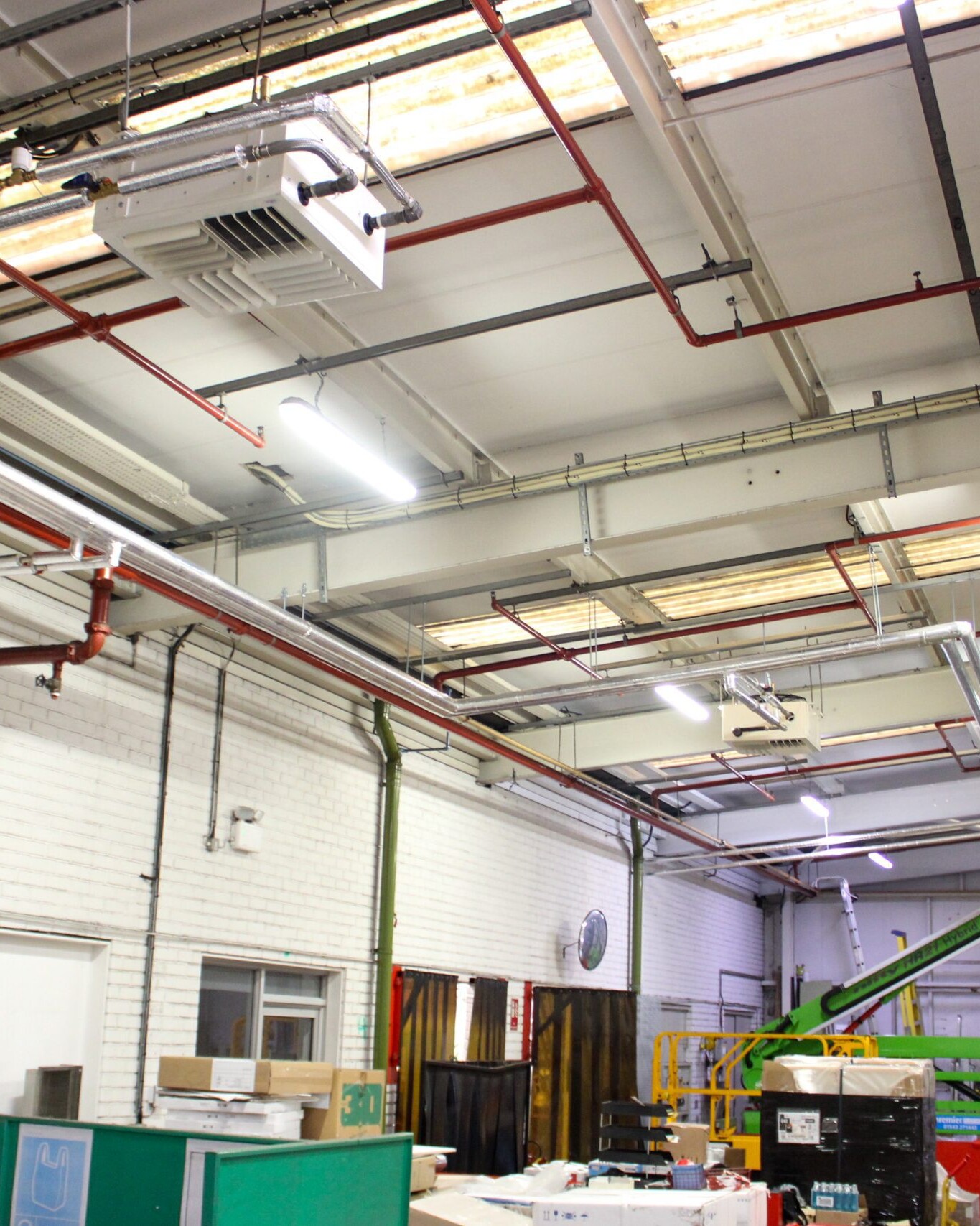
What Should Be Specified Alongside Industrial Radiant Panels?
System design considerations for industrial radiant panel installations include:
- Flow temperature: confirmed at the design stage to ensure compatibility with the heat source
- Panel spacing and coverage: calculated to provide consistent radiant intensity across the occupied zone
- Controls: zone control with black bulb sensors measures resultant temperature, the combined effect of air temperature and radiant temperature, rather than air temperature alone, giving a more accurate picture of actual occupant comfort
- Pipework configuration: counterflow connection for multi-row systems to maximise heat transfer efficiency
For buildings where Embodied Carbon is also being assessed, the CIBSE TM65 methodology provides the industry-standard framework for quantifying the embodied carbon of building services equipment.
SPC, a Leicester-based manufacturer with over 50 years in the HVAC industry, offers the Decarbonisation of Industrial and Commercial Heating Systems CPD, a CIBSE-approved session covering heat pump integration, low-temperature emitter selection, and Embodied Carbon assessment. It is available to architects, mechanical consultants, and contractors.
Frequently Asked Questions
SPC’s industrial radiant panels are designed to run at low water temperatures, making them compatible with heat pump systems. The precise flow temperature required depends on the panel specification and the heating load. SPC can provide selection data for specific project conditions.
Yes. Radiant panels are well-suited to high-bay buildings because the radiant heat transfer mechanism is far less affected by air stratification than convective heating. In a conventionally heated building, warm air rises and much of the energy input is lost to the upper zone before it reaches occupants. With radiant panels, heat is transferred directly to surfaces and occupants in the occupied zone, making them a more efficient choice where ceiling heights are significant.
Yes, and this is one of the scenarios where radiant panels perform particularly well. Because radiant heat warms surfaces and occupants directly rather than heating the air, comfort can be maintained even when large doors are open and air temperature drops. For the loading bay area itself, SPC’s CiRRUS unit heaters can be specified alongside radiant panels to provide rapid heat recovery when doors close.
Radiant panels have no moving parts, which significantly reduces maintenance requirements compared to fan-assisted heating products. Periodic checks on pipework connections and panel mounting are the main service considerations.
Radiant panels support net zero in two ways: they are highly compatible with heat pump systems at the flow temperatures heat pumps can sustain efficiently, and their energy consumption relative to the comfort delivered is lower than convective heating in high-bay spaces. For buildings where Embodied Carbon is also being assessed under TM65, SPC can provide relevant product data.
Talk to SPC About Your Industrial Heating Project
SPC has been manufacturing heating and cooling products for industrial and commercial environments for over 50 years. Whether you are specifying a new warehouse heating system, replacing ageing equipment, or looking to improve efficiency on an existing installation, our technical team can advise on product selection, sizing, and system configuration.
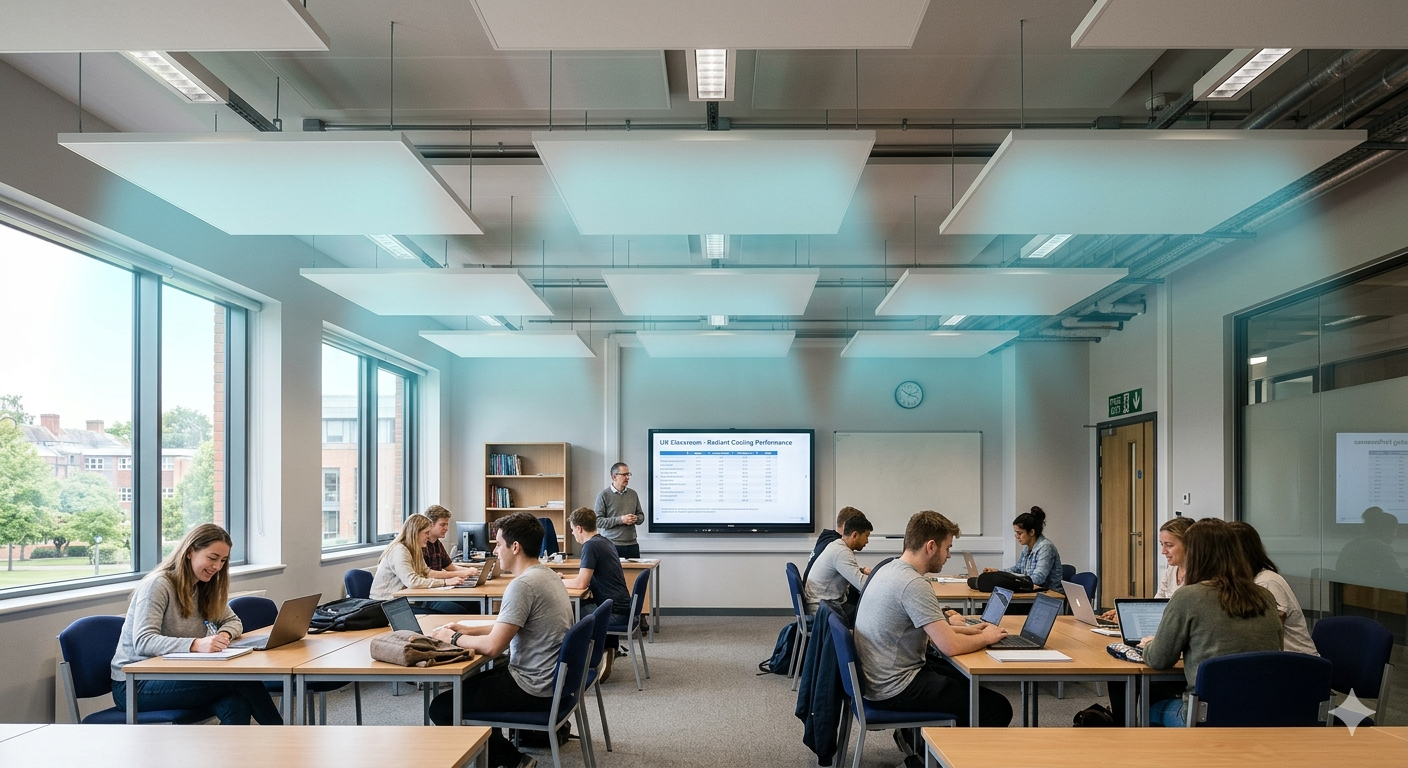
Can Radiant Panels Be Used for Cooling as Well as Heating?
When a UK heatwave hits, and internal building temperatures climb, specifiers and building managers increasingly ask the same question: is there a cooling solution that doesn’t involve noisy fan coil units or bulky air conditioning infrastructure?
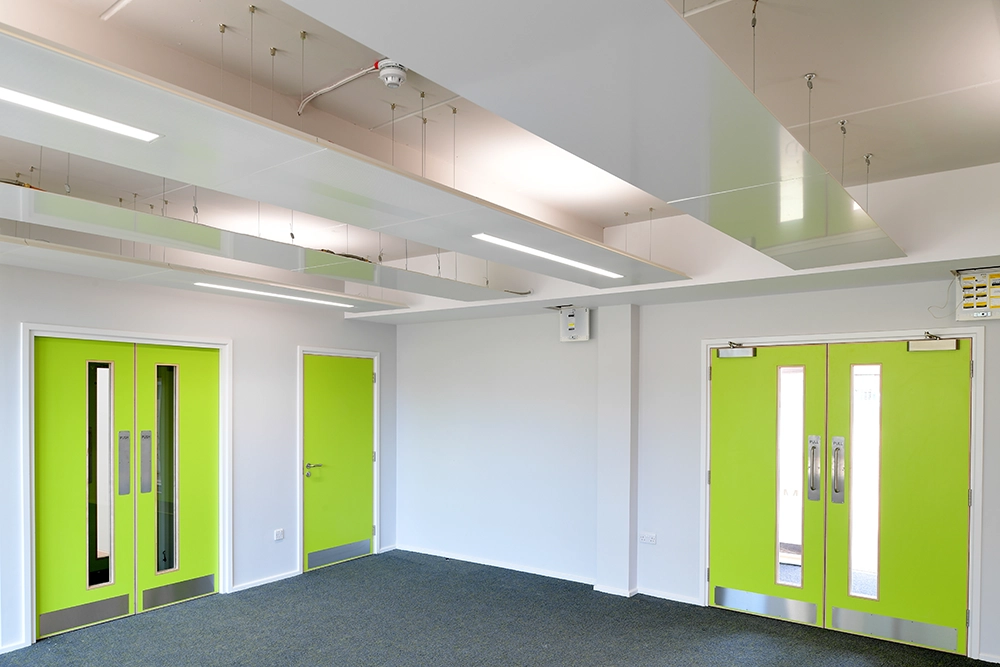
SPC’s Thermatile TEN-TWELVE radiant panels can provide exactly that. The same radiant panels that deliver quiet, draught-free radiant heating in winter can also provide radiant cooling in summer, when supplied with chilled water from a heat pump or chiller unit, offering genuine year-round climate control from a single, discreet system.
How Does Radiant Cooling Work?
Radiant cooling operates on the same principle as radiant heating, but in reverse. Where a heated panel surface radiates warmth directly to occupants and surfaces, a cooled panel surface absorbs radiant heat from the room, drawing it away from people and objects without creating any air movement.
The Thermatile TEN-TWELVE achieves this by circulating chilled water through its copper D-tube waterways. The cooled panel surface temperature must be managed carefully to remain above the dew point of the room air to prevent condensation forming on the panel face. In practice, this is managed through chilled water temperature controls and, in humidity-sensitive environments, a supplementary dehumidification system.
The result is a cooling experience that feels significantly more comfortable than conventional air conditioning: no draughts, no noise, and no recirculation of airborne particles.

Why Specify Radiant Cooling for Offices, Schools, and Healthcare Facilities?
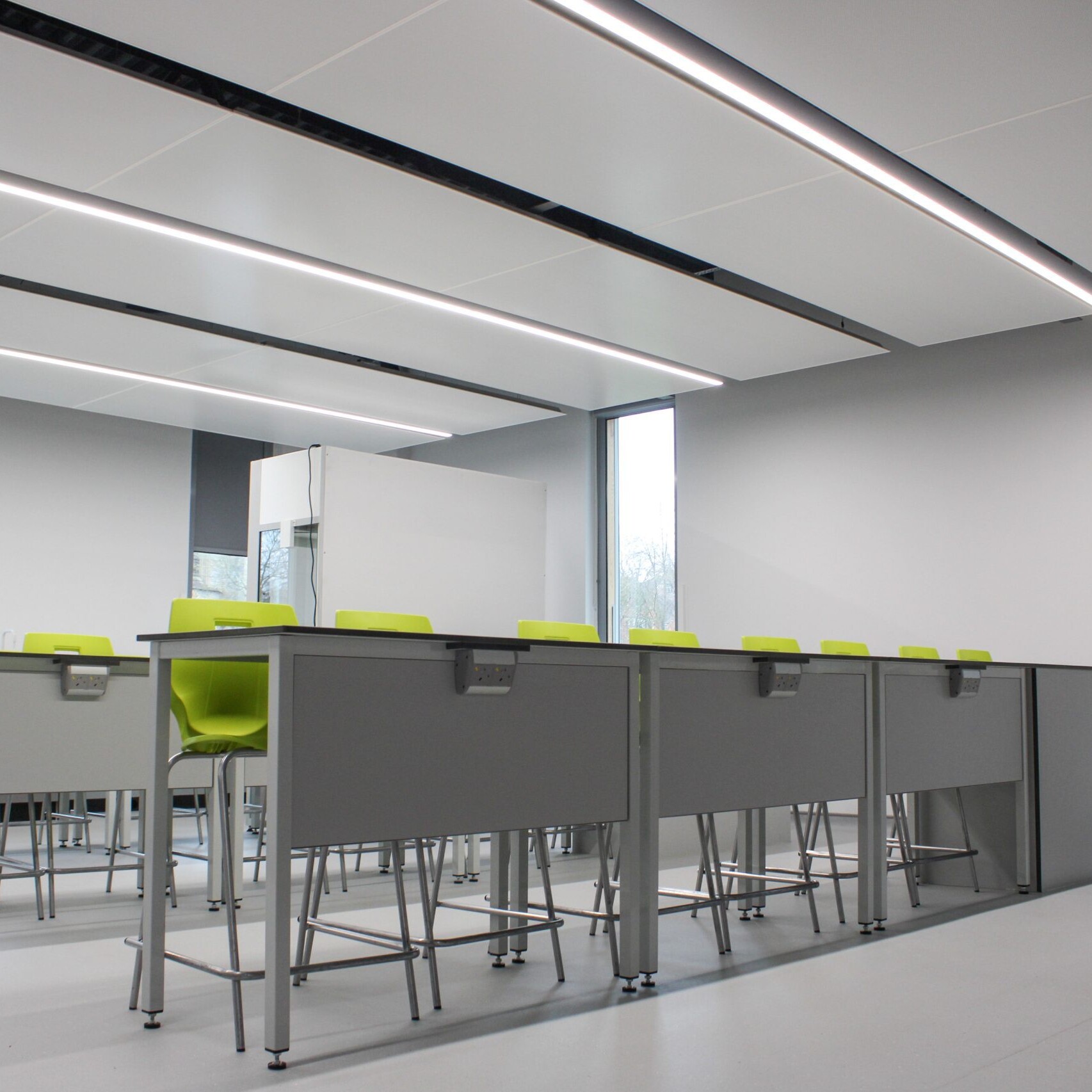
Radiant cooling panels are well suited to environments where air quality, noise, and comfort are priorities. For offices, the absence of air movement eliminates the draughts and temperature stratification that standard fan coil units create. For healthcare facilities, where infection control requires minimal air circulation, radiant cooling panels present a compelling case; they do not circulate airborne particles and are easy to clean.
In schools, radiant cooling addresses the well-documented problem of overheating classrooms, particularly in older buildings with poor thermal mass and large south-facing glazing. Unlike portable air conditioning units, which are loud, energy-intensive, and often ineffective in larger spaces, radiant cooling operates silently and integrates with the building’s existing pipework and controls infrastructure.
What Chilled Water Source Is Required?
Radiant cooling panels require a chilled water supply, typically in the range of 14°C to 18°C flow temperature. This can be delivered by several system types:
- A reversible heat pump operating in cooling mode — the most energy-efficient option and the most compatible with low-carbon building strategies
- A dedicated chiller unit — suitable where a heat pump is not in place or where cooling loads are higher than a heat pump can manage
- A district cooling network — where available in urban locations
The key consideration is that the chilled water flow temperature must be set carefully to avoid condensation at the panel surface. SPC’s technical team can advise on appropriate flow temperature ranges and system compatibility at the specification stage.
Are Radiant Cooling Panels Compatible With Heat Pump Systems?
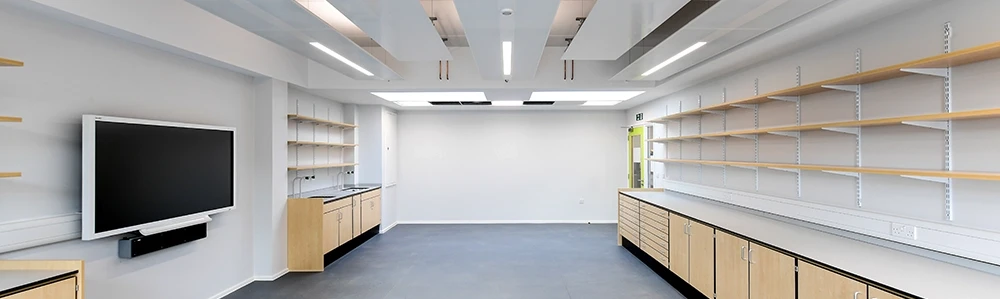
Yes. Reversible air-to-water or ground-source heat pumps that operate in cooling mode are well matched to radiant cooling panels. Heat pumps in cooling mode typically produce chilled water in the range of 7°C to 18°C, and by setting the flow temperature at the upper end of this range (16°C to 18°C), condensation risk at the panel surface is managed effectively while still achieving meaningful cooling output.
This compatibility makes radiant cooling panels one of the more logical choices for buildings already specified with a heat pump for heating, the same unit can drive both the winter heating and summer cooling circuit, reducing plant requirements and simplifying controls.
Year-Round Performance From a Single System
The strongest argument for specifying the Thermatile TEN-TWELVE in a new build or refurbishment project is the ability to serve both heating and cooling from one product. In environments where both seasonal comfort modes are required, offices, healthcare facilities, schools with extended year use, a radiant panel system removes the need for a separate cooling product, saving installation cost, space, and ongoing maintenance complexity.
SPC manufactures the Thermatile TEN-TWELVE at its Leicester facility and has offered a CIBSE-approved CPD on Radiant Heating and Cooling Panels – Fundamentals and Design Guide for architects, mechanical consultants, and contractors looking to understand the specification and design considerations in depth.
Frequently Asked Questions
Yes. The Thermatile TEN-TWELVE panels support both heating and cooling by circulating either hot or chilled water through their copper D-tube waterways. For cooling applications, the chilled water flow temperature is set above the room’s dew point (typically 16°C to 18°C) to prevent condensation at the panel surface. Electric Thermatile panels are heating-only and cannot provide cooling.
Radiant cooling panels typically require a chilled water flow temperature of between 14°C and 18°C. The precise temperature depends on the room’s humidity conditions. Where dehumidification is not present, operating at 16°C or above reduces condensation risk. SPC’s technical team can advise on suitable flow temperatures for a specific project.
Not always, but in spaces with higher humidity (such as sports halls, kitchens, or buildings without mechanical ventilation) a dehumidification system or careful control of chilled water temperature is recommended to keep the panel surface above the dew point. In most standard commercial offices and classrooms with adequate ventilation, condensation risk is manageable through flow temperature control alone.
Yes. A reversible heat pump operating in cooling mode is a common and energy-efficient chilled water source for radiant cooling systems. Setting the heat pump’s chilled water output to the upper end of its cooling range (16°C to 18°C) keeps the panel surface above the dew point while still delivering effective cooling output.
Yes. Radiant cooling panels are well suited to schools, particularly in buildings with overheating problems caused by large glazing areas or poor thermal mass. They operate silently, create no air movement, and do not recirculate airborne particles — advantages that are relevant in occupied classroom environments.
Specify Radiant Cooling for Your Next Project
For specification support on radiant cooling panels, system compatibility advice, or to request product literature and datasheets, contact the SPC team directly.