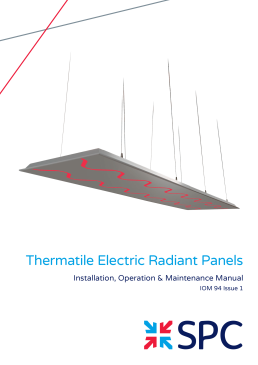

Thermatile Electric Radiant Panels
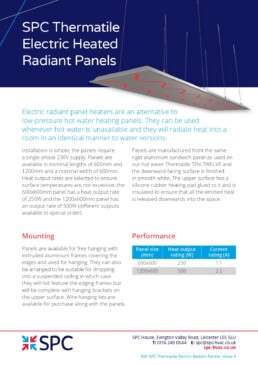
SPC Thermatile Electric Radiant Panels heaters are an alternative to low pressure hot water radiant panels. They are a good choice whenever hot water heating is not an option and they radiate heat into the space in an identical fashion.
Installation is simple and requires a standard 230V electrical supply. Additionally, the panels come in two standard sizes: 600x600mm and 1200x600mm, with heat outputs of 250W and 500W respectively, ensuring a comfortable and safe heating experience.

Ceiling Mounted
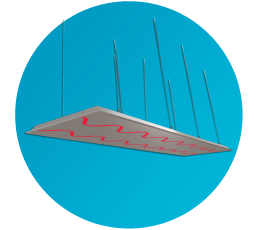
Thermatile Electric Radiant Panels feature insulation across the entire upper surface ensuring that virtually all the heat is radiated downwards into the space. The panels sit in the suspended ceiling and include brackets for wire support from the soffit. Wire hanging kits are available to purchase alongside the panels.

Free-hanging
Thermatile Electric Radiant Panels are available for free-hanging in which guise they incorporate an extruded aluminium frame around their edges. Insulation is hidden behind the frame which is drilled for wire hanging. Wire hanging kits are available to purchase alongside the panels.

Zone Control Kit
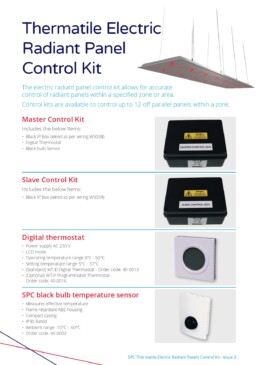
The SPC control kit for electric panels consists of a digital thermostat, remote black bulb sensor and relay box which switches the panels on and off. Up to 12 panels can be controlled from a single zone control kit.
Frequently Asked Questions
Specify electric panels when hot water heating is unavailable or impractical, such as in retrofit projects, temporary buildings, spaces remote from the boiler or heat pump, or buildings where extending pipework would be prohibitively expensive. Electric panels are also ideal for small, isolated spaces like meeting pods, storage rooms, or annexes where running pipework is not cost-effective. However, for primary heating in large buildings with existing LPHW systems, water-based panels are typically more economical to run.
Each panel requires a single-phase 230V AC supply. The 600mm × 600mm panel draws 250W (1.1A), and the 1200mm × 600mm panel draws 500W (2.2A). You need a dedicated circuit with appropriate cable sizing and overcurrent protection. The zone control kit includes a relay box that switches panels on and off together. All electrical work must be carried out by a qualified electrician in accordance with BS 7671 (IEE Wiring Regulations). Contact SPC’s technical team for guidance on electrical load calculations for your specific installation.
Up to 12 panels can be controlled from a single zone control kit. The kit includes a digital thermostat, a black bulb temperature sensor, and a relay box. The black bulb sensor measures resultant temperature (combination of air and radiant temperature), which is more representative of comfort in radiant-heated spaces than air temperature alone. If you need to control more than 12 panels, use multiple control kits to create separate zones, or specify a larger relay with higher switching capacity.
Running costs depend on your local electricity and gas/heat pump tariffs, which vary significantly by location and change over time. Electric panels have the advantage of zero capital cost for pipework, boilers, or pumps, and require no ongoing maintenance. LPHW panels have lower unit energy costs when connected to gas boilers or heat pumps, but require investment in water heating infrastructure and annual servicing. For small installations or retrofit projects, electric panels can be cost-effective when capital and maintenance costs are factored in. For whole-building heating, LPHW is typically more economical. Contact SPC for project-specific advice on system selection and lifecycle costs.
Yes, electric radiant panels are ideal for retrofit because they require no pipework, only an electrical connection. For T-bar suspended ceilings, the panels drop into the grid in place of existing ceiling tiles with minimal disruption. For plasterboard ceilings, an aperture is cut, and the panel is mounted with a frame. The only requirement is routing electrical cable to the panel location and connecting to a local isolator. This makes electric radiant panels an excellent choice for adding heating to spaces that were originally unheated, such as converting a cold storage room into an office.
No, Thermatile Electric radiant panels are heating-only. They cannot provide cooling. If you need both heating and cooling, specify LPHW Thermatile TEN or TWELVE radiant panels connected to a reversible water system (heat pump with heating and chilled water modes). Electric radiant panels work by passing current through a resistive heating element, which can only generate heat, not extract it.