

In buildings where every square metre of usable space matters, classrooms, open-plan offices, heritage spaces, radiant heating panels offer something conventional heating systems cannot: warmth delivered directly from the ceiling, with no intrusion on floor space, wall surfaces, or room layout. SPC’s Thermatile radiant panel range integrates directly into standard suspended ceiling grids, making it a practical and increasingly popular choice for specifiers working on school refurbishments, commercial fit-outs, and sensitive heritage buildings.
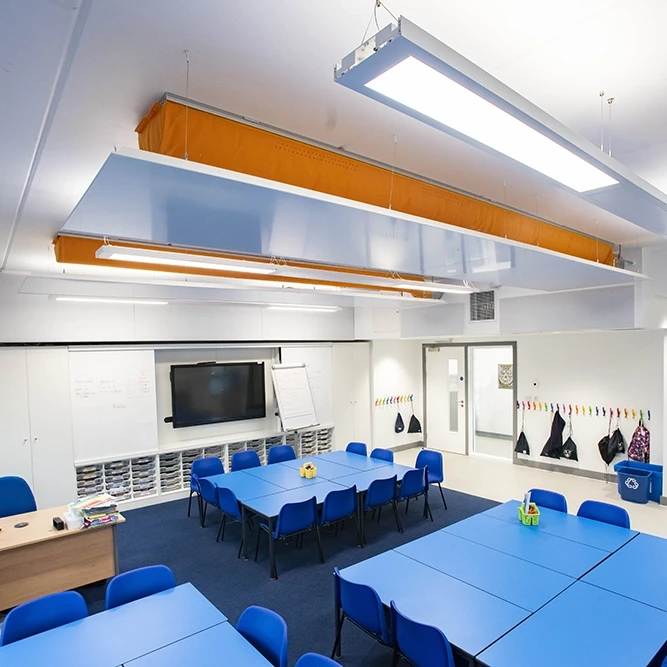
Why Do Specifiers Choose Ceiling-Mounted Radiant Panels?
When specifying heating for occupied buildings, floor and wall space is rarely a neutral variable. In a classroom, wall-mounted heating systems compete with display boards, whiteboards, and furniture arrangements. In open-plan offices, floor-level or perimeter systems can disrupt desk layouts and cable management. In heritage buildings, any visible pipework or casings must be carefully managed.
Traditional radiators consume the very wall space that architects, interior designers, and building users need for other purposes. Ceiling-mounted radiant panels sidestep this problem entirely. Installed flush with (or integrated directly into) a suspended ceiling grid, the Thermatile range occupies zero usable floor or wall space while delivering comfortable, silent warmth to the occupants and surfaces below.
This is not simply a spatial benefit. It also simplifies room design, reduces the risk of accidental contact with heating surfaces, and eliminates the air circulation that conventional convective systems create.
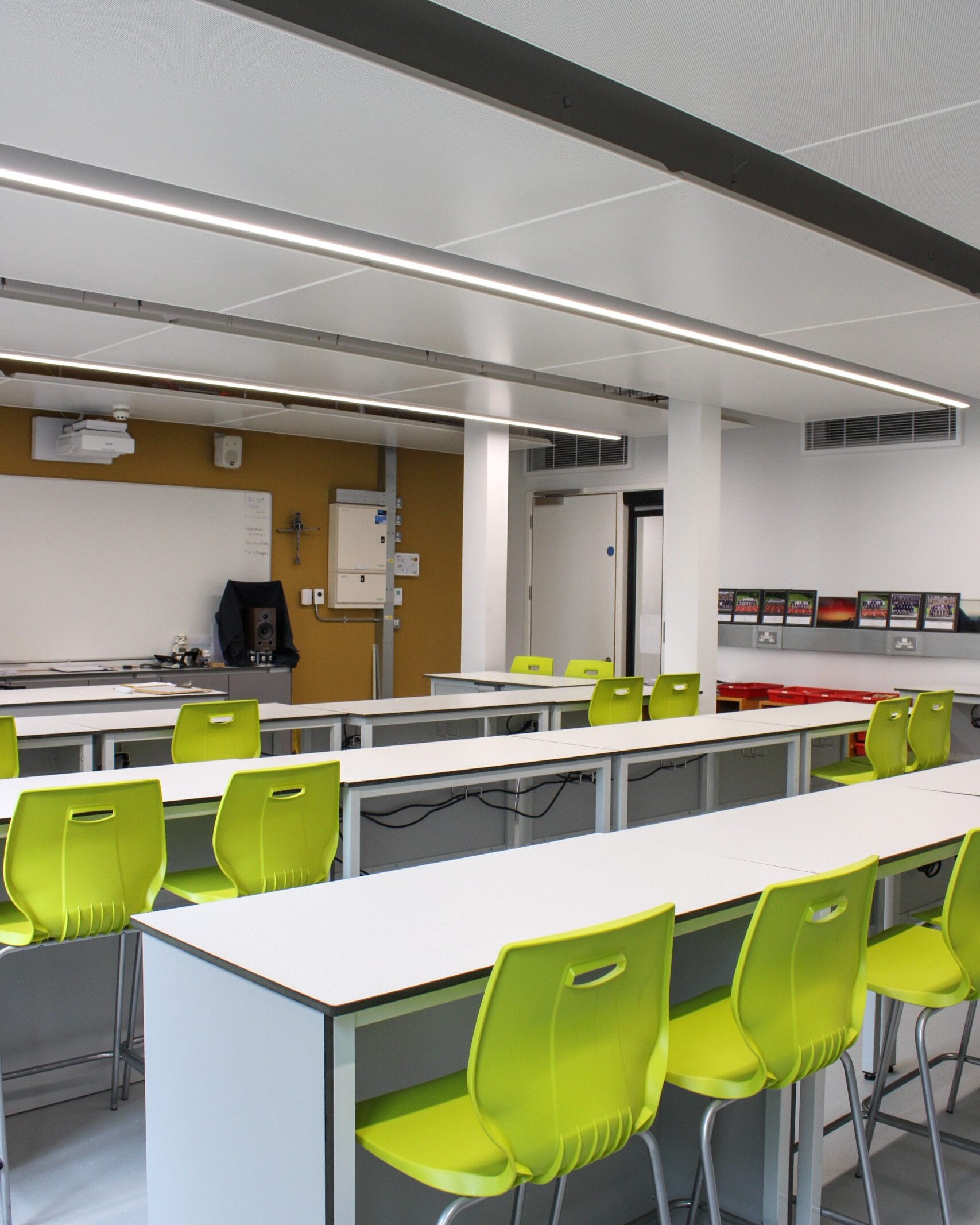
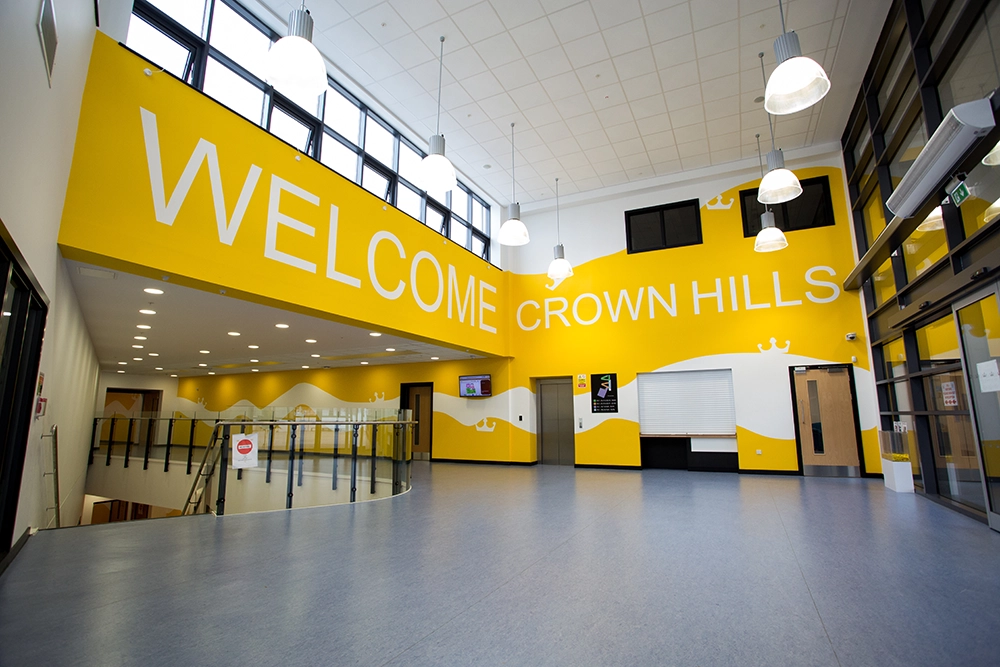
Radiant Panels in Education Environments
Schools are one of the most demanding environments for heating specification. Systems must meet low surface temperature (LST) requirements to protect pupils, operate quietly to avoid disruption, and be practical to maintain during short holiday windows.
Classrooms and teaching spaces benefit from ceiling tile integration in two ways. The Thermatile panels drop directly into standard 600 x 600mm or 1200 x 600mm suspended ceiling grids, requiring no additional structural work and leaving classroom walls entirely free. Because radiant panels transfer heat directly to occupants and surfaces without forcing air movement, they do not circulate dust or airborne particles, a meaningful consideration in spaces shared by large numbers of children.
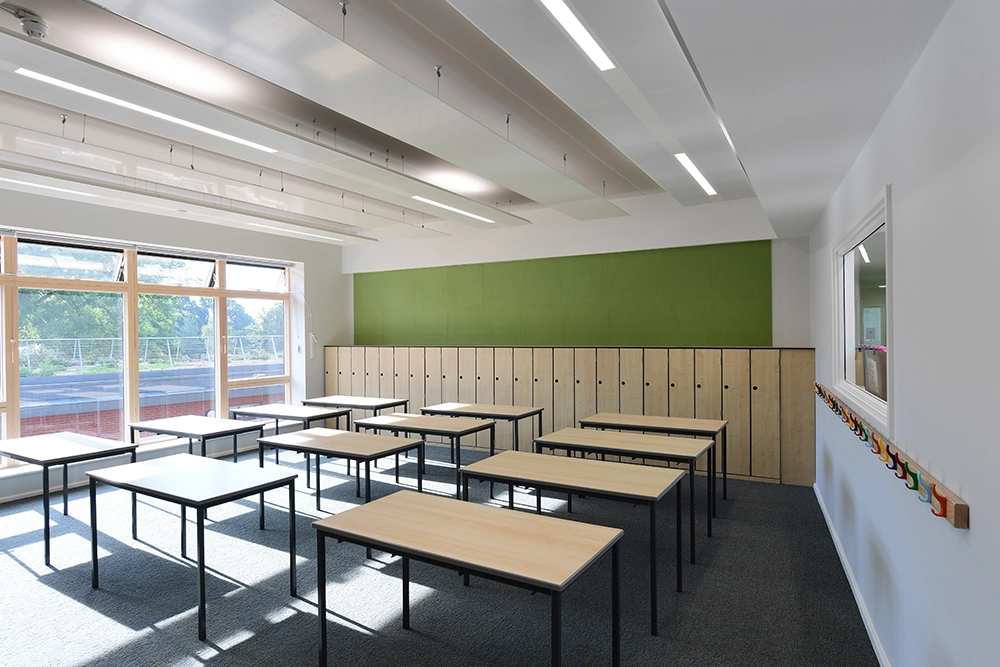
Sports halls present a different challenge: high ceilings, large open volumes, and the constant risk of ball impact. Our radiant panels can be fitted with a ball guard protection, ensuring the panels are protected from impact while preventing sports equipment, such as balls or shuttlecocks, from becoming trapped above the units. Our industrial radiant panel is also compatible with low-temperature heating systems, making it suitable for sports halls where heat pump integration is part of a broader decarbonisation strategy.
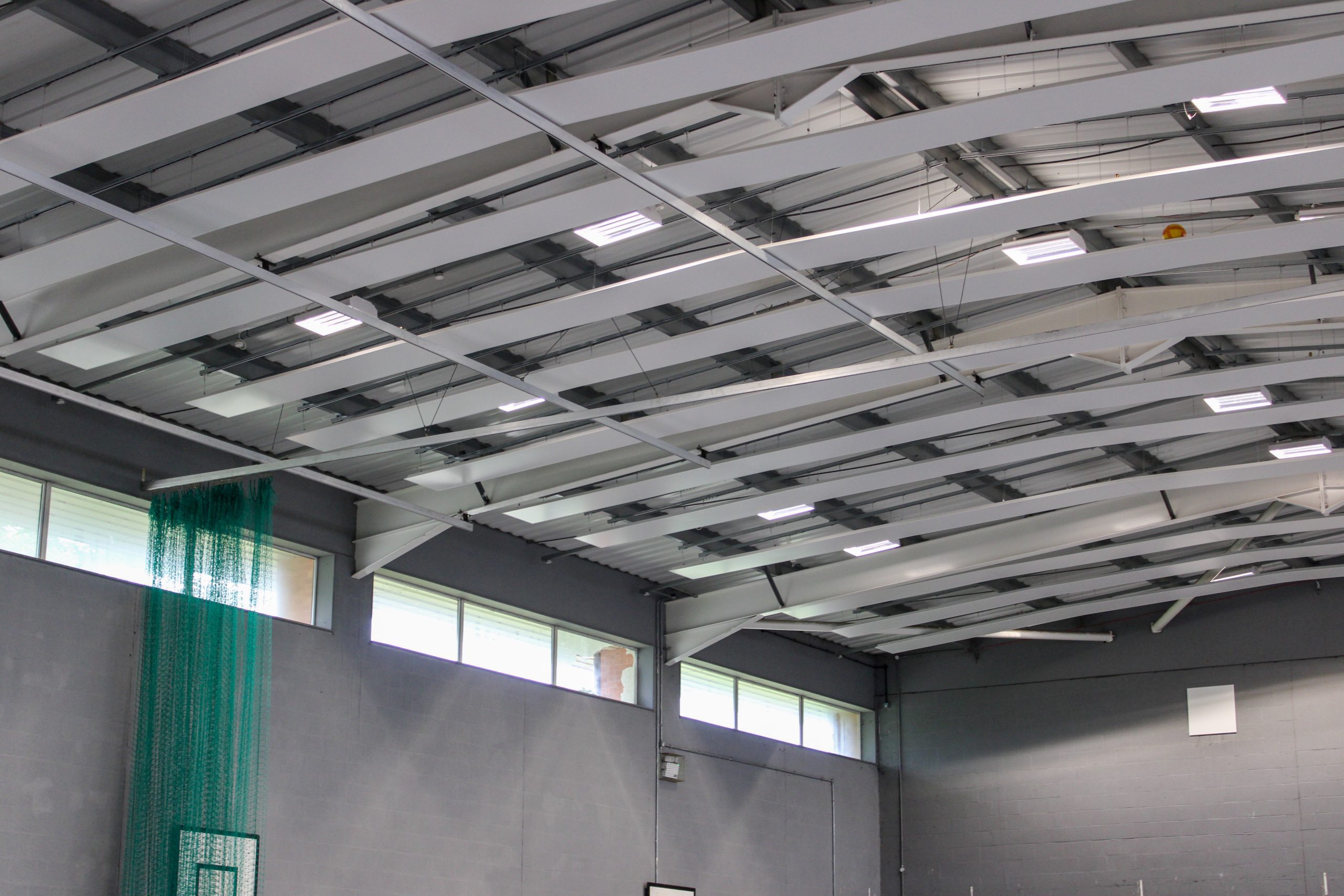
Corridors and assembly halls are well suited to free-hanging or plasterboard-mounted radiant panels where no suspended ceiling grid is present. The result is a clean, low-profile installation that maintains the aesthetic of a shared school space.
For school projects funded through the Salix Finance scheme or the Condition Improvement Fund (CIF), radiant panels have an additional advantage: heat pump compatibility.
Radiant Panels in Commercial Environments
The same space-efficiency benefits that make radiant panels attractive in schools translate directly into commercial applications, often with an even stronger business case.
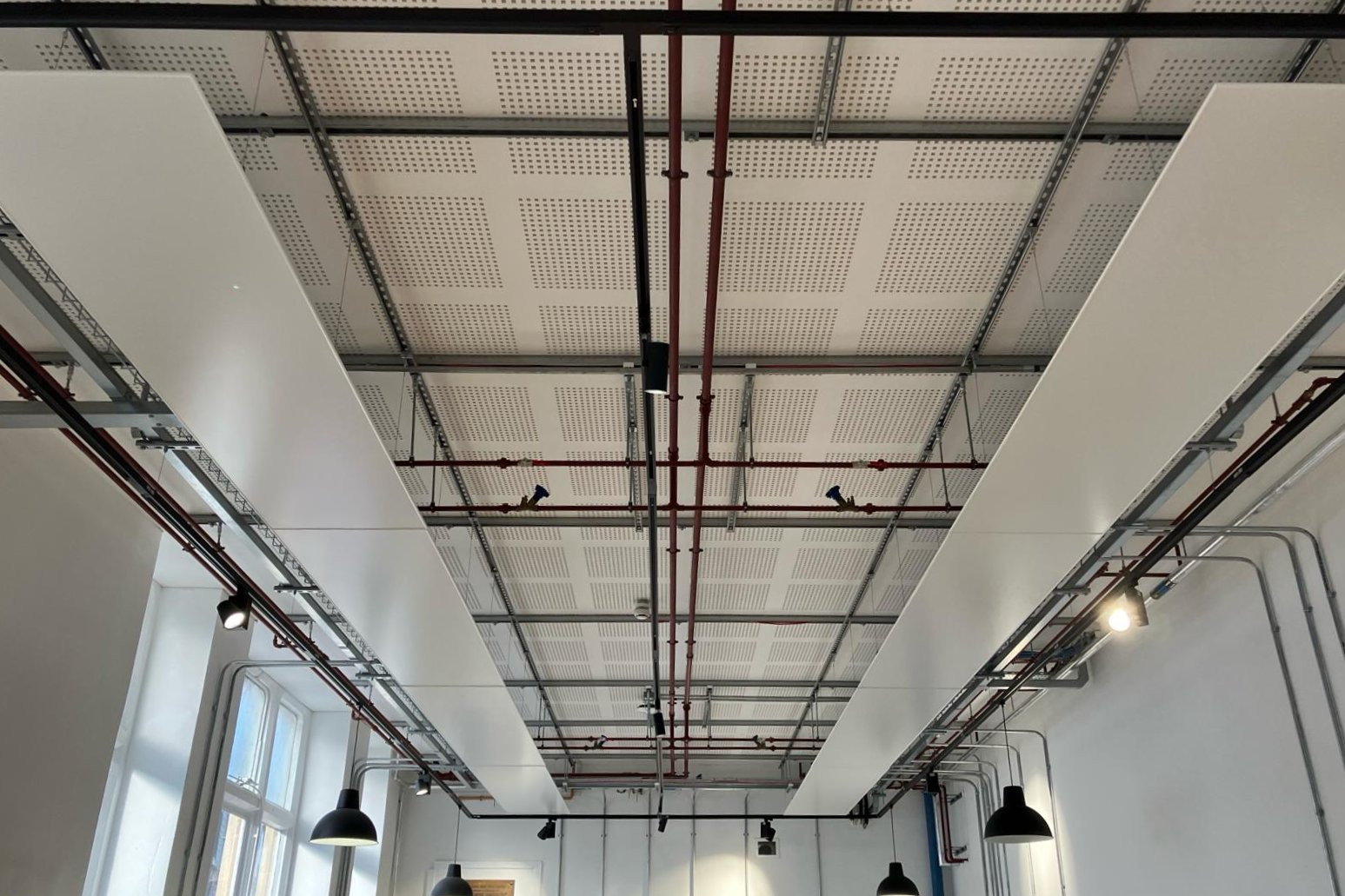
Open-plan offices increasingly use suspended ceiling systems as standard, which makes Thermatile integration straightforward. Panels can be specified in the same grid as lighting and ventilation components, creating a clean and coordinated ceiling plane. At 45–50°C flow temperatures, the Thermatile range operates efficiently with modern heat pump systems, supporting net zero commitments without requiring a complete building services overhaul.
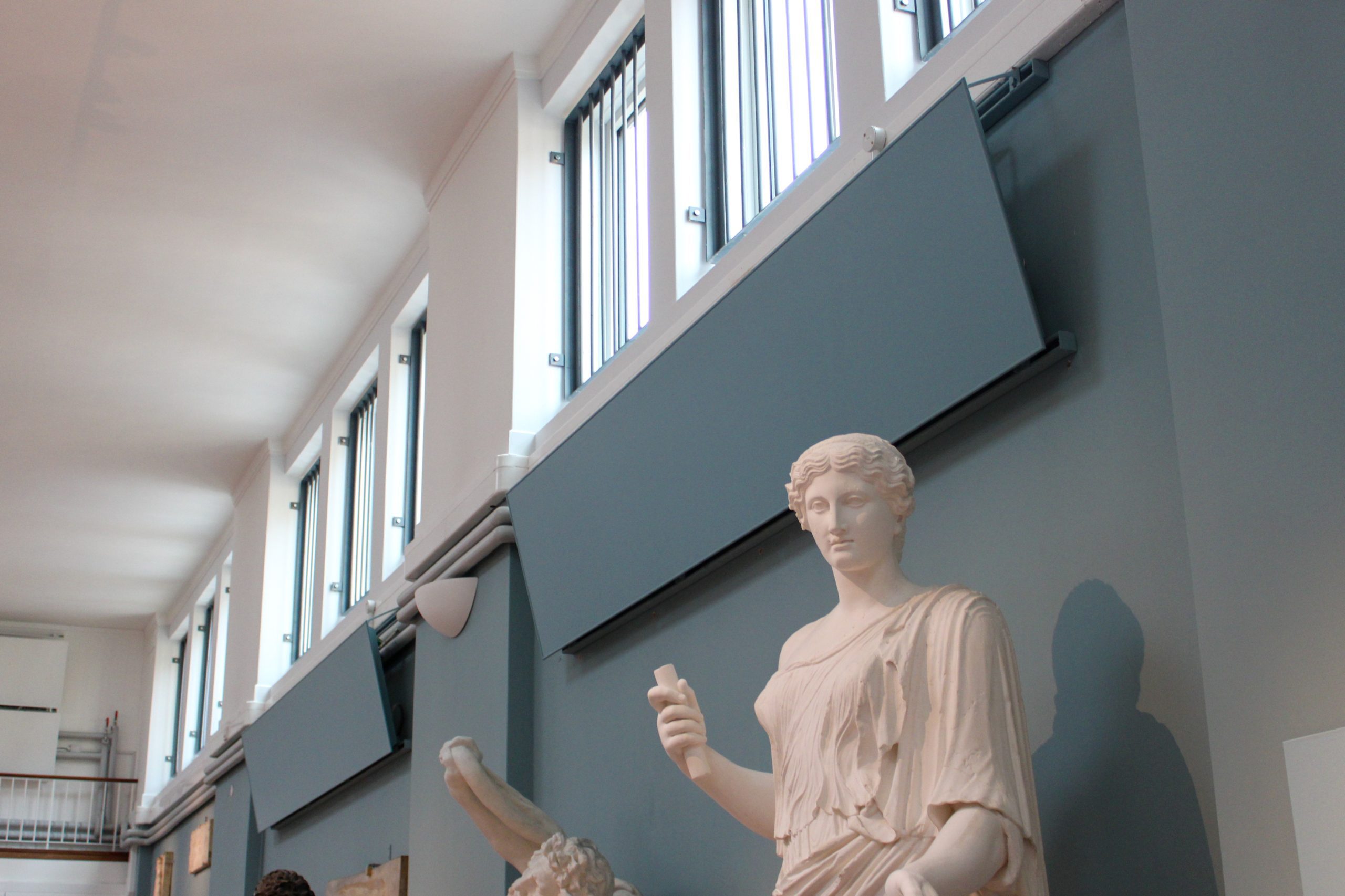
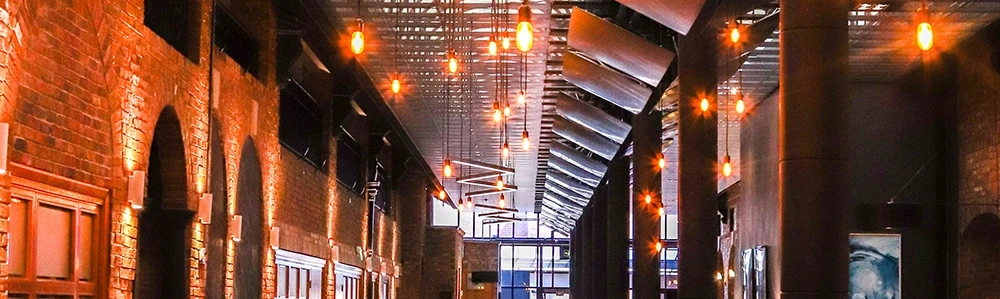
Museums and heritage buildings place particularly stringent demands on heating systems. Visible pipework, wall-mounted casings, or floor penetrations are rarely acceptable in listed or historically sensitive spaces. Radiant panels, whether integrated into an existing ceiling grid or concealed within plasterboard, offer a discreet solution that delivers consistent background warmth without affecting exhibits or original fabric. SPC has supplied Thermatile panels for heritage projects, including the Ashmolean Museum in Oxford.
Libraries and reading rooms benefit from the silent operation of radiant heating. With no fans and no air movement, Thermatile panels create no background noise, an important consideration in spaces where acoustic comfort is a stated design requirement.
What Are the Differences Between the Thermatile TEN, TWELVE, and Electric Panels?
SPC manufactures the Thermatile range at its facility in Leicester. The range covers three main configurations:
Thermatile TEN panels are designed for suspended ceiling tile applications. Each panel is 600mm wide and available in lengths up to 3,600mm for a single unit. The D-Tube technology, a flattened copper tube profile that maintains 360° contact with the aluminium panel, maximises heat transfer and ensures even surface temperatures across the panel face.
Thermatile TWELVE panels use modular connections to form continuous runs of up to 70 metres. This makes them particularly suitable for large-area applications such as open-plan offices or school halls, where a single continuous system is more practical than multiple individual units.
Thermatile Electric panels are available for buildings without an LPHW system. At 250W per 600 x 600mm panel and 500W per 1200 x 600mm panel, they are well suited to retrofit projects, listed buildings where pipework installation would be disruptive, or individual rooms that require supplementary heat.
Water-based Thermatile panels can be supplied for chilled water as well as LPHW. Radiant cooling is suited to free-hanging and wall-mounted panels where summer cooling is also required. Drop-in ceiling tile and concealed plasterboard installations are for heating only, because of the condensation risk in the ceiling void.
Heat Pump Compatibility and Low-Temperature Performance
One of the strongest arguments for specifying radiant panels in refurbishment projects is their compatibility with heat pump systems.
Heat pumps deliver maximum efficiency at low flow temperatures, typically in the range of 45–55°C. Conventional radiators specified for higher-temperature systems often underperform when connected to a heat pump operating at these temperatures, requiring either panel upgrades or system compromises.
Radiant panels are inherently well-matched to low-temperature operation. Because radiant panels transfer heat directly through radiation rather than convection, they achieve comfortable room temperatures at flow temperatures that heat pumps deliver efficiently. The Thermatile range is designed to operate effectively at 45–50°C flow temperature, which aligns with the output range of air source and ground source heat pumps commonly specified for commercial and educational buildings in the UK.
For school projects applying for Salix Finance funding or CIF grants, both of which can include heat pump installation, specifying a radiant panel system removes a potential barrier to whole-building decarbonisation. The heating emitter and the heat source are engineered to work together from the outset.
CIBSE Guide B provides additional guidance on low-temperature heating system design for specifiers working on heat pump-integrated projects: Guide B1 Heating (2016)
Which Radiant Panel Mounting Option Is Right for My Building?
SPC offers five main installation configurations for Thermatile panels, each suited to different building types and refurbishment constraints:
- Ceiling tile (drop-in T-bar) — the standard option for buildings with a suspended ceiling grid. Panels replace existing ceiling tiles with no structural modification. Suited to offices, schools with modern classroom ceilings, and retail or commercial spaces.
- Plasterboard frame (concealed installation) — panels are set into a plasterboard ceiling, with no visible grid. Suited to heritage buildings, high-specification commercial interiors, and spaces where a flush finish is architecturally required.
- Tile replacement (concealed grid) — similar to drop-in, but uses a concealed grid system for a cleaner visual result. Suited to premium commercial environments.
- Free-hanging — panels are suspended from the structural soffit without a ceiling grid. Suited to sports halls, industrial spaces with high ceilings, or buildings without a suspended ceiling infrastructure.
- Wall-mounted (angled) — panels are fixed to walls and can be angled to direct radiant warmth into the occupied zone. Suited to museums and heritage sites (such as the Ashmolean Museum) where ceiling installation is restricted or architectural features need to be preserved.
Frequently Asked Questions
Yes. Radiant panels are well suited to educational environments for several reasons: they install into standard suspended ceiling grids without occupying wall space, they operate silently with no air movement, and they do not circulate airborne particles. SPC’s Thermatile range is compatible with low-temperature hot water systems, including heat pumps, which aligns with many schools’ decarbonisation requirements under Salix Finance or CIF-funded refurbishment programmes.
Radiant panels are one of the most compatible heating emitter types for heat pump systems. They operate efficiently at flow temperatures of 45–50°C, which is within the normal operating range of air source and ground source heat pumps. Unlike oversized radiators specified for higher-temperature boiler systems, radiant panels do not require derating or oversizing when connected to a heat pump, they are designed for low-temperature operation.
Traditional radiators are wall-mounted and occupy surface area that would otherwise be available for furniture, displays, or fixtures. In a classroom, this means competing with display boards and whiteboards. In an office, it means managing perimeter constraints. Ceiling-mounted radiant panels eliminate this entirely; they are installed above the occupied space and occupy no usable floor or wall area. For buildings where space efficiency is a design priority, this is a meaningful specification advantage.
The Thermatile TEN is designed for individual ceiling tile applications, available in panel lengths up to 3,600mm. The Thermatile TWELVE uses a modular connection system that allows continuous runs of up to 70 metres, making it better suited to large open areas such as office floors, sports halls, or assembly spaces where a single connected system is more practical and easier to balance hydraulically.

Specify Radiant Panels with SPC
SPC has manufactured heating and cooling products in Leicester for over 50 years. The Thermatile range is produced to ISO 9001:2015 quality standards, with outputs independently tested to EN 14037.
For specification support, product selection assistance, or to request a sample or datasheet, contact the SPC team: