

When a UK heatwave hits, and internal building temperatures climb, specifiers and building managers increasingly ask the same question: is there a cooling solution that doesn’t involve noisy fan coil units or bulky air conditioning infrastructure?
SPC’s Thermatile TEN-TWELVE radiant panels can provide exactly that. The same radiant panels that deliver quiet, draught-free radiant heating in winter can also provide radiant cooling in summer, when supplied with chilled water from a heat pump or chiller unit, offering genuine year-round climate control from a single, discreet system.
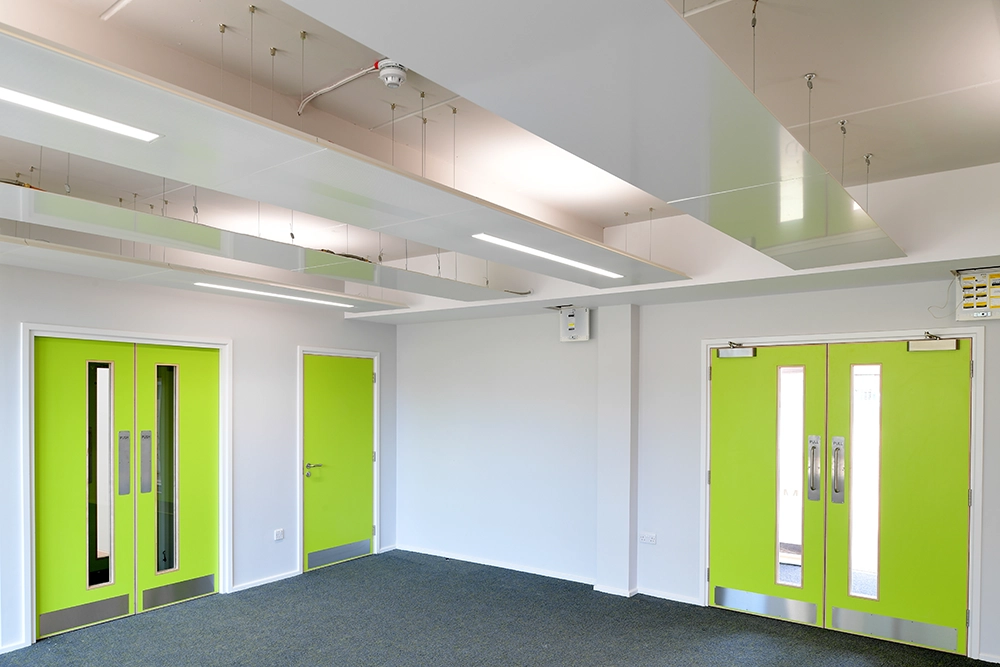
How Does Radiant Cooling Work?
Radiant cooling operates on the same principle as radiant heating, but in reverse. Where a heated panel surface radiates warmth directly to occupants and surfaces, a cooled panel surface absorbs radiant heat from the room, drawing it away from people and objects without creating any air movement.
The Thermatile TEN-TWELVE achieves this by circulating chilled water through its copper D-tube waterways. The cooled panel surface temperature must be managed carefully to remain above the dew point of the room air to prevent condensation forming on the panel face. In practice, this is managed through chilled water temperature controls and, in humidity-sensitive environments, a supplementary dehumidification system.
The result is a cooling experience that feels significantly more comfortable than conventional air conditioning: no draughts, no noise, and no recirculation of airborne particles.

Why Specify Radiant Cooling for Offices, Schools, and Healthcare Facilities?
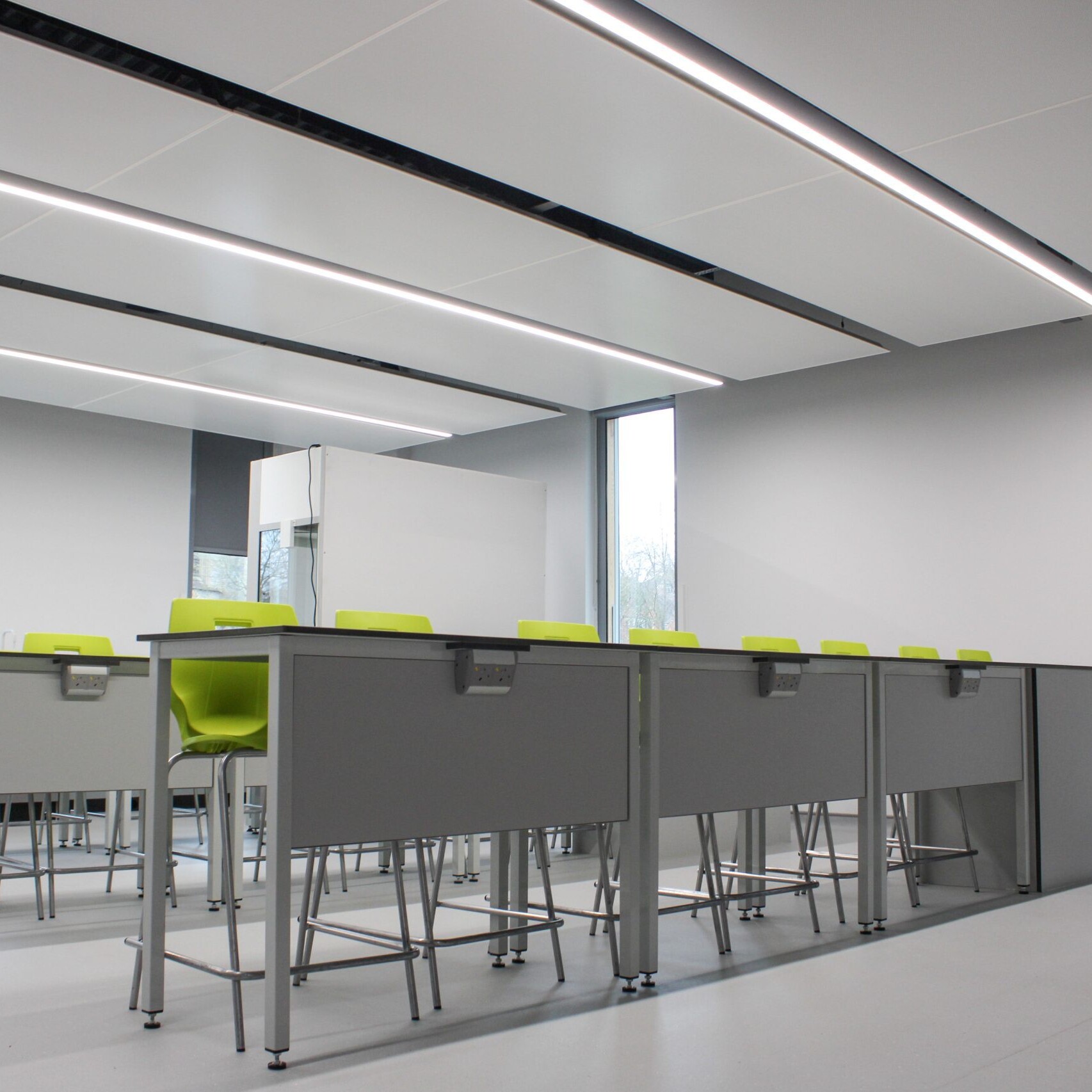
Radiant cooling panels are well suited to environments where air quality, noise, and comfort are priorities. For offices, the absence of air movement eliminates the draughts and temperature stratification that standard fan coil units create. For healthcare facilities, where infection control requires minimal air circulation, radiant cooling panels present a compelling case; they do not circulate airborne particles and are easy to clean.
In schools, radiant cooling addresses the well-documented problem of overheating classrooms, particularly in older buildings with poor thermal mass and large south-facing glazing. Unlike portable air conditioning units, which are loud, energy-intensive, and often ineffective in larger spaces, radiant cooling operates silently and integrates with the building’s existing pipework and controls infrastructure.
What Chilled Water Source Is Required?
Radiant cooling panels require a chilled water supply, typically in the range of 14°C to 18°C flow temperature. This can be delivered by several system types:
- A reversible heat pump operating in cooling mode — the most energy-efficient option and the most compatible with low-carbon building strategies
- A dedicated chiller unit — suitable where a heat pump is not in place or where cooling loads are higher than a heat pump can manage
- A district cooling network — where available in urban locations
The key consideration is that the chilled water flow temperature must be set carefully to avoid condensation at the panel surface. SPC’s technical team can advise on appropriate flow temperature ranges and system compatibility at the specification stage.
Are Radiant Cooling Panels Compatible With Heat Pump Systems?
Yes. Reversible air-to-water or ground-source heat pumps that operate in cooling mode are well matched to radiant cooling panels. Heat pumps in cooling mode typically produce chilled water in the range of 7°C to 18°C, and by setting the flow temperature at the upper end of this range (16°C to 18°C), condensation risk at the panel surface is managed effectively while still achieving meaningful cooling output.
This compatibility makes radiant cooling panels one of the more logical choices for buildings already specified with a heat pump for heating, the same unit can drive both the winter heating and summer cooling circuit, reducing plant requirements and simplifying controls.
Year-Round Performance From a Single System
The strongest argument for specifying the Thermatile TEN-TWELVE in a new build or refurbishment project is the ability to serve both heating and cooling from one product. In environments where both seasonal comfort modes are required, offices, healthcare facilities, schools with extended year use, a radiant panel system removes the need for a separate cooling product, saving installation cost, space, and ongoing maintenance complexity.
SPC manufactures the Thermatile TEN-TWELVE at its Leicester facility and has offered a CIBSE-approved CPD on Radiant Heating and Cooling Panels – Fundamentals and Design Guide for architects, mechanical consultants, and contractors looking to understand the specification and design considerations in depth.
Frequently Asked Questions
Yes. The Thermatile TEN-TWELVE panels support both heating and cooling by circulating either hot or chilled water through their copper D-tube waterways. For cooling applications, the chilled water flow temperature is set above the room’s dew point (typically 16°C to 18°C) to prevent condensation at the panel surface. Electric Thermatile panels are heating-only and cannot provide cooling.
Radiant cooling panels typically require a chilled water flow temperature of between 14°C and 18°C. The precise temperature depends on the room’s humidity conditions. Where dehumidification is not present, operating at 16°C or above reduces condensation risk. SPC’s technical team can advise on suitable flow temperatures for a specific project.
Not always, but in spaces with higher humidity (such as sports halls, kitchens, or buildings without mechanical ventilation) a dehumidification system or careful control of chilled water temperature is recommended to keep the panel surface above the dew point. In most standard commercial offices and classrooms with adequate ventilation, condensation risk is manageable through flow temperature control alone.
Yes. A reversible heat pump operating in cooling mode is a common and energy-efficient chilled water source for radiant cooling systems. Setting the heat pump’s chilled water output to the upper end of its cooling range (16°C to 18°C) keeps the panel surface above the dew point while still delivering effective cooling output.
Yes. Radiant cooling panels are well suited to schools, particularly in buildings with overheating problems caused by large glazing areas or poor thermal mass. They operate silently, create no air movement, and do not recirculate airborne particles — advantages that are relevant in occupied classroom environments.

Specify Radiant Cooling for Your Next Project
For specification support on radiant cooling panels, system compatibility advice, or to request product literature and datasheets, contact the SPC team directly.