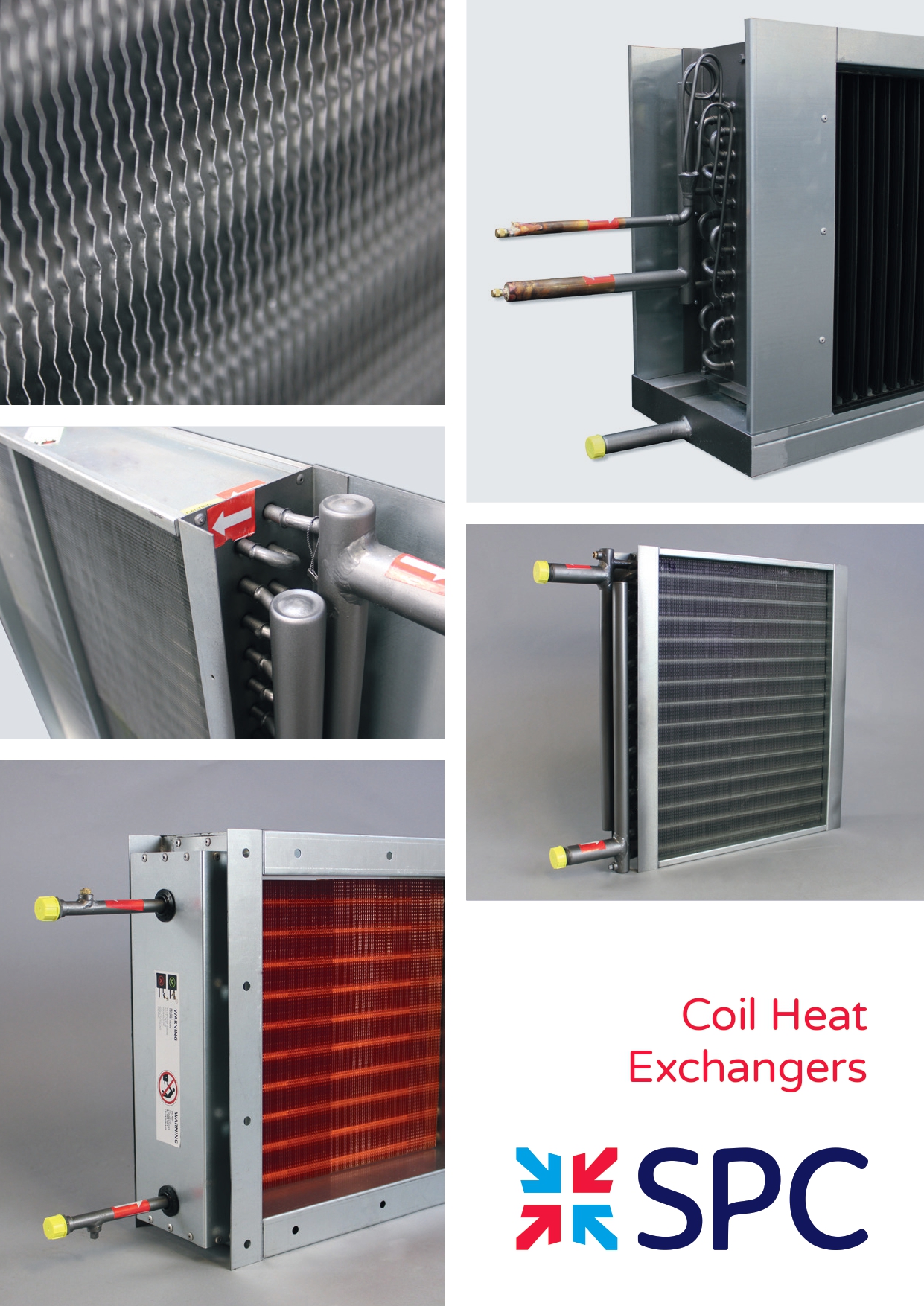
DX, condenser and reverse cycle coils for air handling units and ductwork
SPC refrigerant coils, including DX coils, condenser coils and reverse cycle coils, heat or cool a stream of air using refrigerant in direct vapour compression systems. A DX (direct expansion) or evaporator coil cools and dehumidifies air as the refrigerant evaporates inside its tubes, and a condenser coil heats air as hot refrigerant condenses back to a liquid. Reverse cycle coils do both as part of an air to air heat pump system.
Manufactured in Leicester by S & P Coil Products Limited, SPC refrigerant coils are designed for each duty, with seamless copper tubes, aluminium or copper fins and a casing to bolt into ductwork or slide into an air handling unit (AHU). They are used in commercial, public, industrial and process buildings, in new plant and as replacements in existing plant, and can be split into circuits so one coil is served by several condensing units or heat pumps.

Made to order
Designed for each refrigerant, duty and space
Cooling or heating
DX, condenser or reverse cycle coils
Pressure tested
Typically tested up to 45 barg
Made in Leicester
By S & P Coil Products Limited
Sized to duty
No standard sizes: each coil is selected for your airflow, duty and refrigerant, at the face size your duct or AHU needs.
Free selector
Size refrigerant coils yourself with SPC’s free online coil selector, which saves each coil to a quote with matching BIM files.
Up to 45 barg
SPC refrigerant coils are typically pressure tested up to 45 barg in Leicester before they are delivered.
Dry and sealed
Vacuum dehydrated and capped with a nitrogen holding charge, with plain copper connections for brazing on site.
What are refrigerant coils and DX coils?
Refrigerant coils are finned tube heat exchangers in air conditioning and refrigeration systems, where refrigerant inside the tubes cools or heats the air passing across the fins. In a DX or evaporator coil, the refrigerant evaporates at a constant temperature inside the tubes, taking heat from the air to cool it, and dehumidifying it too if the air is cooled below its dewpoint. SPC DX coils have proprietary brass distributors on the inlets so the liquid and vapour entering the coil mix properly.
In a condenser or condensing coil, high temperature refrigerant condenses to a liquid inside the tubes and gives up its heat to warm the air. A reverse cycle coil forms part of an air to air changeover heat pump system, working as an evaporator (air cooler) or a condenser (air heater) as the system switches between cooling and heating.
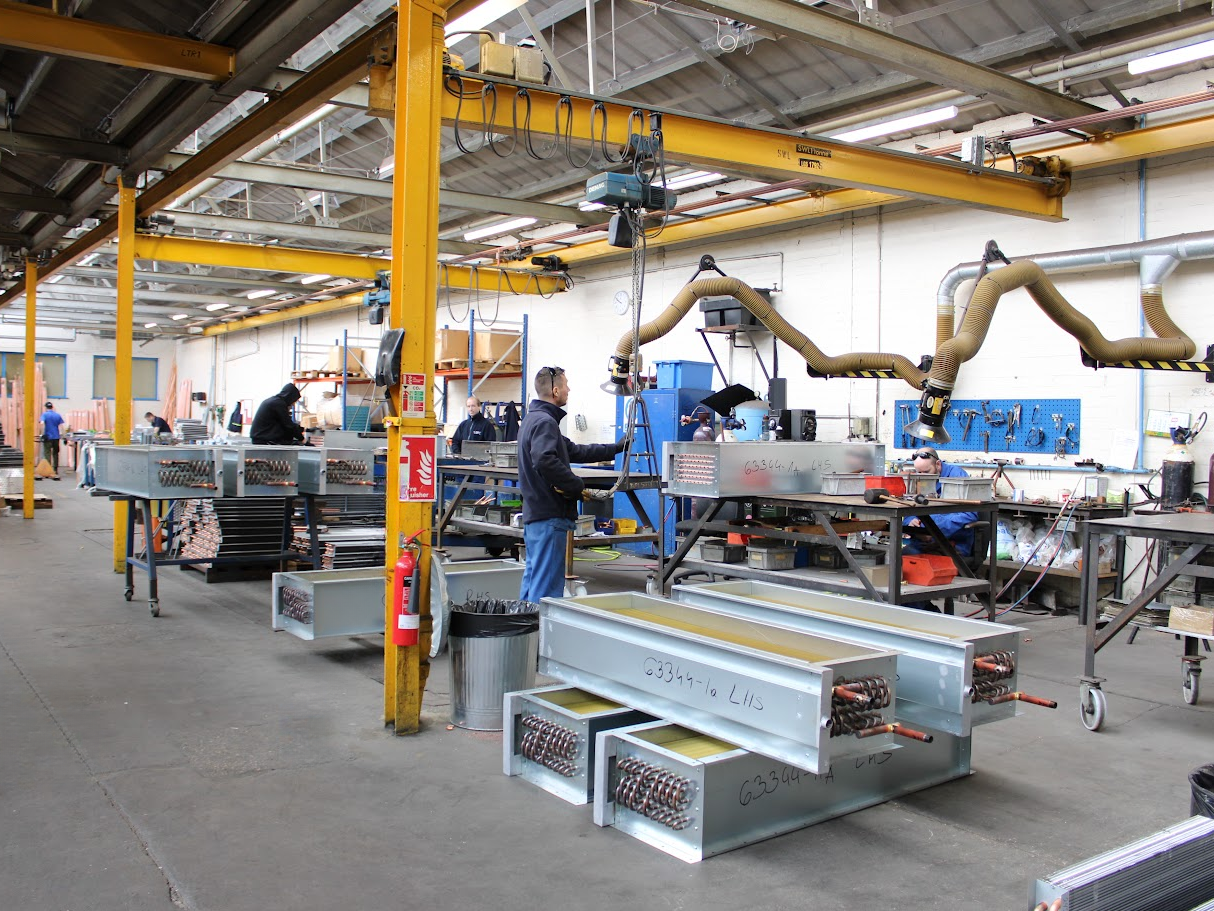
Coils being made in the coil section of SPC’s factory in Leicester.
SPC also makes water coils, steam coils, runaround coils and electric heater batteries. See the full range on our Heating and Cooling Coils page.
What refrigerant coils can SPC make?
SPC refrigerant coils have no standard sizes. The face size, number of rows, fin spacing and refrigerant circuits are worked out for each project from the airflow, the duty and the refrigerant, so the coil fits the duct or AHU and suits the condensing unit or heat pump. The table below shows the options SPC can build from, taken from the SPC Coil Heat Exchanger Brochure and the SPC Coils for Heating and Cooling IOM.
| Feature | SPC refrigerant coils |
|---|---|
| Coil types | DX (evaporator) coils for cooling, or cooling and dehumidifying; condenser (condensing) coils for heating; reverse cycle coils for air to air changeover heat pump systems |
| Refrigerants | All common refrigerants, pure and blended, except ammonia |
| Circuits | Split into any number of sections (circuits), so a single DX coil can be served by several condensing units or heat pumps |
| Distributors | Proprietary brass distributors, with capillary tubes, on the liquid inlets of DX and reverse cycle coils |
| Tubes | Seamless copper, 12 mm or 5/8″ outside diameter |
| Tube wall | 0.4 mm standard; 0.7 mm (12 mm tube) or 0.9 mm (5/8″ tube), typically used for some condenser applications |
| Fins | Plain aluminium as standard; precoated (vinyl coated) aluminium; postcoated, such as Blygold; or copper |
| Fin profile | Rippled; louvred fins available on 12 mm tube for special applications |
| Casing material | Galvanised sheet steel, 1.5 mm, as standard; stainless steel (304 or 316); brass, copper or aluminium to special order |
| Casing types | Economy and standard (flanged, for ductwork); enclosed (flanged, with sealed coverboxes); unitary (for inside AHUs); bespoke casings on request |
| Connections | Plain copper, for brazing to the refrigerant pipework |
| Condensate (DX coils) | Integral drainpan; stainless steel drainpan; removable drainpan (enclosed casings); perforated base (unitary casings); plastic moisture eliminator blades |
| Connection handing | Left hand or right hand side, looking in the direction of airflow |
| Testing and supply | Typically pressure tested up to 45 barg; vacuum dehydrated and supplied with a holding charge of nitrogen |
| Selection | Free online coil selector (registration needed), or selection by SPC’s technical team |
| Manufactured | Leicester, UK, by S & P Coil Products Limited (ISO 9001:2015) |
SPC refrigerant coil casings, materials and options
Choose the casing by where the refrigerant coil will sit, how condensate will be collected and how much air leakage the system can accept.
- Economy and standard casings have flanged trays all round to bolt to the adjoining ductwork. The return bends and headers sit outside the casing and the tubes can expand and contract within the tubeplates, so some air leakage is expected. On DX cooling coils, the drainpan extends below the fin block only, so moisture forming under the ends needs another way to be collected.
- Enclosed casings add sealed coverboxes over the return bends and headers to minimise air leakage. They are usually specified for hospitals and other critical areas, and are the normal choice for duct-mounted cooling coils because the drainpan can extend under the ends to catch all the condensate. Removable drainpans are available for cleaning.
- Unitary casings sit inside an air handling unit rather than bolting into ductwork. The casing is sized to fill the open area inside the AHU, with baffle plates over the return bends and headers to stop air bypassing the coil. DX cooling coils can have a perforated base to drain into the AHU’s own drainpan, or an integral drainpan where the AHU has none.
- Bespoke casings are available for special requirements: contact SPC with the details.
Standard SPC refrigerant coils have copper tubes, plain aluminium fins and a galvanised steel casing. Other materials protect against corrosion or suit particular duties.
- Precoated aluminium fins have a thin vinyl coating applied before the fins are formed: a cost effective choice for mildly corrosive air.
- Postcoated fins, such as Blygold, are sprayed on after the coil is made so they cover the whole fin block and all edges, giving more protection at a higher price.
- Copper fins add weight and cost. On DX cooling coils, copper fins on copper tubes avoid galvanic corrosion when the fins are wet with condensate.
- Louvred fins on 12 mm tube increase heat transfer, but add airside resistance, so they are only used where performance matters more than fan power.
- Stainless steel casings (304 or 316) give extra corrosion protection to cooling coils that condense moisture. A stainless steel drainpan can also be fitted to a galvanised casing.
- Thicker tube walls are available and typically used for some condenser applications.
Read more in Protecting HVAC Coils from Corrosion: Another Successful Site Survey in the South.
Tell SPC the refrigerant, the number of condensing units and the connection handing you need before the refrigerant coil is made.
- Connections: refrigerant coils are always supplied with plain copper connections for brazing to the adjoining pipework. SPC brazes its refrigerant coils in the presence of nitrogen, and the coil should be brazed into the system the same way.
- Circuits and distributors: DX and reverse cycle coils with several tube circuits have capillary tubes and brass distributors on the liquid inlets. When connecting thermostatic expansion valves to these coils, use external equaliser lines, because the distributor and capillary tubes add considerable resistance.
- Handing: on coils with more than one row, the refrigerant should flow generally against the airflow so the coil gives its quoted performance. Connections can be on the left or right hand side, looking in the direction of airflow.
- Drainpans and eliminators: DX cooling coils that may form moisture need a drainpan, and plastic eliminator blades can be fitted to the leaving face of coils that run at high air velocities, to stop condensate being blown downstream.
SPC refrigerant coils are supplied for installation by your mechanical or refrigeration contractor. The SPC Coils for Heating and Cooling IOM gives full instructions.
- Duct-mounted coils bolt to the adjoining duct flanges, with a gasket supplied by the installer. Where the coil is larger than the duct, transformation pieces are fitted on both faces, with straight ducting before and after the coil for even airflow.
- AHU coils are blanked and sealed against the inside of the unit so all the air passes through the finned area, and fixed so they cannot move.
- Each coil arrives capped with a holding charge of nitrogen. Cut the tubes with a tube cutter, expecting a release of nitrogen, and on DX coils with several circuits identify the matching inlet and outlet connections by passing gas through them in turn.
- Coil casings are supplied uninsulated for indoor mounting. On cooling coils, vapour seal any bends and headers outside the airstream. Never lift or carry a coil by its pipe connections.
- Trap every active drain connection and blank off any unused ones.
- Clean the finned surfaces with compressed air, a vacuum or a low pressure spray with mild detergent, not a pressure washer, and check them regularly, especially when the coil is new.
Where are SPC refrigerant coils used?
SPC refrigerant coils cool and heat air in commercial, public and industrial buildings and in process plant. Typical applications include:
Air handling units
DX cooling and condenser heating coils in unitary casings, sized to the inside of the AHU, for new units or to replace coils in existing ones.
Ductwork cooling and heating
Flanged coils that bolt into the duct run, with enclosed casings where condensate must be caught under the ends or air leakage kept low.
Air to air heat pumps
Reverse cycle coils that work as an air cooler or an air heater as an air to air changeover heat pump system switches mode.
Several condensing units
DX coils split into circuits, so a single coil can be served by several condensing units or heat pumps.
Corrosive environments
Coated or copper fins and stainless steel casings or drainpans for coastal or polluted air and for DX coils that run wet.
New DX and condenser coils for existing AHUs and ductwork, made to match the original dimensions as closely as possible to keep rework on site to a minimum.
Planning a coil replacement? Read How Does HVAC Coil Replacement Work in Commercial Buildings? and Protecting HVAC Coils from Corrosion: Another Successful Site Survey in the South.
Selection and design support for refrigerant coils
Free tools, BIM objects, training and surveys to help you specify the right coil.
Select coils online
Size refrigerant coils with SPC's free online coil selector and download each quote as a PDF.
Download BIM objects
DX and condenser coil BIM objects on bimstore, plus a type catalogue for each coil you select.
Coil heat exchanger CPD
SPC's CIBSE approved CPD: An Introduction to Coil Heat Exchangers.
Replacement coil surveys
Book a site survey or send the details on SPC's coil survey sheet.
Listed on the CIBSE CPD directory.
Discuss your refrigerant coil requirements
Need a DX, condenser or reverse cycle coil for a new air handling unit, a duct run or a replacement in a commercial, public or industrial building? Send us the airflow, duty, refrigerant and space available, and our technical team will select the right coil. Call 0116 249 0044 or email spc@spc-hvac.co.uk.
Frequently Asked Questions
DX stands for direct expansion. In a direct expansion system the refrigerant cools the air directly, evaporating inside the coil tubes, rather than cooling water in a chiller that is then pumped to a coil. DX coil, DX cooling coil, direct expansion coil and evaporator coil are all names for this type of SPC refrigerant coil.
A DX (evaporator) coil cools air: liquid refrigerant evaporates at a constant temperature inside the tubes and takes heat from the air, dehumidifying it too if the air is cooled below its dewpoint. A condenser (condensing) coil heats air: high temperature refrigerant condenses to a liquid inside the tubes and gives up its heat. SPC can also make reverse cycle coils that work either way as part of an air to air changeover heat pump system.
Both cool and dehumidify air. A DX coil is part of the refrigerant circuit: the refrigerant evaporates inside its tubes, and the coil is brazed into copper pipework connected to a condensing unit or heat pump. A chilled water coil carries water, or water and glycol, cooled by a chiller elsewhere. Which one suits depends on the system design, and SPC makes both: see our water coils page for chilled water, hot water and changeover coils.
SPC refrigerant coils have copper tubes, which can be used with all common refrigerants, pure and blended, except ammonia. Tell SPC the refrigerant and operating conditions when you ask for a selection, and the coil and its circuits will be designed to suit.
Yes. SPC can design and supply reverse cycle coils for air to air changeover heat pump systems, working as evaporators (air coolers) or condensers (air heaters) as the system switches between cooling and heating. SPC DX coils can also be split into any number of sections (circuits), so a single coil can be served by several condensing units or heat pumps.
SPC refrigerant coils are typically pressure tested up to 45 barg before they leave the factory in Leicester. They are then vacuum dehydrated and supplied capped with a holding charge of nitrogen, not refrigerant. Coils are designed and made under SPC’s ISO 9001 quality system, to sound engineering practice as the Pressure Equipment Directive (Article 3) requires for this type of equipment. Equipment in this category is not CE or UKCA marked, so you will not see either mark on an SPC coil.
Usually, yes. If a DX coil cools the air below its dewpoint, moisture condenses on the fins and runs down into a drainpan. On duct-mounted coils, enclosed casings let the drainpan extend under the return bends and headers to catch all the condensate. Inside an AHU, the coil can have a perforated base to drain into the AHU’s own drainpan, or an integral drainpan where the AHU has none. Every active drain connection must be trapped, and unused ones blanked off.
Yes. SPC makes replacement coils for existing AHUs and ductwork, including DX and condenser coils from other manufacturers, matching the original dimensions as closely as possible to keep rework on site to a minimum. Send the details on the SPC Coil Survey Sheet in the Downloads section below, or contact us to arrange a site survey for a coil that cannot be removed. Read more in How Does HVAC Coil Replacement Work in Commercial Buildings?
Yes. SPC’s Standard DX Coil, Enclosed DX Coil, Standard Condenser Coil and Enclosed Condenser Coil Heat Exchanger Range BIM objects are on bimstore. When you select a refrigerant coil with SPC’s free online coil selector, it also gives you a type catalogue for that coil to load with the Revit family, so the BIM object carries your project’s selection data.