

Heating a cold warehouse effectively means delivering heat to the occupied zone, rather than letting warm air collect beneath the roof. High roofs, large floor areas and frequently opened loading doors all make that difficult, and HSE guidance says workrooms should normally be at least 16°C, or 13°C where much of the work involves rigorous physical effort.
This article looks at the main considerations for warehouses, distribution centres and workshops: heat delivery, mounting position, controls, low-temperature systems and heat loss through loading doors. CiRRUS unit heaters from SPC are available for wall or ceiling mounting and can be considered as part of a suitably designed industrial heating system.

Why does heating a cold warehouse matter for the people working in it?
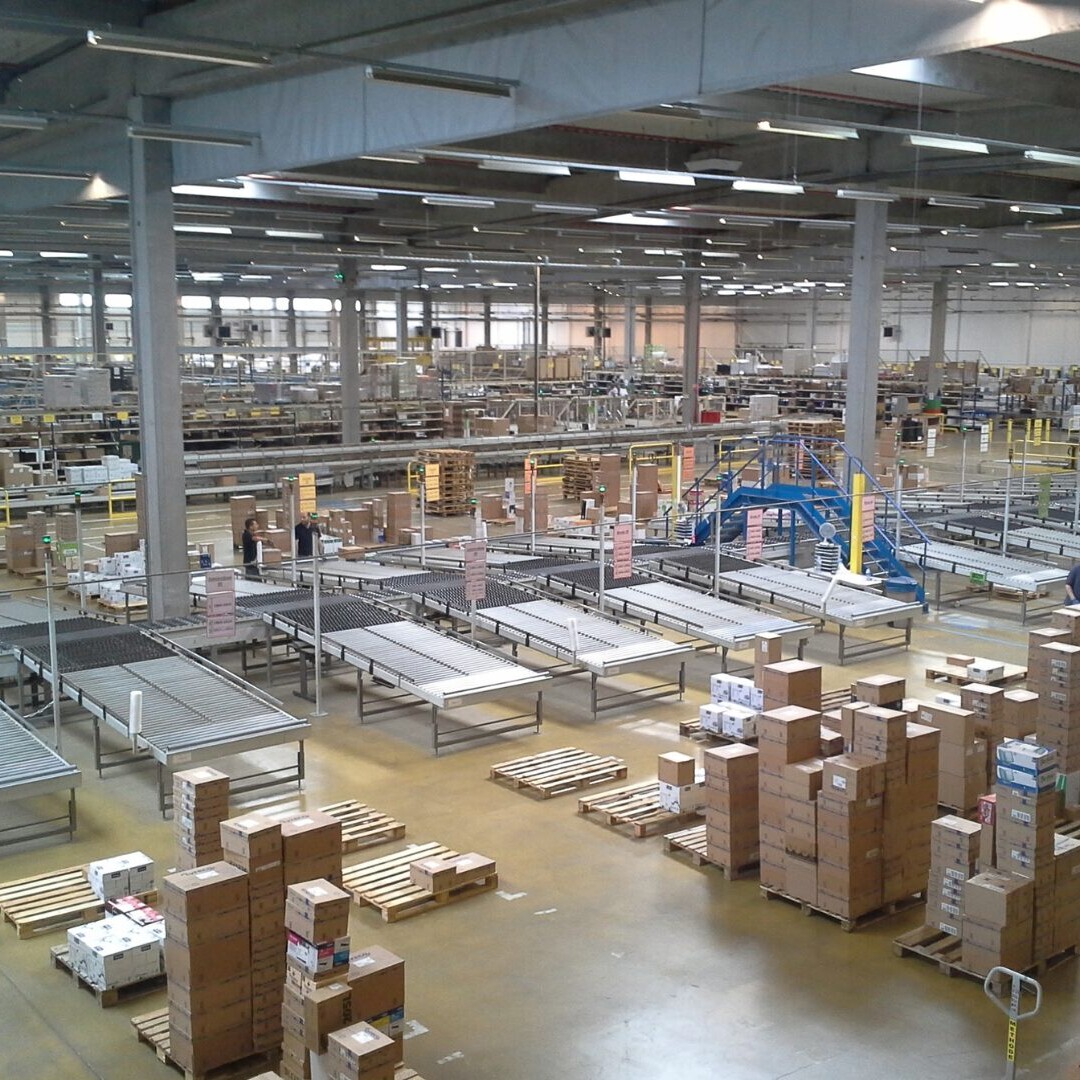
Warm air rises, so in a building with a high roof the heat tends to collect overhead while pickers, drivers and packers work in the coldest layer. Each time a loading door opens, cold air enters and the problem gets worse.
Regulation 7 of the Workplace (Health, Safety and Welfare) Regulations 1992 requires employers to provide a reasonable temperature in indoor workplaces during working hours. The HSE Approved Code of Practice says workrooms should normally be at least 16°C, or 13°C where much of the work involves rigorous physical effort. These figures are guidance rather than absolute legal minimums, and the appropriate temperature depends on the work and the environment. If staff are keeping coats and gloves on all shift, it is worth reviewing the heating.

How can unit heaters help deliver heat to floor level?
CiRRUS unit heaters use an axial fan with an EC motor to draw in room air, pass it across a heat exchanger coil and discharge it through adjustable, angled louvre blades. Horizontal units are wall mounted, with the louvres angled to blow air towards the floor. Vertical units normally hang from the ceiling on drop rods and blow downwards, with an optional 4-way louvre available. The electric Ci5 is available for horizontal mounting only. For a wider overview of the category, see why industrial unit heaters excel in warehouses and factories.
The EC fan is continuously controllable via a 0-10V signal, so air movement can be matched to the mounting height. Recommended mounting heights range from 2.0m to 6.0m depending on model and fan speed. At high speed, the largest model, the Ci8, has a throw of up to 27m for horizontal wall-mounted units and a coverage area of 25m x 25m for vertical units. These figures are for guidance, and actual performance depends on mounting height, room layout, heat load and leaving air temperature.
Unit heaters are intended to be mounted outside the occupied area, and selecting excess airflow increases draught and noise. Each unit should therefore be sized for the building rather than selected on output alone.
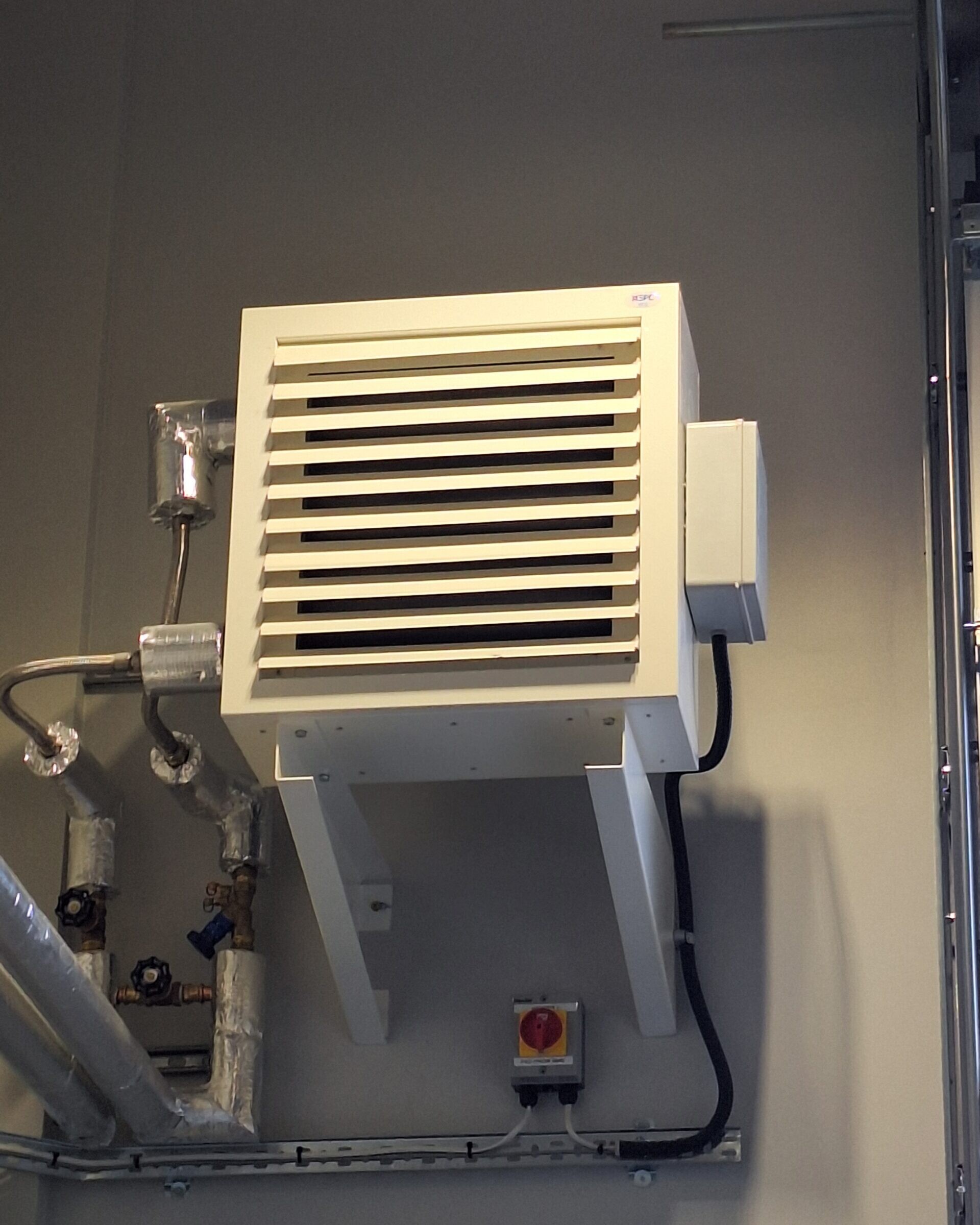
Which CiRRUS unit heater suits your warehouse?
The CiRRUS range has four sizes, from the 500mm wide Ci5 to the 800mm wide Ci8. Selection depends on the heat source available and the heat load.
| Version | Models | Key information |
| Water heated | Ci5, Ci6, Ci7 and Ci8 | 230V single-phase supply. The standard 2-row coil suits conventional boiler temperatures, with 3 and 4 row coils available for lower water temperatures. At 80/70°C and high speed, the 2-row coil delivers from 9.2kW (Ci5) to 37.0kW (Ci8) |
| Electric | Ci5 only | Fixed 9kW output on a 400V three-phase supply, for horizontal mounting only. Self-regulating ceramic PTC elements, with surface and air overheat switches |
The Ci8 with a 3-row coil at 82/71°C delivers up to 50.9kW at an airflow of 1.61 m³/s. Indicative sound pressure levels, measured at around 3m, run from 41 to 66 dBA depending on model and fan speed.
Can unit heaters work with a heat pump?
CiRRUS unit heaters with enhanced-depth coils can be considered for heat pump-led systems where the selected coil and operating conditions deliver the required heat output. The standard 2-row coil suits conventional boiler temperatures close to 80°C, while 3 and 4 row coils are available to maintain output at lower water temperatures. Our performance data covers 4-row coils at flow and return temperatures down to 45/35°C for the Ci6 to Ci8. The design should still be checked against the heat pump’s flow and return temperatures, water flow rate and the building’s heat loss.
At Blackley Community Fire Station in Manchester, two CiRRUS Ci6 horizontal unit heaters with 3-row coils heat the appliance bays on a system specified around 45/35°C low water temperatures. The units have BMS enable/disable control and local three-speed switches, and the scheme supports Greater Manchester’s target of becoming carbon neutral by 2038.
SPC’s CIBSE-approved CPD, Decarbonisation of Industrial and Commercial Heating Systems, covers how heat pumps can reduce carbon emissions in low-temperature heating systems, and can be booked for your team.
How do you control heating across a large warehouse?
Heating a cold warehouse well depends on control as well as output. Reducing fan airflow reduces heat output but also shortens throw and coverage, so output is best controlled on the waterside rather than the airside. Appropriate controls can also help reduce unnecessary heating.
The SPC Delta Waterside Controller works with a two-port valve and modulating actuator to vary hot water flow in response to sensed temperature, so airflow and throw are not compromised as output follows demand. A single controller can serve multiple units in one zone, and it also provides volt-free terminals and BACnet compatibility. CiRRUS unit heaters can also be controlled manually, automatically or via a BMS, while the electric Ci5 operates on and off rather than modulating.

What about heat escaping through loading doors?
Heating the space is only part of the job. Loading bay and roller shutter doors can be a significant source of heat loss when open. SPC’s iForce Industrial Air Curtains are designed to protect doorways up to 6 metres high and can be fitted horizontally above the door or vertically at the sides. They help limit heat loss while the doors are open, and are available in ambient, electric and LPHW versions.
S & P Coil Products Limited has manufactured heating and cooling products in Leicester for over 50 years and holds ISO 9001:2015 certification. For specification support on heating a cold warehouse, workshop or distribution centre, contact the team on 0116 249 0044 or at spc@spc-hvac.co.uk, or view the CiRRUS unit heater range.
Frequently Asked Questions
The number depends on the building’s heat loss, roof height, door usage and layout, so there is no single rule of thumb. The SPC team can size a CiRRUS scheme from your building details, and the online product configurator, which includes CiRRUS Unit Heaters, supports selection.
Water-heated CiRRUS models need a hot water supply from a boiler or heat pump. Where a building has no wet heating system, the Ci5 is also available with a direct electric element, rated at 9kW on a 400V three-phase supply and suitable for horizontal mounting only.
Portable heaters can provide short-term relief, but they are not designed to heat a whole building or to be controlled as part of a wider system. A fixed installation of CiRRUS unit heaters, wall or ceiling mounted and linked to a controller or BMS, is better suited to ongoing heating.
CiRRUS unit heaters are supplied in white or black as standard, and any other RAL colour is available on request.
Talk to SPC About Your Warehouse Heating Project
Is your warehouse still too cold? Send us your project details and the SPC team will help you find the right CiRRUS unit heater solution for your building.