

Air curtains improve comfort and reduce energy loss at commercial entrances by projecting a controlled stream of high-velocity air across the full width of a doorway, creating an invisible barrier between inside and outside. For building services engineers and facilities managers specifying commercial entrances in schools, healthcare facilities, retail centres, and visitor attractions, an air curtain is often the most practical solution for maintaining internal conditions without restricting access or requiring a physical lobby.
This article explains how air curtains achieve this, what the comfort and energy benefits are in practice, and how the AIRDOR Forcefield range has been specified on commercial and public sector projects across the UK.
Why Commercial Entrances Lose So Much Energy
Commercial buildings with high-footfall entrances face a consistent problem: every time a door opens, a volume of conditioned air escapes and external air enters. In buildings with automatic sliding or swing doors (shopping centres, hospital receptions, school main entrances, visitor attractions), the door may be open for a significant proportion of the working day. This continuous exchange of air places a direct load on the heating or cooling system, increases energy consumption, and creates uncomfortable draughts in the entrance zone that affect staff and visitors near the door.
Draught lobbies and vestibules solve this architecturally, but they are not always possible in refurbishment projects, heritage buildings, or spaces where the footprint cannot accommodate a secondary entrance structure. Air curtains solve the problem without structural modification.
How Air Curtains Create An Effective Barrier
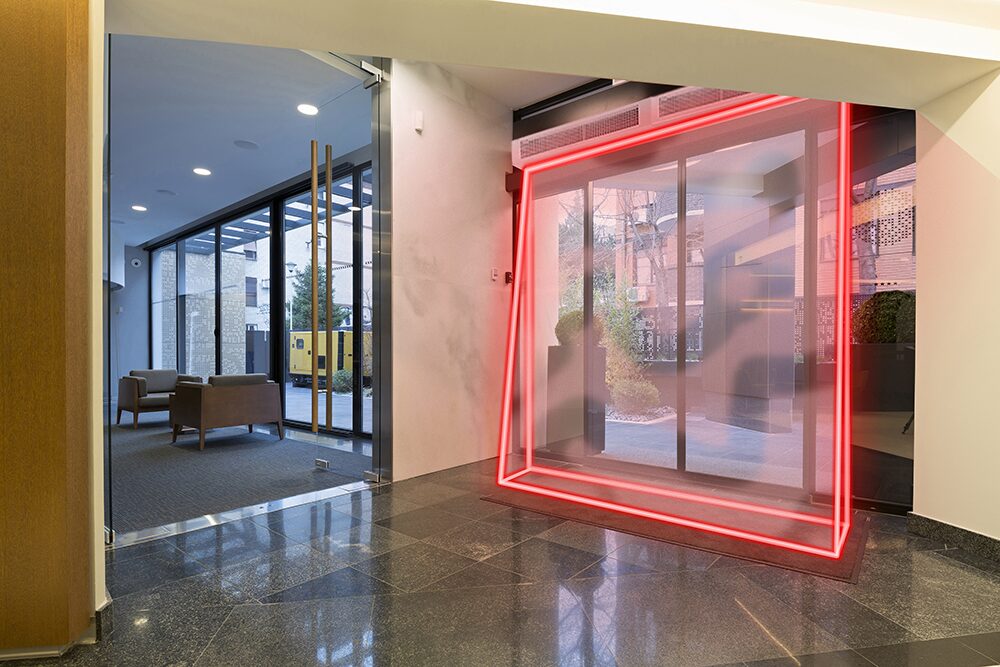
An air curtain works by directing a high-velocity jet of air downward across the full width of the opening, from the unit mounted above the doorway to floor level. This air jet disrupts the natural exchange of air that would otherwise occur when the door is open, significantly reducing the volume of conditioned air that escapes and the volume of external air that enters.
The AIRDOR Forcefield range uses EC (electronically commutated) motors as standard across all units. EC motors offer continuous, variable-speed controllability via a 0-10V DC signal, and run at significantly lower wattage than equivalent AC motors at the same airflow. Units can be connected to door contactors with delay relays so the air curtain operates only when the doorway is open, avoiding unnecessary energy use during closed periods.
For spaces where the internal heating system operates at low flow temperatures, including buildings served by heat pumps or condensing boilers, LPHW Forcefield units are available with enhanced heat exchangers that maintain effective thermal performance at low water temperatures. This makes Forcefield a practical specification for heat pump-compatible building services designs.
Comfort Benefits Beyond Thermal Management
In addition to reducing heat loss, air curtains improve occupant comfort in several ways that are particularly relevant in commercial and public sector buildings.
The air barrier prevents cold draughts from reaching staff and visitors in the entrance zone. In retail environments, this affects the experience of shoppers immediately inside the entrance. In schools and healthcare facilities, it protects occupants near reception areas who might otherwise be exposed to repeated blasts of cold external air during busy periods.
Air curtains also prevent the ingress of insects, airborne dust, and odours through open doors. This is a specification consideration in food service environments, healthcare buildings where infection control is a priority, and visitor attractions where maintaining air quality affects both comfort and the preservation of exhibits or collections.
Projects Where Forcefield Has Been Specified
The AIRDOR Forcefield has been used across a range of commercial, education, heritage, and healthcare applications.
The Ashley Centre, Epsom
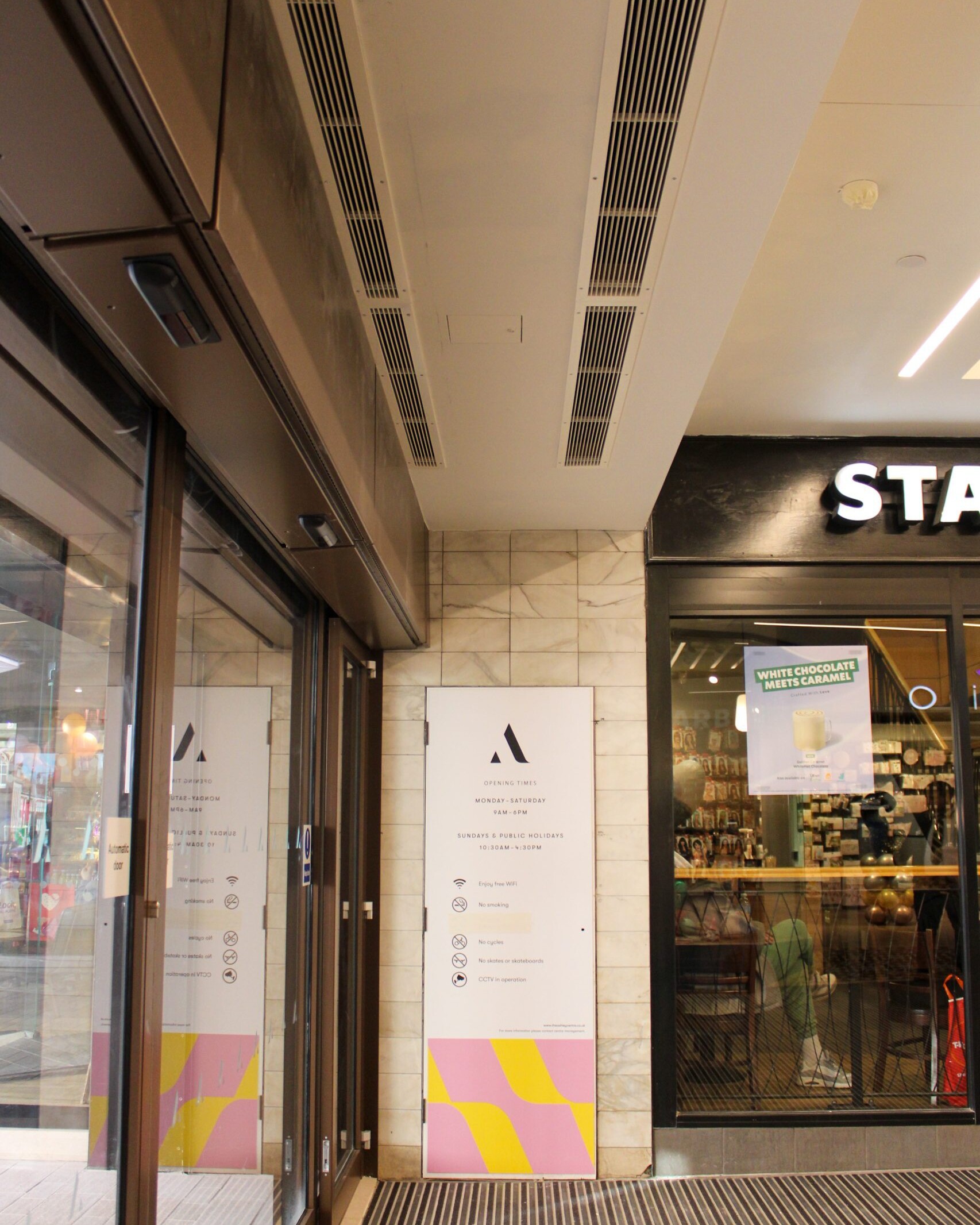
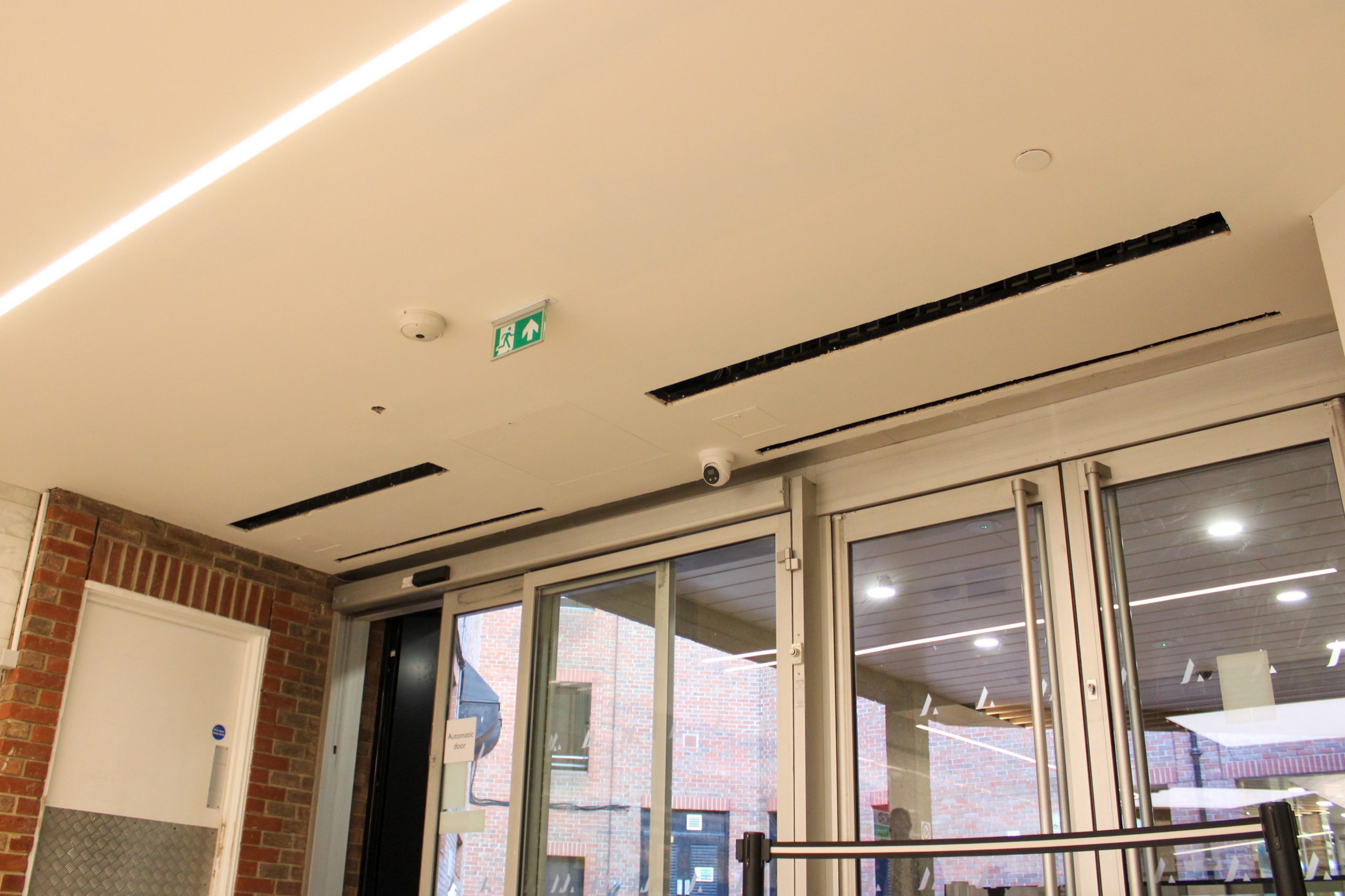
At the Ashley Centre in Epsom, concealed Forcefield electric units with plasterboard room inlets were installed across multiple entrance points at the shopping centre. The mix of 1m, 1.5m, and 2m units was selected to match each entrance width, with the concealed installation ensuring the units integrated cleanly with the centre’s interior.
Claverham Community College, Battle
At Claverham Community College in Battle, East Sussex, four 2m LPHW Forcefield units were installed at the college’s main entrances. The units were specified with air on 15°C and water at 80/60°C, a standard selection basis for an educational building with a conventional hot water system. Installation was carried out by Derry Building Services, with Bowmer + Kirkland as main contractor.
Greater Manchester Fire Station Museum, Manchester
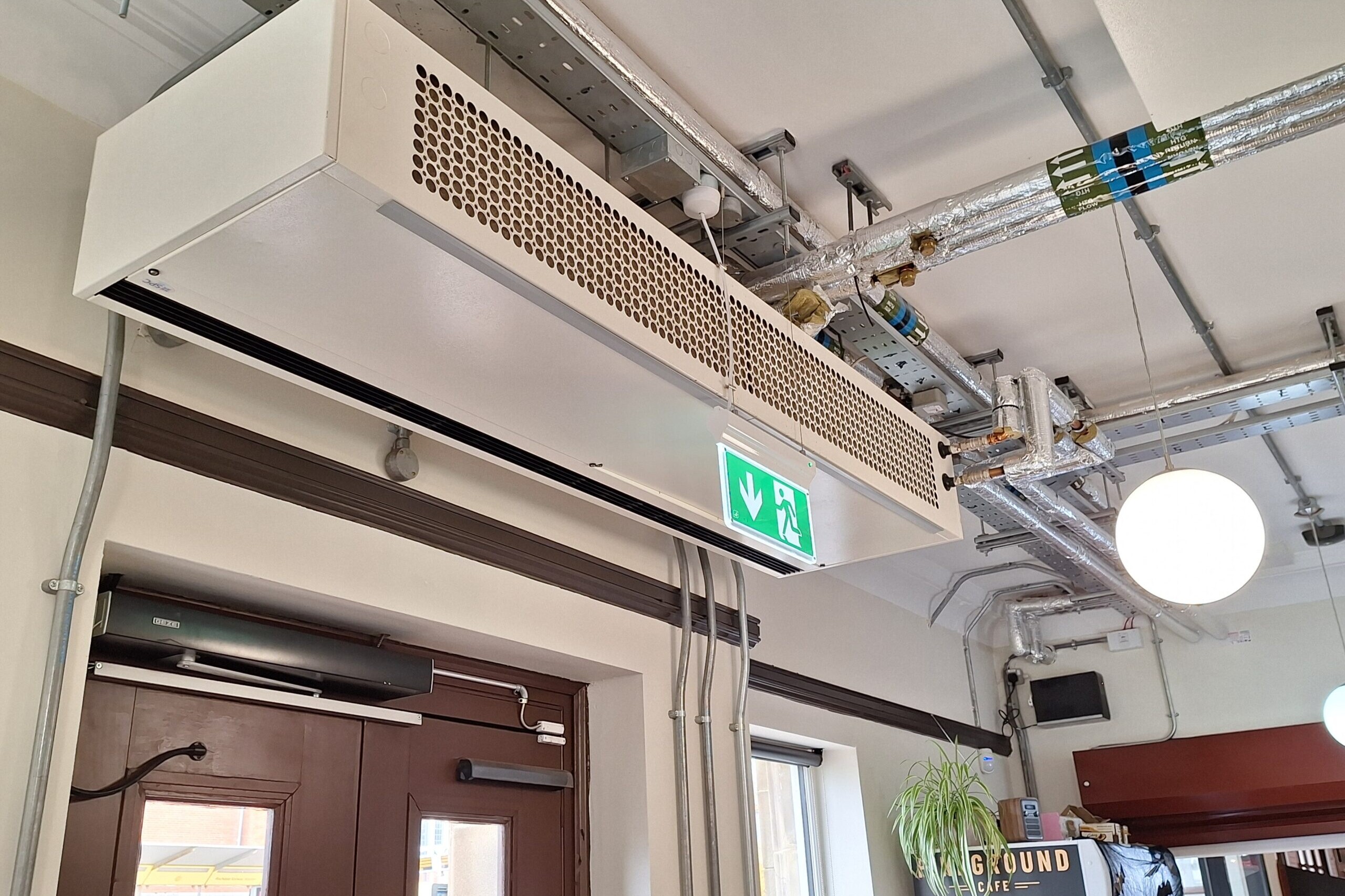
At the Greater Manchester Fire Station Museum (Fireground) in Manchester, three ceiling-mounted Forcefield units were supplied across the primary museum entrance, secondary museum entrance, and café entrance. The project used a mix of electric and LPHW models to suit the available heat source at each location, with BMS integration and EC motor control across all three units.
St Anne's Hospice, North West
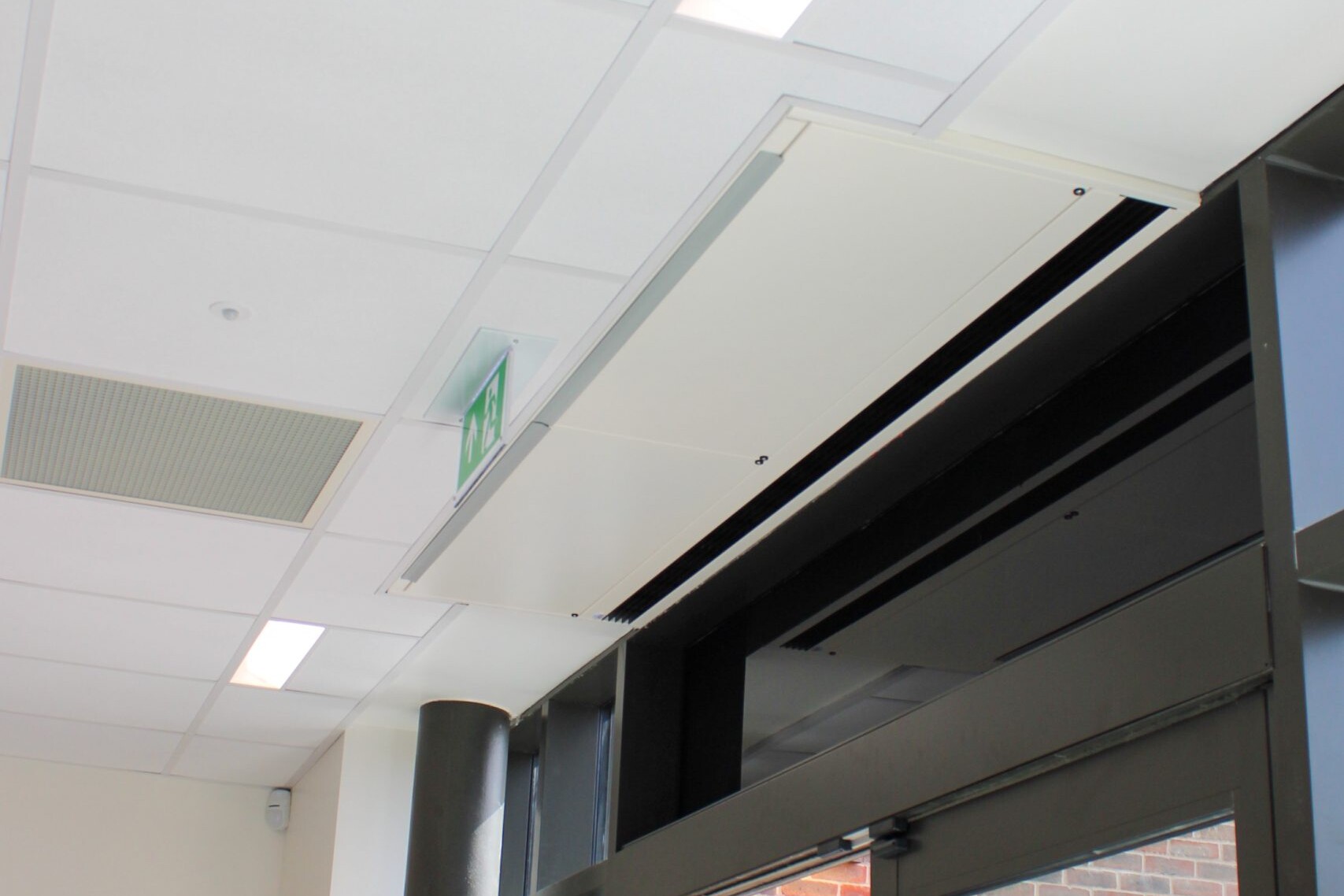
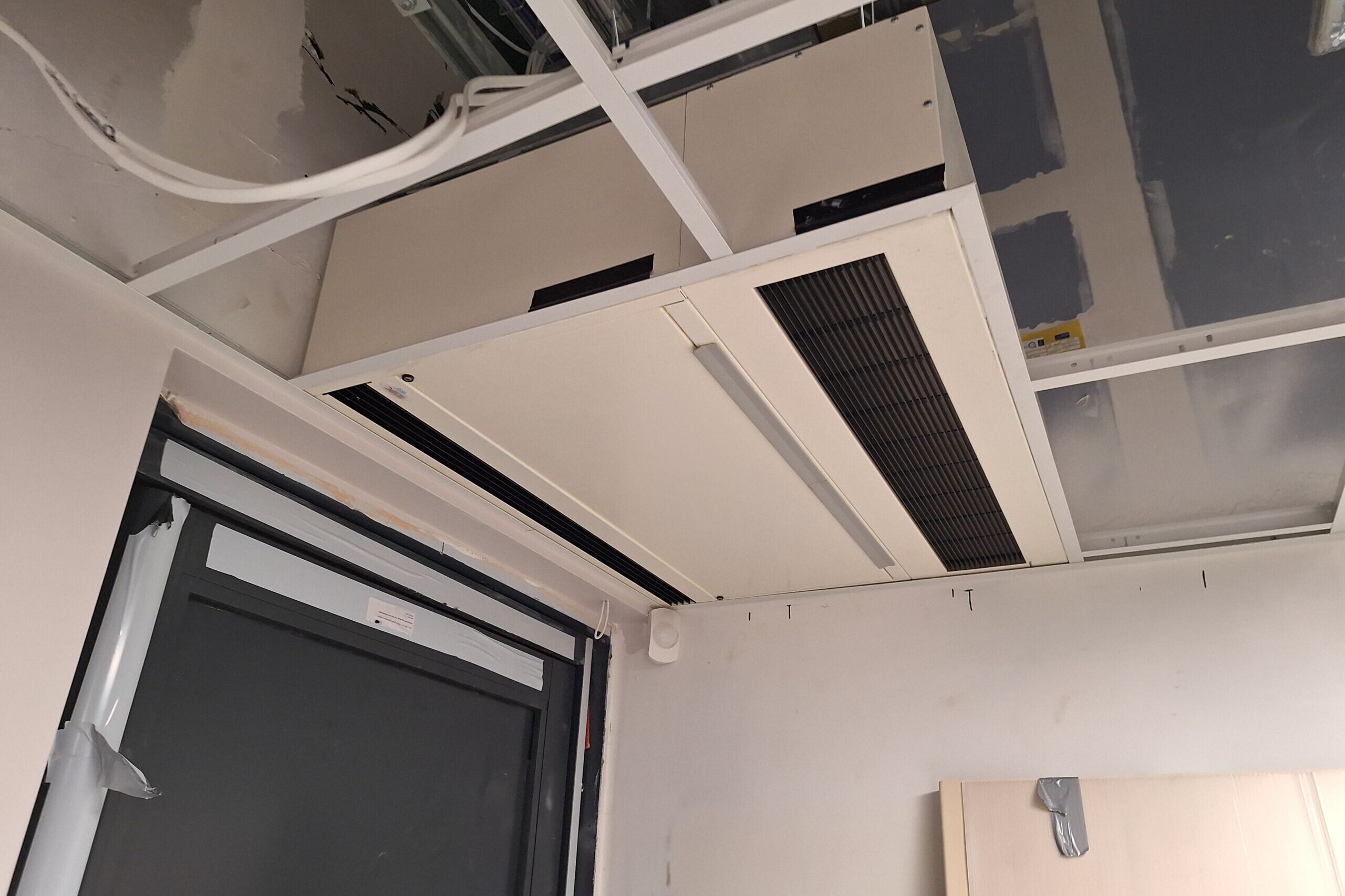
At St Anne’s Hospice in the North West, a recessed T-bar ambient Forcefield unit was installed to improve thermal separation at the entrance without requiring a heated unit. The ECM motor and clean RAL 9010 finish were specified to match the clinical aesthetic of the healthcare environment.
When To Specify The iForce For Larger Openings
The AIRDOR Forcefield is designed for commercial building entrances up to 3.5 metres high. For industrial and large commercial openings up to 6 metres, the iForce Industrial Air Curtain provides the same thermal separation at a larger scale, with LPHW outputs up to 69.6kW on the 2.5m unit and electric options available where hot water is not accessible. The iForce is used in warehouses, distribution centres, food processing facilities, and large public buildings where the door height exceeds the Forcefield’s range.
For more information on choosing between horizontal and vertical mounting configurations for your project, see our guide to vertical vs horizontal air curtains.

Frequently Asked Questions
Yes. AIRDOR Forcefield units can be connected to door contactors with delay relays, so the unit activates when the door opens and continues running briefly after the door closes. This ensures the air curtain is only operating when the opening is active, avoiding unnecessary energy use during closed periods. The delay relay prevents rapid cycling on busy entrances where the door opens and closes frequently.
The unit length should match the width of the door opening as closely as possible, undersizing leaves part of the opening unprotected. The Forcefield range is available in lengths from 600mm to 2,000mm; for wider openings, multiple units can be placed side by side. The selection also depends on mounting height (the Forcefield covers 1.8m to 3.5m) and whether a heated or ambient unit is required. SPC’s technical team can provide selection support based on your door dimensions, mounting height, and heat source.
Yes. LPHW Forcefield units are available with enhanced heat exchangers suited to low flow temperature operation, including systems served by heat pumps or condensing boilers. For standard LPHW selection, the Forcefield is typically sized at 80/60°C or 80/70°C water temperatures. For heat pump systems operating at lower flow temperatures, contact SPC’s technical team for selection advice to ensure the unit achieves the required thermal output.
Yes. Concealed and recessed Forcefield configurations allow units to be installed with minimal visual impact, flush with a plasterboard ceiling or integrated into a T-bar grid. At the Greater Manchester Fire Station Museum, three ceiling-mounted units were installed across the public entrance points of a 1933 listed building without structural modification. Custom RAL finishes are also available where a specific colour match is required.
An ambient air curtain has no heat exchanger; it projects room-temperature air across the opening. It provides an effective barrier against draughts, insects, and external air infiltration, but adds no heat to the airstream. A heated air curtain (electric or LPHW) warms the air before it is discharged, which offsets heat loss at the door and maintains comfort in the entrance zone during cold weather. The ambient version is suitable for year-round use in conditioned buildings where entrance temperatures are already maintained by the building’s primary heating system. Where the entrance zone is subject to significant cold weather exposure, a heated unit is generally the better specification.
Specifying the AIRDOR Forcefield Air Curtain
The Forcefield range is available in ambient (no heat), electric, and LPHW variants, in lengths from 600mm to 2,000mm. Mounting height range is 1.8m to 3.5m. All units use EC motors with 0-10V DC control and are available in textured RAL 9010 white as standard, with custom finishes available to order.
Standard accessories include washable air filters, low-temperature cut-out thermostats, BMS interface modules, remote switches, and connection boxes. Enhanced heat exchangers for low-flow and heat pump systems are available on LPHW units.
View the full AIRDOR Forcefield range